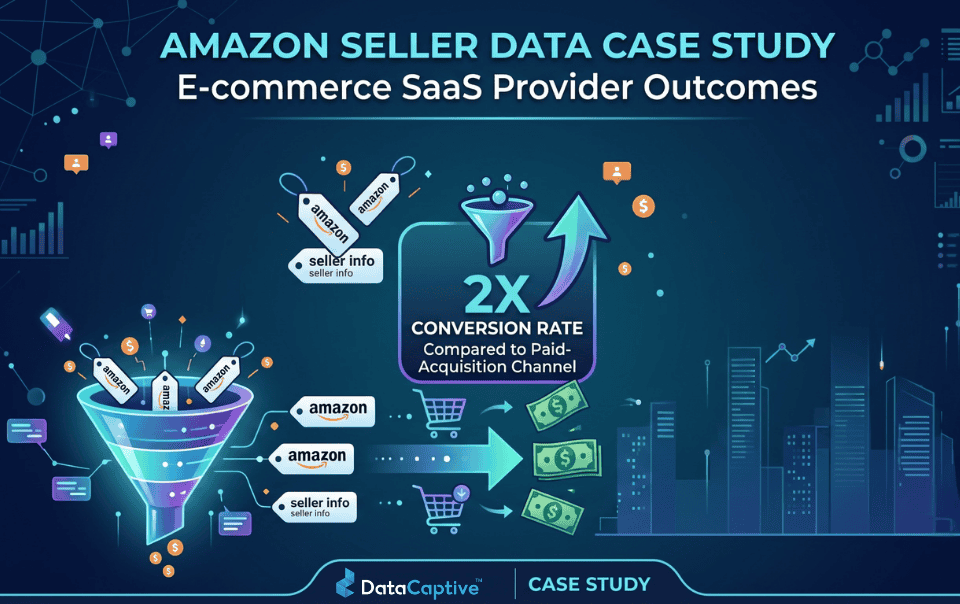
An e-commerce software provider wanted to expand beyond paid advertising and organic community growth. To build a more scalable outbound channel, the company partnered with DataCaptive to reach active Amazon sellers and e-commerce operators through targeted B2B data segmented around key audience and business attributes.
The client is an e-commerce software provider serving Amazon sellers and marketplace sellers with tools that support key areas of seller operations. Its solutions cover product research, keyword research, listing optimization, advertising management, inventory management, and financial analytics.
The company needed a more focused way to reach active Amazon sellers and e-commerce operators who could be relevant to its software solutions. Its goal was to strengthen its outbound efforts with targeted prospect data rather than relying only on broader acquisition channels.
The client also needed a prospecting solution that could support an immediate outbound campaign while offering the potential to become a repeatable source for future acquisition efforts.


The client’s product suite supports sellers across several important areas of e-commerce operations, including:
With this audience at the center of its business, the client needed a practical way to identify and engage prospects that fit its seller-focused e-commerce market.
The client had reached a plateau with paid advertising and organic community growth as its primary acquisition channels. While these channels continued to support customer acquisition, the company needed another scalable way to reach its intended audience.
Its outbound and partnerships teams needed a more direct path to active Amazon sellers and e-commerce operators. Instead of depending entirely on existing acquisition channels, the client wanted a targeted prospecting audience that could be used for direct outreach.
Several requirements shaped the challenge:
The immediate objective was to create a focused prospecting audience for an outbound push ahead of quarter-end. At the same time, the client needed the approach to have enough value to support future acquisition efforts if the initial campaign performed well.
DataCaptive provided targeted e-commerce seller data focused on active Amazon sellers and e-commerce operators, delivered as a B2B dataset built around the client’s existing audience requirements rather than a broad, general-purpose contact database.
The prospect audience was segmented using relevant business characteristics, including revenue band and marketplace activity. This gave the client’s outbound team a more focused audience for its campaign and helped align the prospect data with the types of businesses the client wanted to reach.
The delivered Amazon seller contact data centered on:
This targeting approach allowed the client to work with a more defined pool of Amazon seller leads instead of approaching the wider e-commerce market without segmentation.
Revenue band and marketplace information provided additional context around each prospect. These fields helped the outbound team organize a segmented outreach audience based on business characteristics and marketplace presence, making the dataset more practical for targeted campaign planning.
The segmentation also supported the client’s need to scale its outreach. The first dataset was used for the initial quarter-end outbound initiative, and the positive performance created the basis for expanding the volume through a repeat order.
The dataset included contact and company-level information needed by the client’s outbound team. By bringing contact information together with business attributes, the data could support prospect identification, audience organization, and direct outreach activities.
The solution therefore addressed both the immediate campaign requirement and the client’s broader need for a repeatable prospecting source.
This Amazon seller contact list included the following fields:
Together, these fields gave the client structured Amazon seller data and the business context required to structure its outbound prospecting efforts — the kind of detail a reliable B2B data provider should deliver.
The initial outbound campaign delivered a measurable improvement compared with the client’s paid-acquisition channel when targeting the same audience.
The outbound channel built using the DataCaptive dataset converted at approximately 2x the rate of the client’s paid-acquisition channel for the same audience. This gave the client evidence that targeted prospect data could support a stronger acquisition approach for this segment.
The performance also changed how the client viewed the dataset. Rather than treating the purchase as a one-time source for a single campaign, the client expanded the volume after the first batch performed well.
The most significant outcome was the transition from a single outbound campaign to a repeatable acquisition process — the kind of maturity a well-structured outbound acquisition strategy aims for over time. The client identified enough value in the data source to incorporate it into its ongoing quarterly planning.
This case demonstrates how targeted Amazon seller prospecting data can support businesses that need to reach a specific customer segment through outbound channels.
For a business serving Amazon and marketplace sellers, reaching the broader e-commerce market may not provide the same value as reaching prospects that closely match its customer profile. A focused audience helped the client direct its outbound efforts toward relevant sellers and operators.
Revenue band and marketplace information provided useful context around the prospects. These attributes helped the client organize its audience and support more focused outbound activity.
The dataset was initially used for a specific quarter-end campaign. After the first batch performed well, the client expanded the volume and incorporated the source into its quarterly acquisition planning.
The case study shows how an outbound initiative can move beyond a one-time campaign when the underlying audience and data source continue to provide value. In this case, the client adopted the data source as part of its ongoing quarterly acquisition strategy. DataCaptive has supported similar transitions for other e-commerce sellers, including in this Shopify seller case study.
The value of the dataset came from its alignment with the client’s target market. By focusing on active Amazon sellers and e-commerce operators and providing relevant business and contact attributes, the solution supported the client’s specific prospecting requirements.
Looking to reach a specific B2B audience with targeted contact data? DataCaptive can help you build a data solution around your prospecting requirements, audience characteristics, and outreach goals.
Whether you need a focused audience for an upcoming campaign or a repeatable data source for ongoing acquisition, discuss your requirements with the DataCaptive team and request pricing for a customized solution.