
B2B data is not a static CSV file that can be purchased once, uploaded into a CRM, and trusted indefinitely. People change jobs, companies restructure, domains change, phone numbers are reassigned, and business information becomes outdated. As a result, the quality of a revenue database can deteriorate continuously even when the underlying systems remain operational.
For Revenue Operations teams, this creates a larger problem than inaccurate contact information. Poor-quality data can affect segmentation, lead routing, sales territories, campaign deliverability, account prioritization, forecasting, reporting, and increasingly, AI-driven workflows.
The solution is to treat B2B data as GTM infrastructure rather than a prospecting list.
A reliable data environment requires governance across the entire lifecycle of a record: sourcing, ingestion, normalization, enrichment, verification, compliance, deduplication, monitoring, and refresh. It also requires RevOps teams to evaluate data across multiple dimensions instead of relying on accuracy alone.
This guide explains how to build that framework and how to make B2B data reliable enough to support modern revenue operations.
Revenue teams invest heavily in CRM systems, sales engagement platforms, marketing automation, enrichment tools, intent platforms, and analytics infrastructure.
Yet all of these systems depend on one underlying asset: data quality.
If the underlying records are inaccurate or outdated, even sophisticated technology can produce poor results.
A sales representative may spend time calling disconnected numbers. A marketing team may send campaigns to people who have already left their companies. A RevOps manager may find duplicate accounts during territory planning. A marketing automation workflow may route leads using outdated company information.
These problems are often treated as individual operational issues.
They are actually symptoms of a larger data-governance problem.
Research frequently cited in the B2B data-quality industry estimates that sales representatives can lose more than 22 working days per year dealing with inaccurate or unusable data. Poor data quality has also been associated with multimillion-dollar losses for large enterprises.
The exact financial impact varies by organization, but the operational pattern is consistent: bad data creates hidden costs across the revenue organization.
The problem becomes more significant as GTM teams automate more of their workflows.
A human sales representative can recognize that a company record looks suspicious and investigate it. An automated workflow may simply execute the instruction it has been given.
That means the quality of the underlying data increasingly determines the quality of the resulting action.
The traditional view of B2B data is straightforward:
Buy contacts → upload contacts → contact prospects.
A modern RevOps architecture looks different:
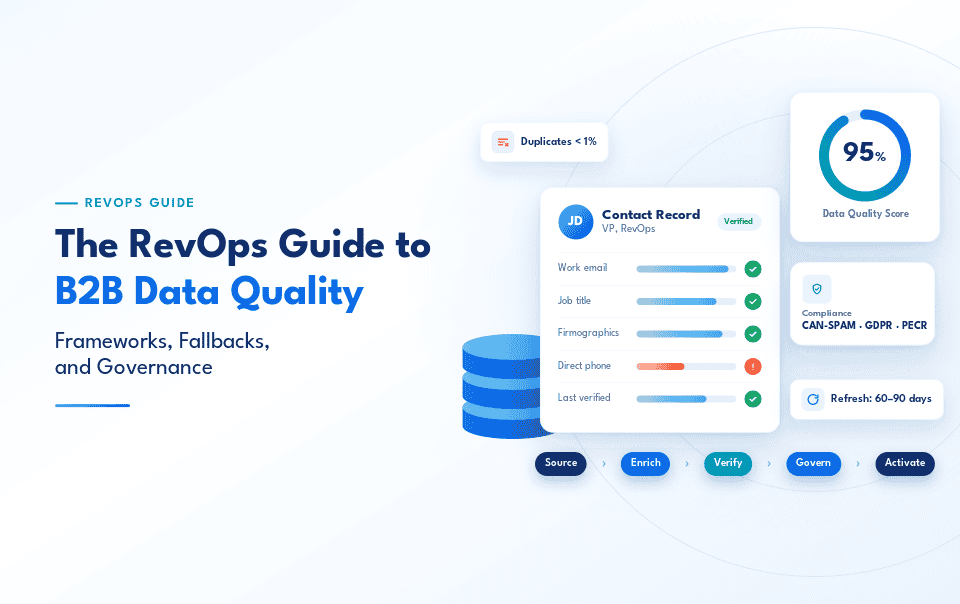
Source → Normalize → Enrich → Verify → Govern → Activate → Monitor → Refresh
This shift is important because data quality is not achieved at the moment a record enters the CRM.
It is maintained throughout the record’s lifecycle.
B2B data changes because businesses and people change.
Employees move between organizations. Job titles change. Companies acquire other businesses. Departments are reorganized. Organizations change domains, locations, technologies, and operating structures.
A work email that was valid six months ago may no longer belong to the same person. A company that previously matched an ICP may have grown beyond the intended employee range. A technology field may become outdated after a platform migration.
Industry research commonly estimates significant annual decay in B2B contact databases, with email addresses and other contact fields changing continuously. Some estimates place email decay around 3.6% per month, while broader contact databases can experience substantially higher annual deterioration depending on the market and data type.
The precise decay rate is less important than the underlying principle:
B2B data has a shelf life.
Suppose a company downloads a large database in January.
By March, some contacts may have changed roles.
By June, additional email addresses may have become inactive.
By September, company information, employee counts, technology stacks, and organizational structures may have changed.
By December, the original dataset may no longer accurately represent the target market.
The database did not necessarily become “bad” overnight.
It simply became less representative of the current market over time.
Third-party data can also contain a gap between collection and activation.
A vendor may compile information from multiple sources, process it, and eventually make it available to customers. During that period, some records may already have changed.
This is why RevOps teams should evaluate not only whether a provider claims to have accurate data, but also:
Without those controls, a CRM can become a historical archive rather than a current representation of the market.
Data decay affects more than contactability.
A stale email can contribute to higher bounce rates.
An outdated job title can cause incorrect segmentation.
A wrong employee count can place an account in the wrong ICP tier.
A duplicate account can split opportunity history across multiple records.
An outdated technology field can cause an account to be incorrectly included or excluded from a campaign.
The result is a chain reaction:
Data decay → inaccurate segmentation → inefficient outreach → unreliable reporting → weaker revenue decisions.
Accuracy is one of the most important characteristics of B2B data, but it is not the only one.
The foundational data-quality framework developed by Wang and Strong demonstrates that information quality is multidimensional. For RevOps, those principles can be translated into seven practical dimensions.
Accuracy measures whether a record represents the real-world entity it claims to represent.
For a contact record, this could mean:
Accuracy should ultimately be measured against real-world ground truth.
A technically valid field is not automatically an accurate field.
Completeness measures whether the record contains the information required for its intended purpose.
For example, a contact may have a valid email address but still be incomplete if the revenue team requires:
Incomplete data limits segmentation and can prevent automated routing.
RevOps teams should therefore define the minimum required fields for different workflows and monitor field-completion rates continuously.
Timeliness determines whether information is current enough for the business process that depends on it.
Different fields may require different refresh frequencies.
A company description might remain useful for months.
A job title may require much more frequent verification.
An email address can change immediately after an employee leaves.
A strong governance model therefore assigns refresh intervals based on field volatility rather than applying one universal schedule to every record.
For critical contact data, a 60–90 day re-verification cycle can provide a practical starting point, with more frequent refreshes for high-value or rapidly changing segments.
Consistency means that different systems should maintain compatible representations of the same entity.
A company might appear with different employee counts in the CRM and data warehouse.
A contact might have different job titles in the CRM and marketing automation system.
An account might have different industry classifications across enrichment tools.
These conflicts can create unpredictable automation.
A strong architecture establishes authoritative sources and synchronization rules for critical fields.
Validity determines whether information follows the structural, formatting, and business rules established by the organization.
Examples include:
International phone numbers, for example, should follow a consistent format such as E.164 when supported by the systems involved.
Validity makes data usable across multiple systems.
Uniqueness ensures that the same company or contact is not represented multiple times without a legitimate reason.
Duplicates can create:
A strong deduplication strategy combines deterministic matching with probabilistic or fuzzy matching.
Exact work email addresses and known company identifiers can be used for deterministic matching, while variations in company names and addresses may require additional matching logic.
The final dimension asks whether the data is trustworthy enough for the specific process using it.
A dataset may be sufficient for manual market research but unsuitable for automated lead routing.
A contact record may be useful for account discovery but insufficient for an autonomous AI agent.
Fitness for purpose therefore depends on the risk and complexity of the workflow.
The more consequential the automated action, the stronger the underlying data controls should be.
No single data provider can necessarily provide perfect coverage across every market, geography, industry, and contact type.
This creates an architectural challenge for RevOps teams.
Data providers often differ in the markets and fields where they perform best.
One source may have strong email coverage.
Another may provide better phone data.
Another may specialize in firmographics.
Another may provide stronger technographic information.
Therefore, evaluating providers solely on a single accuracy percentage can produce an incomplete picture.
RevOps teams should evaluate at least two dimensions:
Accuracy: How correct are the records returned?
Coverage: How much of the target population can the provider identify?
A provider with high accuracy but limited coverage may still leave large gaps in the addressable market.
A data waterfall allows multiple sources to work together.
Instead of asking one provider for every record, the system follows an ordered sequence.
For example:
This architecture can improve coverage while controlling enrichment costs.
It also creates a fallback mechanism.
If Provider A cannot identify a contact, the system does not immediately classify the record as unavailable. It moves to Provider B or Provider C.
The goal is not to use more providers simply because more is better.
The goal is to use multiple sources strategically.
Third-party enrichment should not automatically overwrite trusted first-party information.
Suppose a sales representative manually verifies a contact’s role during a conversation.
A later enrichment process should not blindly replace that information with a less reliable third-party value.
Organizations should therefore define field-level source priorities.
For example:
Rep-verified CRM data > approved internal source > trusted enrichment source > inferred value
The exact hierarchy will vary by organization, but the principle remains important:
Not every data source should have equal authority.
Another important architectural distinction is between hard gating and scoring.
Observable attributes such as:
can often be used as hard qualification criteria.
Inferred attributes such as:
should generally be treated more cautiously.
If an estimated revenue field is wrong and is used as a hard gate, a potentially valuable account may be excluded.
A stronger approach is:
Gate on observable characteristics. Score on uncertain characteristics.
This allows RevOps teams to preserve potentially valuable accounts while still prioritizing them intelligently.
Traditional CSV workflows create periodic snapshots.
A record is exported, uploaded, enriched, and eventually becomes stale again.
Data-as-a-Service architectures allow enrichment and verification to happen closer to the moment the information is needed.
For example, a new account entering the CRM can trigger:
Account creation → Firmographic enrichment → Contact discovery → Verification → Routing
The result is a more dynamic data environment that continuously maintains the information required by downstream systems.
Email verification is an important component of data quality, but it should not be confused with complete contact verification.
Technical email verification may evaluate:
These checks help identify addresses that are unlikely to be usable before a campaign is launched.
That is valuable because unnecessary hard bounces can negatively affect email deliverability.
A technically deliverable email does not prove that:
This creates one of the most important distinctions in B2B data governance:
Verification does not equal accuracy.
Consider a contact whose email address successfully passes a technical verification process.
The mailbox exists.
The domain works.
The address appears deliverable.
But if the person left the company several months ago, the record is commercially inaccurate even though the email technically works.
RevOps teams therefore need multiple layers of validation.
A mature process can combine:
This layered approach creates a much stronger definition of data quality.
Data quality and compliance cannot be treated as separate disciplines.
A record may be accurate and deliverable while still being inappropriate to use for a specific marketing activity.
Compliance governance should therefore be built into the data lifecycle.
The CAN-SPAM Act applies to commercial email, including commercial B2B messages.
Organizations sending commercial emails must use accurate header information, avoid deceptive subject lines, provide appropriate identification and a valid physical postal address, and provide recipients with a clear method to opt out.
Opt-out requests must be honored within 10 business days.
There is no general B2B exemption that removes these requirements simply because the recipient is a business professional.
For RevOps teams, this means compliance should be embedded into campaign infrastructure rather than checked manually after a campaign has been prepared.
UK PECR creates an important distinction between different types of recipients.
Corporate subscribers, such as companies with separate legal identity, are treated differently from individual subscribers such as sole traders and certain partnerships.
For electronic marketing, the requirements can therefore differ depending on the recipient classification.
This makes recipient classification an important part of data governance.
A database should not simply contain a generic “B2B” label.
It should contain enough information for the organization to apply the appropriate compliance process.
A professional email address can constitute personal data when it identifies an individual.
This means B2B contact databases can fall within data-protection requirements even when the data is used exclusively for business outreach.
One important requirement concerns objections to direct marketing.
Under Article 21, individuals have an absolute right to object to processing for direct marketing.
Once a valid objection is made, the organization must stop using the individual’s personal data for that marketing purpose.
Deleting an individual record entirely can create an unexpected problem.
If the organization later imports the same contact from another source, there may be no record that the person previously objected.
A suppression list provides a mechanism for preventing that reintroduction.
Therefore:
Suppression data is itself an important component of data governance.
Organizations should maintain centralized suppression controls across CRM, marketing automation, sales engagement, and enrichment workflows.
Artificial intelligence is increasing the importance of data quality.
Traditional automation typically follows predefined rules.
Agentic AI systems can potentially interpret information, make decisions, execute multiple steps, and initiate actions across systems.
That creates both opportunity and risk.
Consider an AI system instructed to identify high-value accounts and initiate sales activity.
If the underlying records contain incorrect information, the system may:
The problem is not necessarily the AI model.
The problem may be the data supplied to the model.
As automation becomes more autonomous, the cost of poor data can increase because the same error may be repeated across hundreds or thousands of records.
AI-ready data requires more than populated fields.
Systems should be able to synchronize changes without creating conflicting versions of the same record.
Teams should know where important fields came from, when they were updated, and what process changed them.
Critical records should include information about when key fields were last verified.
Automated systems should reject structurally invalid records before they reach downstream workflows.
AI systems should respect opt-outs, suppression lists, and other outreach restrictions.
Not every field deserves the same level of trust.
A verified field from a trusted source should carry different confidence from an inferred value.
Low-confidence records should be routed for human review instead of automatically triggering high-impact actions.
This leads to an important principle:
AI readiness begins with data governance.
A sustainable B2B data-quality program should operate across seven major phases.
Every incoming record should have source information attached to it.
Track:
Avoid relying entirely on one external provider.
Combine appropriate first-party, third-party, self-reported, and API-based sources where necessary.
Standardize the structure before the data reaches downstream workflows.
Normalize:
Normalization allows different sources to be compared and matched consistently.
Create a defined enrichment sequence.
Establish:
This reduces unnecessary enrichment costs while improving coverage.
Before activating contact records, verify the fields that directly affect outreach.
For email:
For phones:
Remember that technical verification should supplement, not replace, real-world identity and employment validation.
Compliance checks should happen before activation.
Review:
The process should be automated wherever possible.
Use deterministic matching for strong identifiers.
Examples include:
Use fuzzy matching for variations such as:
Account hierarchies should also be mapped where subsidiaries and parent organizations need to be treated separately or collectively.
Data quality should be monitored after records enter the CRM.
Track:
A “bad data” feedback option for sales representatives can also create a useful feedback loop.
When a rep identifies an outdated record, the system can trigger re-verification instead of waiting for the next scheduled database cleanup.
A data-quality program becomes much easier to manage when the organization defines measurable thresholds.
| Governance KPI | Target Benchmark | Measurement Frequency | Business Impact |
|---|---|---|---|
| Email hard bounce rate | <2% | Per campaign | Protects sender reputation |
| Work email accuracy | ≥95% | Continuous/Monthly | Reduces wasted outreach |
| CRM duplicate account rate | <1% | Weekly | Protects attribution and ownership |
| ICP field completeness | 100% required fields | At entry | Improves routing and scoring |
| Compliance checks | 100% pass | Continuous | Reduces regulatory risk |
| Data refresh cadence | ≤60–90 days | Automated | Reduces data decay |
| Waterfall match coverage | Target ≥80% | Per enrichment request | Expands market coverage |
These benchmarks should be adapted to the organization’s business model and risk profile.
For example, a high-volume outbound organization may require stricter email-quality thresholds than a research team using data primarily for market analysis.
The objective is not to create arbitrary numbers.
The objective is to make data quality measurable, visible, and accountable.
The strongest RevOps teams do not treat data quality as a quarterly cleanup.
They create a continuous feedback loop:
Capture → Validate → Normalize → Enrich → Verify → Activate → Monitor → Correct → Refresh
Each stage feeds the next.
When a sales representative reports a bad phone number, that feedback should not disappear into a spreadsheet.
When an email bounces, the record should be flagged.
When a contact changes companies, the old record should be reviewed.
When a prospect opts out, the suppression status should propagate across systems.
When an enrichment provider supplies a conflicting value, the source hierarchy should determine which value has authority.
When an AI workflow encounters a low-confidence record, the system should know when to stop and request human review.
This is what turns data quality from a cleanup project into an operating system.
Reliable B2B data helps teams improve prospecting, segmentation, reporting, and AI-driven workflows.
DataCaptive helps businesses access verified B2B contact data to support smarter targeting and better revenue decisions.
The goal is simple: better data, better decisions, and stronger revenue operations.
Get a Sample Email List
