For growing SaaS companies, data quality directly impacts sales performance, lead generation, and customer engagement. Even the most advanced campaigns can struggle when powered by outdated, duplicate, or incomplete records. That’s why investing in reliable B2B data cleansing processes has become essential for modern SaaS teams.
As databases expand, maintaining accurate and clean CRM data becomes increasingly challenging. Invalid email addresses, inconsistent company details, and outdated contacts can reduce campaign effectiveness and slow down revenue growth.
This is where strong data quality and enrichment capabilities make a difference. From improving deliverability to enhancing segmentation, the right cleansing features help SaaS businesses maintain scalable and high-performing databases.
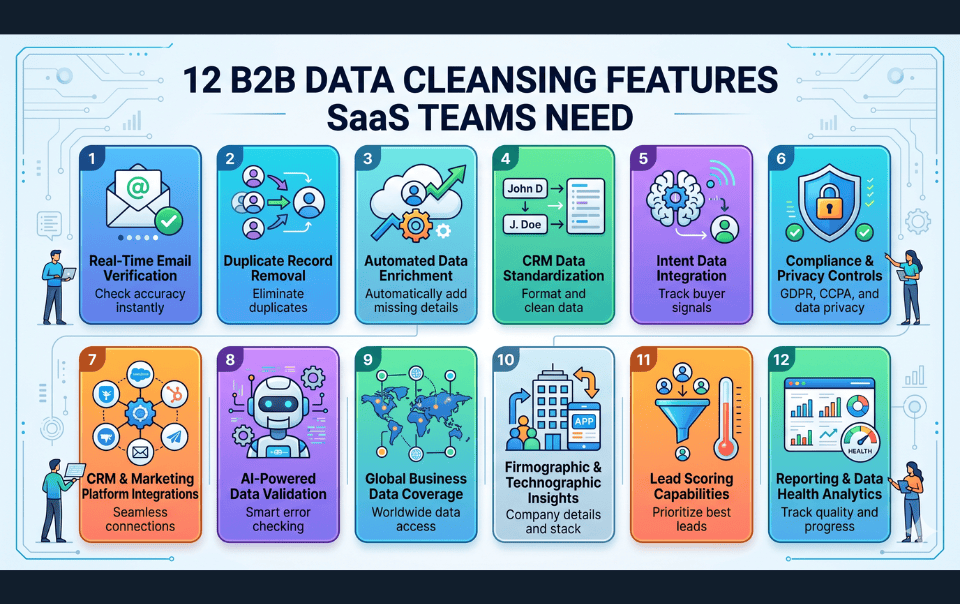
In this guide, we’ll explore 12 essential B2B data cleansing features SaaS teams should prioritize when evaluating providers and solutions.
Poor-quality data creates inefficiencies across marketing, sales, and customer acquisition workflows. When teams rely on inaccurate records, campaigns become less targeted and CRM systems become harder to manage.
High-quality business contact and company data helps SaaS teams:
As SaaS organizations scale, maintaining accurate and CRM-ready data becomes critical for supporting long-term growth.
Managing large volumes of business contact and company data manually is both time-consuming and inefficient. SaaS teams need scalable solutions that continuously validate, standardize, and enrich their records.
Reliable B2B data cleansing services help businesses maintain accurate and CRM-ready databases while reducing operational inefficiencies.
For growing SaaS organizations, investing in high-quality data services is no longer optional; it’s a strategic necessity.
Email verification is one of the most important features in any data cleansing solution. Invalid or outdated email addresses can increase bounce rates and damage sender reputation.
Accurate email verification helps SaaS teams improve deliverability and maintain stronger outreach performance.
Duplicate records create confusion across sales and marketing teams. They can also impact reporting accuracy and reduce CRM efficiency.
A reliable cleansing solution should automatically identify and merge duplicate entries.
Incomplete records limit personalization and campaign effectiveness. Automated data enrichment fills missing fields with valuable company and contact insights.
Enriched business contact and company data improve segmentation and support better outreach strategies.
Data inconsistencies often create operational challenges. Different formats for names, phone numbers, and company fields can reduce CRM usability.
Intent data helps identify prospects actively researching products or services related to your offering.
Integrating intent signals with your database allows teams to prioritize high-interest accounts and improve outreach timing.
Growing SaaS teams need more than just large databases; they need clean, accurate, and enriched data that supports better targeting and outreach.
With DataCaptive, businesses can access targeted business contacts and company data designed to improve CRM usability, segmentation, and campaign performance.
DataCaptive helps SaaS teams:
Data privacy regulations continue to evolve, making compliance an important factor when evaluating data providers.
Reliable B2B data services should support privacy-focused practices and help reduce compliance risks.
Compliance-focused B2B data cleansing practices help reduce risk while supporting ethical data management.
Strong integrations ensure data flows smoothly across systems while supporting automation efforts.
AI-powered validation tools help maintain data accuracy at scale by identifying outdated or inconsistent information automatically.
As databases grow, automated validation becomes increasingly valuable for SaaS teams.
Many SaaS companies target customers across multiple industries and regions. Limited geographic coverage can restrict growth opportunities.
A broader data network allows SaaS organizations to scale outreach more effectively.
These insights support better segmentation, account prioritization, and personalized outreach.
Not every lead has the same level of value or intent. Lead scoring helps sales teams focus on the most promising opportunities.
Data quality should be measurable. Reporting and analytics tools help teams monitor database health and identify improvement opportunities.
Choosing the right provider involves more than comparing database sizes. SaaS companies should evaluate vendors based on data quality, scalability, enrichment capabilities, and integration support.
A provider that supports long-term data quality management can significantly improve operational efficiency and campaign outcomes.
Many SaaS companies face ongoing data management challenges that impact performance and scalability.
Without regular cleansing and enrichment, these problems can quickly reduce campaign effectiveness.
Maintaining high-quality databases requires continuous monitoring and optimization.
Consistent data quality and enrichment practices help SaaS teams maintain scalable and reliable CRM systems.
Maintaining accurate and enriched data is essential for improving campaign performance and sales efficiency.
DataCaptive helps businesses access targeted, verified B2B contact data designed to support cleaner CRM records, stronger segmentation, and more effective outreach.
With advanced B2B data cleansing capabilities, SaaS teams can:
By combining accurate business contact and company data with scalable enrichment capabilities, DataCaptive helps SaaS teams strengthen their outreach and improve revenue performance.
As SaaS companies grow, maintaining accurate and reliable databases becomes increasingly important.
With DataCaptive, businesses can improve outreach performance using scalable data enrichment solutions and targeted verified B2B contact data built for modern sales and marketing teams.
✔ Improve segmentation with enriched company insights
✔ Enhance outreach with accurate decision-maker data
✔ Support scalable campaigns with cleaner CRM records
✔ Improve engagement with high-quality contact data
Build stronger pipelines and maximize growth with smarter B2B data cleansing strategies.
Choosing the right provider ensures your organization has access to accurate, enriched, and CRM-ready data that supports better targeting and stronger business outcomes.
SaaS teams typically evaluate providers based on data accuracy, enrichment capabilities, integrations, compliance support, and scalability.
Most businesses should regularly audit and cleanse CRM data quarterly or implement automated workflows for continuous maintenance.
Get a Sample Email List