
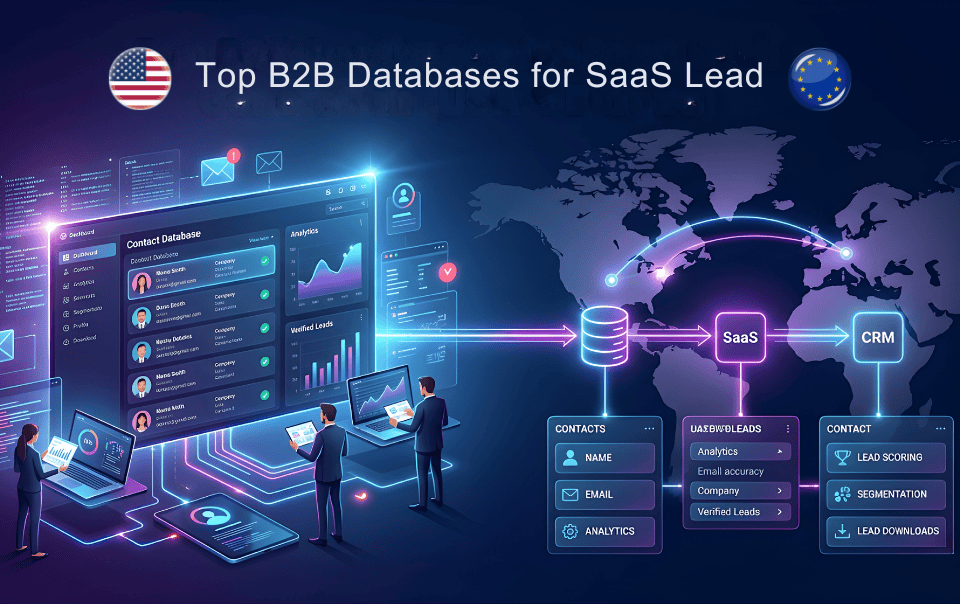
A B2B database is a structured collection of business contact information and company details that sales and marketing teams use to find and reach potential customers. Think of it as a searchable directory containing emails, phone numbers, LinkedIn profiles, and company data like industry, employee count, and revenue. Rather than spending hours hunting down contacts manually, you get direct access to decision-makers in one place.
How many hours does your team spend scrolling through LinkedIn, copying contact info into spreadsheets? Sales reps spend only 30% of their time selling, a prospecting database cuts that time dramatically. Instead of building lists from scratch, your sales reps get direct access to C-level executives, VPs, and department heads—the people who actually sign contracts.
Here’s the thing about email campaigns: they only work when your messages land in inboxes. Verified B2B data reduces bounce rates, which protects your sender reputation. When emails bounce, email providers start flagging your domain as spam. Clean data keeps your campaigns running smoothly and your response rates climbing.
If you’re expanding internationally, geographic coverage becomes critical. A strong B2B leads database includes contacts across both regions while accounting for different compliance rules—GDPR in Europe, CAN-SPAM in the USA. Without proper coverage, you’re either stuck in one market or risking legal trouble in another.
The right provider depends on your team size, target market, and what you’re willing to spend. Here’s how the leading options stack up for SaaS companies focused on the USA and Europe.

DataCaptive provides 100% opt-in contacts with a 45-day refresh cycle and a 7-tier verification process that combines AI and human review. The database includes 200M+ contacts and 75M+ company profiles with strong USA and Europe coverage. You can segment by 40+ data attributes and download in CRM-ready formats. Free samples are available before you commit.

ZoomInfo dominates the enterprise market with deep company insights and intent data. The platform offers comprehensive B2B intelligence, though pricing reflects that—it’s built for larger organizations with bigger budgets.

Cognism takes a GDPR-first approach, which makes it particularly strong for European markets. The platform is known for phone-verified mobile numbers, so if direct dial accuracy matters to your team, Cognism delivers.

Apollo combines a massive contact database (210M+ contacts) with built-in sales automation and intent data. Teams wanting prospecting and outreach in one platform often land here instead of juggling multiple tools.

Lusha works as a Chrome extension that pulls contact data directly from LinkedIn profiles. It’s quick and simple—ideal for individual prospectors or small teams who want contact info on the fly rather than bulk lists.

UpLead focuses heavily on data accuracy, offering 50+ search filters and real-time email verification. Teams that have been burned by bad data from other providers often appreciate the accuracy guarantees.
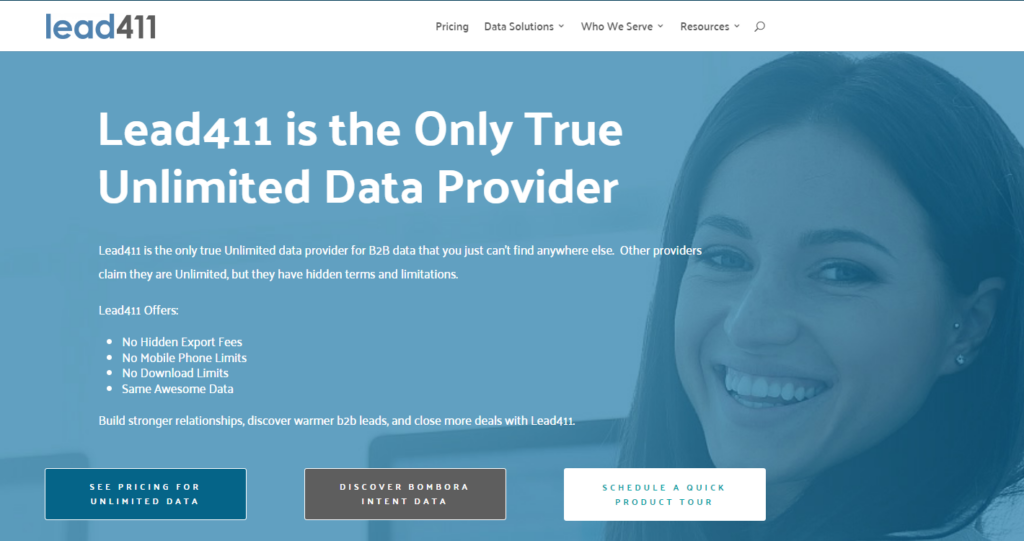
Lead411 pairs its contact database with intent data triggers and buying signals. Sales teams can prioritize prospects who are actively researching solutions, rather than cold-calling contacts with no current interest.
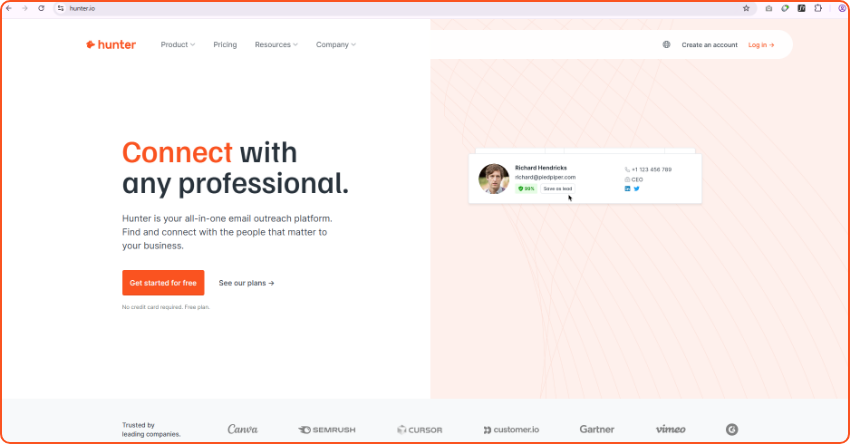
Hunter specializes in finding and verifying email addresses for cold outreach. The toolset stays focused—no extra features, just accurate emails.
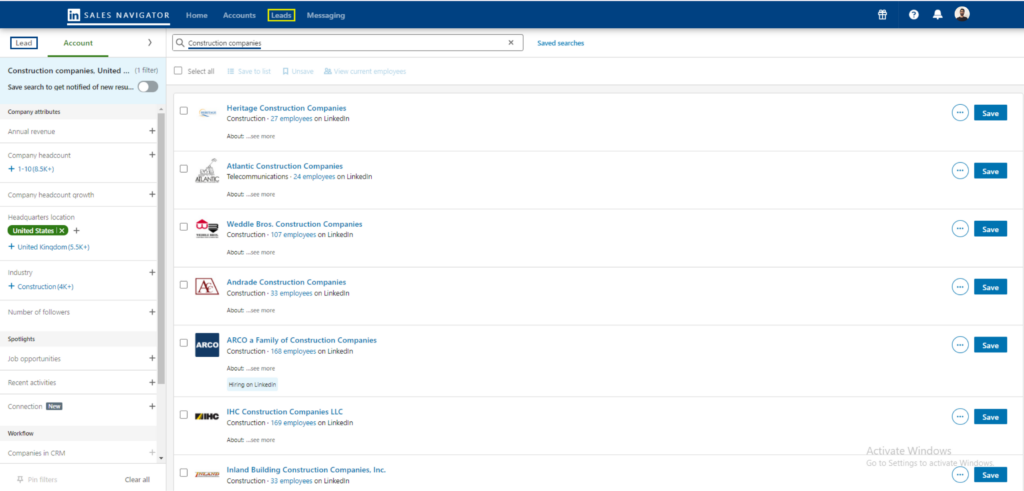
Sales Navigator isn’t a traditional database. It works within LinkedIn’s ecosystem, making it best for social selling alongside other data sources rather than standalone prospecting.
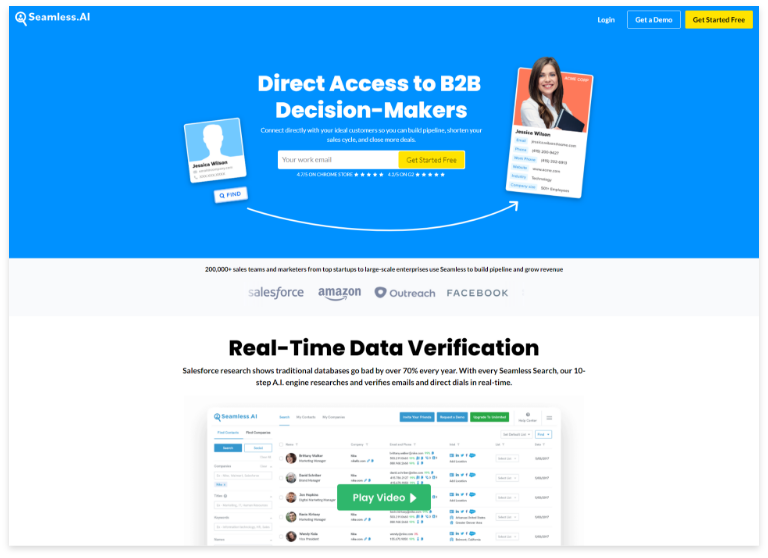
Seamless.AI functions as a real-time search engine for contact information, using AI to retrieve data on demand. The approach differs from static databases, though accuracy can vary depending on the contact.
| Provider | Best For | Key Feature | Geographic Strength |
|---|---|---|---|
| DataCaptive | Verified, compliant data | 7-tier verification, 45-day refresh | USA & Europe |
| ZoomInfo | Enterprise teams | Comprehensive intelligence | Global |
| Cognism | European markets | Phone-verified mobiles | Europe-first |
| Apollo.io | All-in-one prospecting | Built-in outreach tools | Global |
| Lusha | Quick lookups | Chrome extension | Global |
| UpLead | Accuracy-focused teams | Real-time verification | USA & Europe |
| Lead411 | Intent-driven prospecting | Buying signals & triggers | USA-focused |
| Hunter.io | Email-focused outreach | Email finder & verification | Global |
| LinkedIn Sales Navigator | Social selling | LinkedIn ecosystem integration | Global |
| Seamless.AI | Real-time contact search | AI-powered data retrieval | USA & Global |
What verification process does the provider actually use? Look for multi-step validation that combines AI and human review. Before purchasing, ask for accuracy guarantees in writing. Reputable providers typically offer 90%+ accuracy rates and stand behind their data.
Compliance protects your business from fines and legal headaches. GDPR governs European data, CCPA covers California, and CAN-SPAM sets email rules for the USA. Look for providers offering 100% opt-in data with documented consent processes. Cutting corners here creates real risk.
More attributes mean more precise targeting. Common filters include industry, job title, company size, revenue, technology used, and location. The difference between a generic list and a high-converting one often comes down to how granularly you can segment your audience.
Your data is only useful if it flows into your existing workflow. Check for CSV, XLS, and API delivery options, plus native integrations with Salesforce, HubSpot, and other CRMs your team uses daily.
Always test data quality through free samples before committing to a larger purchase. Watch for providers with hidden costs or unclear pricing structures. Transparent pricing usually signals a provider confident in their data quality.
Also Read: View DataCaptive’s pricing plans
Direct dials bypass gatekeepers and general company lines, connecting your sales reps straight to decision-makers. Mobile data also enables SMS outreach for teams running multichannel sequences.
Firmographics describe the company itself—size, revenue, and industry. Technographics reveal the tech stack, showing which software and tools a company already uses. Both help you qualify prospects and personalize outreach based on their actual situation.
Intent data identifies companies actively researching solutions like yours. This helps prioritize leads most likely to convert, so your team focuses energy on prospects already in-market rather than completely cold contacts.
Deliverability guarantees mean the provider stands behind their email accuracy. Look for catch-all detection and hard bounce reduction—both protect your sender reputation and campaign performance over time.
People change jobs constantly. Companies merge, relocate, or close. Email lists degrade by about 30% each year, so a database refreshed every 30-45 days stays current, while one updated annually becomes a liability. Ask about refresh cycles before purchasing.
First-time buyers often mix up these terms, so here’s the distinction:
Databases work well for teams with an existing tech stack who just want clean data. Platforms suit teams wanting an all-in-one solution. Your choice depends on what tools you already have in place.
Your ideal customer profile describes the traits of your best customers—industry, company size, job titles, geography. This determines which B2B sales lead database fits your needs and prevents wasted spend on irrelevant contacts.
Test before you buy. Evaluate sample contacts for email validity, contact relevance, and data completeness. A provider confident in their data will offer samples without hesitation.
Compare sample contacts to your existing CRM data. Check for duplicates, outdated information, and missing fields. This reveals true data quality before you scale up.
Resist the urge to buy massive lists upfront. Start with one industry or region to validate quality, then expand once you’ve confirmed the data performs.
Bounce rate, open rate, and response rate reveal true data quality after deployment. If metrics underperform, you’ve learned something valuable before investing further.
Invalid emails trigger bounces, which damage your domain reputation. Once your sender score drops, even good emails land in spam folders. Recovery takes months of careful sending.
Poor data wastes ad spend, SDR time, and campaign resources. Over 60% of teams report that poor data disrupts lead handoffs and slows productivity—every hour spent chasing bad contacts is an hour not spent on real opportunities.
Using non-compliant data in Europe creates financial and reputational risk. DLA Piper’s 2026 GDPR survey reports aggregate fines have surpassed €7.1 billion since 2018, and brand damage lasts longer than any penalty.
Unreliable leads create inconsistent sales forecasting. When you can’t trust your data, you can’t trust your pipeline projections—and that uncertainty compounds across your entire revenue operation.
Verified emails power cold outreach sequences and nurture campaigns. Clean data means higher deliverability and more conversations started.
Match database contacts to LinkedIn profiles for connection requests and InMail. This creates a coordinated multichannel approach that increases touchpoints with prospects.
Phone data enables SDR teams to reach decision-makers directly. Direct dials bypass gatekeepers and general lines, improving connect rates significantly.
ABM—account-based marketing—requires precise targeting at the account level. B2B company database segmentation enables personalized, account-specific campaigns that resonate with buying committees.
Mailing addresses enable physical outreach, which remains effective for executive targeting when digital channels get crowded.
The right B2B database accelerates your pipeline by connecting you directly with decision-makers who match your ICP. Accuracy, compliance, and geographic coverage matter most—everything else follows from those foundations.
Before committing to any provider, request a free sample and test the data against your actual campaign needs. Quality reveals itself in performance metrics, not marketing claims.
Ready to see the difference verified data makes? Request your free sample list from DataCaptive and test before you buy.
Reputable providers refresh data every 30-90 days to account for job changes and company updates. Look for providers with documented refresh cycles—anything longer than quarterly becomes a liability.
Yes, you can upload email lists to LinkedIn for matched audience targeting. Match rates vary based on email type and data quality, with business emails typically performing better than personal addresses.
B2B data refers to raw contact and company information. B2B leads are contacts who have shown interest or fit specific qualification criteria—essentially, data that’s been filtered for sales readiness.
Free databases typically have lower accuracy, outdated information, and limited verification. Paid providers offer guarantees, fresher data, and compliance documentation that free options lack.
Ask for documentation of data sourcing methods and confirm opt-in consent processes. Check for stated compliance with GDPR, CCPA, and other regulations—reputable providers make this information readily available.
Request email, phone, job title, company name, industry, company size, revenue, location, and LinkedIn profile at minimum. Technographic data adds targeting precision for SaaS companies selling into specific tech stacks.
Get a Sample Email List
