
How Targeted B2B Data Helped an IT Firm Generate Pipeline

How Targeted B2B Data Helped an IT Firm Generate Pipeline

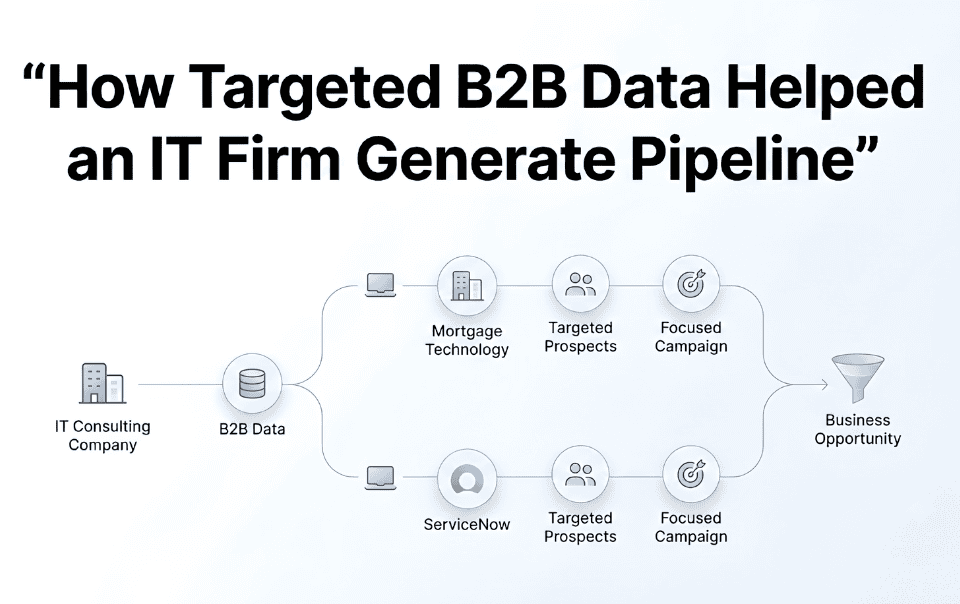
An IT consulting firm grew two implementation practices by keeping their target audiences separate. It segmented prospects by technology platform and ran focused outbound campaigns for each practice, helping the business development team engage more relevant prospects and generate new implementation opportunities.

About the Client

The client is an IT consulting and software services company supporting organizations with technology implementation, staffing, software development, and specialized consulting services. Its capabilities span multiple technology and business environments, allowing it to support clients with both strategic and technical requirements.

Its service portfolio includes:
  • ServiceNow implementation and managed services for organizations looking to improve enterprise workflows and technology operations.
  • Mortgage-technology consulting for businesses operating within the mortgage and lending technology ecosystem.
  • Cloud migration services to help organizations modernize their technology infrastructure.
  • Cybersecurity services designed to support organizations with their technology and security requirements.
  • Data-science staffing for businesses looking to strengthen specialized technical teams.
  • Custom software development to address specific business and technology requirements.
The company was also operating two distinct implementation practices that required different prospecting approaches. One practice focused on organizations using a mortgage-industry software platform, while the other centered on ServiceNow users.
Because these practices addressed different technology environments, the company needed its outbound efforts to reflect those differences.

Why the Client Needed Targeted Data

The business development team needed a practical way to identify organizations that were already using the relevant platforms and could potentially benefit from the company’s implementation and consulting expertise.

The data therefore needed to help the team:

  • Identify companies aligned with each implementation practice.
  • Reach relevant contacts within those organizations.
  • Separate prospects according to the technology environment they operated in.
  • Build independent campaigns for each practice.
  • Give sales representatives enough company and contact information to personalize their outreach.

Rather than treating its entire addressable market as one audience, the company needed two clearly defined prospect pools that could support two different outbound motions.

The Challenge

The primary challenge was not simply finding more contacts. It was finding the right contacts within the right technology environments and keeping the two audiences separate.

The company’s implementation practices served different markets, which meant that combining prospects into a single database could make campaign targeting less precise.

Several challenges had to be addressed:

  • Different technology audiences: The two practices were associated with different software environments, requiring separate targeting criteria.
  • Different prospect profiles: Organizations using one platform were not necessarily relevant to the other implementation practice.
  • Campaign relevance: A broad list could make it difficult for the business development team to create messaging specific to each service.
  • Technology-based targeting: The client needed visibility into the platform being used by prospective organizations.
  • Outbound efficiency: Sales representatives needed a more focused prospect pool instead of spending time filtering through broadly defined accounts.
  • Pipeline attribution: The company wanted to understand how each targeted audience contributed to new implementation opportunities.

The challenge was therefore to create a data strategy that supported two separate outbound campaigns without diluting either practice’s target audience.

The DataCaptive Solution

DataCaptive developed and delivered two separate, purpose-built B2B contact lists, with each list aligned to one of the client’s implementation practices.

Instead of creating one generalized database containing prospects from both technology environments, the data was structured around the specific audience requirements of each practice.

Separate Audience Segmentation

The first dataset focused on verified contacts at organizations using the relevant mortgage-industry technology platform.

The second dataset focused on organizations using ServiceNow, allowing the client to build a separate prospecting pool for its ServiceNow implementation services.

This separation enabled the business development team to approach each market independently.

Targeted Data Customization

The datasets were customized around the client’s prospecting requirements, incorporating both contact-level and company-level information.

The targeting approach helped the client focus its outreach on:

  • Organizations associated with the relevant technology platform.
  • Contacts suitable for business development outreach.
  • Companies matching the required size and regional criteria.
  • Prospects that could be aligned with the specific implementation practice being promoted.

Verification and Data Quality

The solution also emphasized the delivery of verified contact information, helping the client work with a more usable prospect database.

Having relevant contact and company information in a structured format gave the business development team a stronger starting point for outbound execution.

Campaign-Specific Prospecting

Most importantly, the two datasets allowed the client to build separate campaigns for separate practices.

This meant the team could:

  • Develop messaging specific to the technology environment.
  • Prioritize prospects according to the relevant implementation service.
  • Avoid sending unrelated messaging to prospects outside a practice’s target audience.
  • Track campaign performance independently.
  • Compare the pipeline contribution generated by each audience.

The approach transformed the data from a general contact resource into a more focused prospecting asset for the company’s outbound strategy.

Data Fields Delivered

DataCaptive provided a combination of contact, company, technology, and geographic information to support account identification and outreach.

Contact Information

  • Contact Name: Helped the sales team identify the individual being approached.
  • Job Title: Provided visibility into the prospect’s role and helped the team prioritize relevant contacts.
  • Direct Email: Supported direct outbound communication with targeted prospects.

Company Information

  • Company Name: Enabled account identification and organization-level prospecting.
  • Company Size: Helped the client assess organizations according to its preferred account profile.
  • Region: Supported geographic segmentation and campaign organization.

Technology Information

  • Platform in Use: Provided an important targeting signal by identifying the technology environment associated with the prospect organization.

This combination of fields helped the client move beyond a basic email database. The team could evaluate who the prospect was, where they worked, what technology environment they were associated with, and whether the account aligned with the relevant practice.

Results

The two-list strategy produced measurable results for the client’s outbound efforts.

During the first quarter, the company generated:

  • 18 discovery calls across both implementation practices.
  • Approximately 40% of new implementation pipeline was contributed by the ServiceNow-focused list.
  • Separate campaign performance visibility, allowing the client to evaluate each practice independently.
  • More focused prospecting, with each campaign directed toward organizations relevant to the corresponding technology service.

The results demonstrated that separating audiences based on technology usage could create a more focused path from prospect identification to sales conversation.

Stronger Practice-Level Targeting

The ServiceNow-focused campaign was particularly significant, contributing approximately 40% of the new implementation pipeline during the period.

This gave the client a clearer indication of how a technology-specific prospecting strategy could support implementation opportunities.

More Focused Outbound Execution

The two datasets also gave the business development team a clearer framework for campaign execution.

Instead of approaching prospects with broad messaging, the team could organize outreach around the specific technology environment and implementation service relevant to each account.

Better Visibility into Campaign Contribution

Because the prospect pools were separated, the client could evaluate results at the practice level rather than treating all outbound activity as one campaign.

This made it easier to understand:

  • Which audience generated discovery conversations.
  • Which practice contributed to new implementation opportunities.
  • How technology-specific targeting influenced pipeline generation.
  • Where future outbound efforts could be concentrated.

Key Takeaways

This case study highlights an important principle for B2B lead generation: different services often require different prospecting audiences.

When a company operates multiple practices, combining all potential buyers into one broad contact list can make targeting and messaging less effective.

The client’s experience demonstrates several practical lessons:

  • Segment prospects by business relevance: Different services should be supported by audiences that actually align with those services.
  • Use technology as a targeting signal: Knowing which platforms an organization uses can help identify prospects with a stronger potential need for implementation or consulting services.
  • Separate campaigns by practice: Independent prospect lists make it easier to create relevant messaging and measure performance.
  • Combine contact and firmographic data: Contact details become more useful when paired with company size, region, and technology information.
  • Measure each audience independently: Separate datasets make it easier to identify which prospect segments are contributing to conversations and pipeline.
  • Build data around the ICP: A customized dataset can be more useful than a broad database when the objective is targeted outbound prospecting.

Ultimately, the case demonstrates that effective B2B prospecting is not only about having more contacts. It is about having contacts that match the service, technology environment, and campaign objective.

For businesses running multiple practices or serving different technology ecosystems, building separate prospecting lists can create a clearer and more measurable path to pipeline growth.

Build a More Targeted Prospect List

If your business serves multiple industries, technologies, or buyer groups, a single broad contact database may not give your sales team the targeting precision it needs.

DataCaptive’s Custom B2B Data Solutions can help you build prospect datasets around your specific audience, technology requirements, company characteristics, geographic focus, and campaign objectives.