The education industry has plenty of B2B opportunities, but reaching the right schools, colleges, universities, and education decision-makers isn’t always easy. Many businesses promise better prospecting, but the real challenge is finding institutions that fit your target market and the professionals who influence purchasing decisions.
Whether you’re selling educational software, learning solutions, academic resources, or institutional services, the right data can help you focus your prospecting efforts.
In this guide, we’ll explore how education industry data supports B2B lead generation, which contacts to target, and how an education industry email list helps businesses find relevant contact data for their outreach goals.
Education industry data includes information about educational institutions and, depending on the dataset, their associated professional contacts.
Businesses can use this information to identify potential customers, research education-sector markets, and build targeted B2B prospect lists.
Key data categories may include:
For example, an EdTech company selling learning management software may target institutions that fit its customer profile, while an academic publisher may focus on organizations that could benefit from its educational resources.
The right dataset depends on your target audience, geographic requirements, and the information the provider offers.
Identifying educational institutions is only the first step. Businesses also need to find relevant professionals, organize prospect information, and narrow their audience.
Common challenges include:
A well-defined education industry database strategy helps businesses organize their research and prioritize prospects that align with their sales and marketing objectives.
An education industry email list can support businesses that sell products or services to educational institutions.
EdTech companies can use institutional research and relevant contact data to identify potential customers for:
Companies offering consulting, training, technology implementation, or administrative services can use relevant data to identify institutions that match their service offerings.
Publishers and learning solution providers can research schools, colleges, and universities that may be interested in:
Sales and marketing professionals can use education-sector data to:
Research and business development teams can use institutional information to explore education-sector opportunities, assess potential markets, and identify organizations for further research.
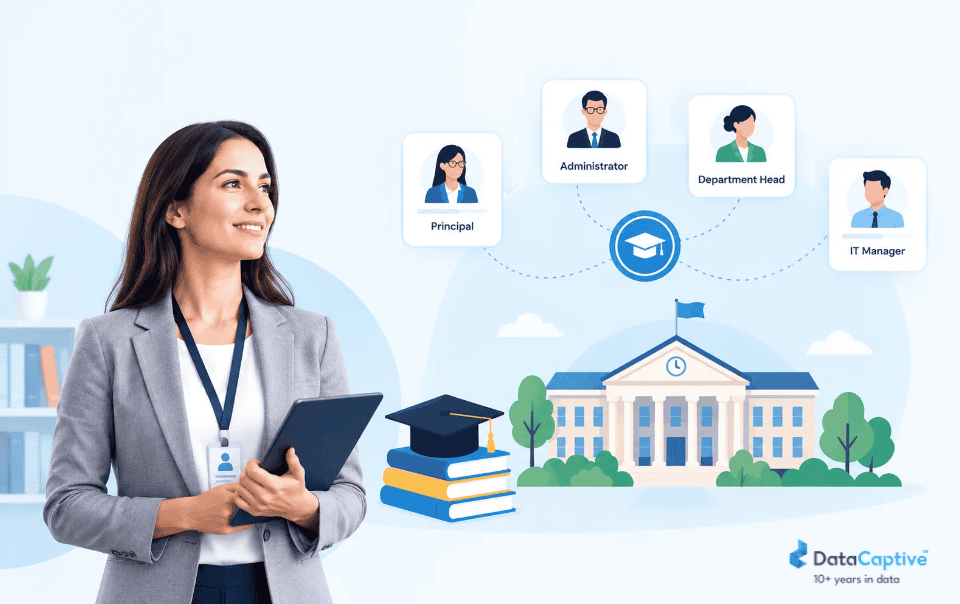
Having a list of educational institutions doesn’t automatically connect you with the right people. Your outreach strategy should identify professionals whose responsibilities align with your product or service.
Potential education-sector contacts include:
For example, an educational software provider may prioritize IT leaders and administrators, while an academic resource provider may focus on relevant academic departments.
Choose B2B contacts based on their professional relevance, and assess privacy requirements and applicable marketing rules before conducting outreach.
An education industry database can support several business activities when it matches your prospecting goals.
Remember, data supports prospect identification and campaign planning; it doesn’t guarantee conversions. Results depend on data relevance, qualification, outreach quality, and how well your offering fits.
Finding relevant education-sector prospects starts with understanding your target institutions, the professionals you want to reach, and the information your team needs.
DataCaptive provides B2B contact data and business database solutions to support your prospecting needs. For education-focused campaigns, share your institution types, target markets, and professional contact requirements so we can recommend the best-fit data options.
Before requesting an education industry email list, define your requirements clearly:
Looking for education industry data for your next B2B campaign? Request a free sample from DataCaptive to assess whether the available data aligns with your targeting requirements.
Reaching the right education-sector audience requires more than collecting a broad list of institutions. Businesses need relevant institutional contact information, appropriate professional contacts, and a clear targeting strategy.
Education industry data can help teams:
DataCaptive can support B2B contact data needs. Define your target audience, confirm the availability of relevant education-sector records, and request a free sample to evaluate whether the data fits your business goals.
Education industry data includes information about educational institutions and, where available, their associated professional contacts. Businesses can use it for B2B prospecting, market research, audience segmentation, and business development.
Depending on provider coverage, datasets may include schools, colleges, universities, and other educational organizations. Confirm the available institution types and geographic coverage before purchasing.
An education industry contact list contains professional contact records associated with educational institutions. Depending on coverage, it may include administrators, department heads, IT professionals, procurement contacts, and other relevant professionals.
EdTech companies, education service providers, academic publishers, B2B sales teams, marketing agencies, and business development professionals may use relevant education-sector data to identify potential business audiences.
It can help businesses identify relevant institutions, research professional contacts, and organize prospect lists. Lead generation outcomes depend on targeting accuracy, contact suitability, outreach quality, and the offering’s value.
Review the following:
Customization depends on the provider’s available services and data coverage. Businesses should specify their target institution types, locations, professional roles, and required fields when discussing their requirements with DataCaptive.
Start by defining your target audience and required contact information. Request a free sample, review the available records, and confirm education-specific coverage, data-quality practices, and delivery options before deciding to purchase.
Get a Sample Email List
