
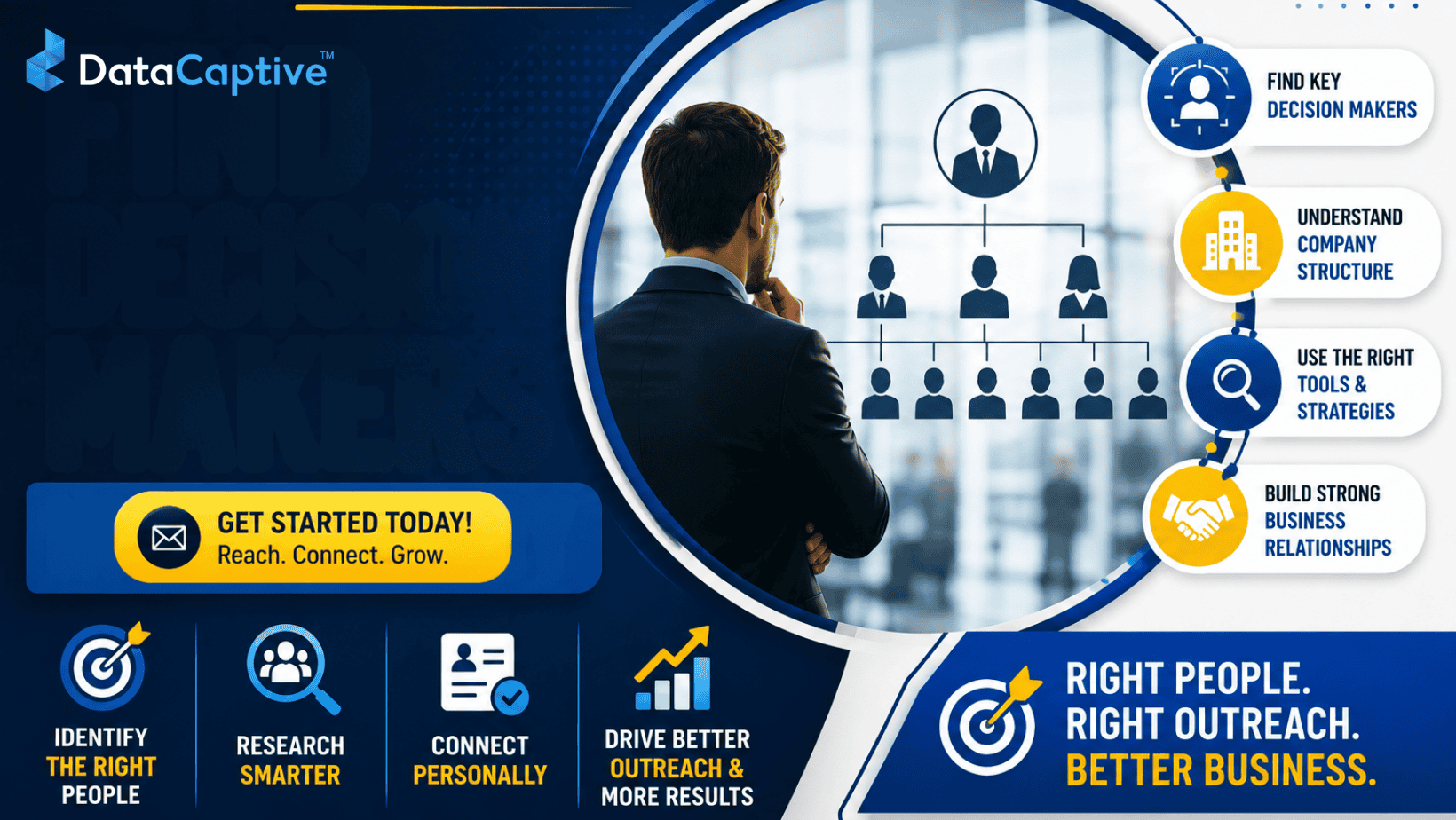
Finding the right Decision Makers is what separates wasted outreach from real revenue opportunities.
In B2B sales and marketing, even the best product fails if it never reaches someone with buying authority. That’s why research, personalization, and accurate contact intelligence matter more than ever as buying committees continue to grow.
Whether you’re running outbound campaigns, ABM strategies, or enterprise prospecting, knowing how to find decision makers in companies directly improves response rates, shortens sales cycles, and drives better conversions.
This guide shows you how to identify the right roles, avoid common mistakes, and build a repeatable system to reach real buyers consistently.
Decision makers are individuals who have the authority to approve purchases, influence buying decisions, allocate budgets, or sign contracts on behalf of an organization. In B2B organizations, purchasing decisions are rarely made by one person. Instead, buying committees include executives, department heads, procurement professionals, technical evaluators, finance leaders, and end users.
Examples include:
Understanding who actually controls purchasing decisions helps sales teams focus their efforts on prospects with genuine buying influence.
Benefits include:
Instead of sending hundreds of emails to generic inboxes, targeting the right executive contacts significantly improves campaign effectiveness.
Even experienced sales teams encounter obstacles.
Common challenges include:
Overcoming these challenges requires continuous research and updated contact intelligence.
To find decision makers in companies, you need to combine structured account research, organizational mapping, and verified contact intelligence to identify the right executives who influence or approve purchasing decisions.
Start by clearly defining:
This ensures you are targeting companies where real B2B decision makers exist for your solution.
A specific business function owns every product.
Examples:
Knowing the department helps quickly narrow down relevant target company contacts.
Most companies follow a layered hierarchy:
Decision-making is usually distributed across these layers, not centralized in one person.
Focus on these categories:
This helps you build a full buying committee instead of targeting a single contact.
One of the most efficient ways to find decision-makers in companies at scale is to use high-quality, verified data sources.
A platform like DataCaptive helps sales and marketing teams identify and connect with the right executive contacts across industries. It provides segmented, verified B2B databases that allow users to customize contacts by job title, industry, company size, geography, and department, making it easier to pinpoint actual decision-makers rather than guessing or relying on outdated information.
By using DataCaptive, teams can reduce manual research time, improve targeting accuracy, and directly reach professionals who have purchasing authority within target organizations.
Finding the right decision-makers in companies shouldn’t take hours of manual research or guesswork. That’s where DataCaptive makes the difference, turning complex prospecting into fast, targeted access to real buyers who matter.
Outcome: With DataCaptive, teams can quickly move from “searching for contacts” to “engaging real decision makers,” improving pipeline quality and accelerating revenue growth.
Follow these proven strategies.
Experience the power of verified Decision Makers Email List. Get a free sample to see how it can fuel your retail lead generation.
Finding the right decision-makers isn’t about more outreach; it’s about smarter outreach. In B2B, success comes from precision. When you map buying committees, understand roles, and focus on real authority holders, your outreach becomes sharper and more effective.
With structured targeting and trusted data sources such as DataCaptive, you can skip guesswork, connect with verified decision makers, and turn conversations into faster revenue.
Define your ICP, target the right roles, and personalize every message to improve response rates and shorten sales cycles.
Final thought: Better targeting leads to better conversations, and better conversations lead to better conversions.
Decision makers are individuals such as CEOs, VPs, Directors, and Managers who have the authority to approve budgets, evaluate vendors, and make purchasing decisions within an organization.
You can find decision-makers at target companies using DataCaptive, which provides verified and segmented B2B contact data to help you directly identify and reach executives, department heads, and other key stakeholders with purchasing authority.
Targeting decision-makers improves outreach accuracy, increases response rates, shortens sales cycles, and ensures your message reaches the people who can actually approve purchases.
Key decision makers typically include CEOs, CFOs, CIOs, CMOs, department heads, procurement managers, and other senior executives involved in budgeting and strategy.
The fastest way is to use a verified B2B database provider such as DataCaptive, which provides access to decision-makers by job title, industry, company size, and more.
DataCaptive offers verified and up-to-date B2B contact data, enabling users to directly reach CEOs, directors, and managers through advanced segmentation by industry, role, and company profile.
Yes, with advanced options on platforms like DataCaptive, you can target specific job titles, such as CEOs, CFOs, IT Directors, or Procurement Heads, for precise outreach.
Manual research can help, but it is time-consuming and often incomplete. Combining it with a reliable data provider like DataCaptive improves accuracy and efficiency.
Contact data should be updated regularly, ideally every 45 days, to ensure accuracy, given frequent job changes and organizational restructuring.
Using DataCaptive helps sales and marketing teams quickly connect with verified decision makers, improve campaign performance, and generate higher-quality leads with less effort.
Get a Sample Email List
Get A Quote on Price
