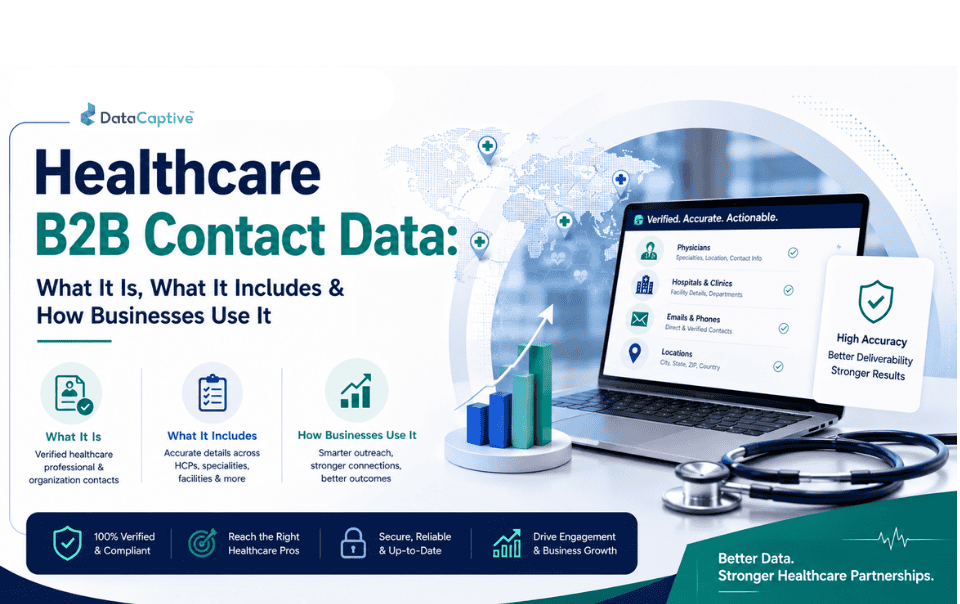
Healthcare B2B Contact Data is verified business contact and organizational information for professionals and companies operating across the healthcare industry — physicians, hospital executives, health IT leaders, and the organizations they work for. It covers professional details like job title and department, organizational details like facility type and size, and contact details like business email and phone. It does not include patient or clinical health information; it’s strictly professional, business-to-business data.
Sales, marketing, and recruiting teams use it to identify and reach healthcare buyers directly, rather than relying on generic or unqualified contact lists.
This article focuses specifically on Healthcare B2B Contact Data — what it is, what it contains, and how businesses actually use it. For the broader framework covering database types, sources, and how to choose a provider, see our Healthcare Industry Contact Database guide.
Healthcare B2B Contact Data is business contact and organizational information tied to a healthcare professional’s role, used specifically for business-to-business outreach rather than consumer or patient communication.
It connects two layers: information about the individual (a physician, a CFO, an IT director) and information about the organization that employs them (a hospital, a clinic, a health plan). Both layers matter for B2B targeting — a job title alone doesn’t tell you much without knowing the size and type of organization behind it.
At the contact level, this includes names, titles, departments, and verified business emails or phone numbers. At the organization level, it includes the employer’s name, type, size, and healthcare segment. Together, these layers let a business identify not just who to contact, but why that contact is relevant to a specific offer.
| Data Category | Examples | How Businesses Use It |
|---|---|---|
| Contact Information | Name, verified business email, phone number | Direct outreach via email, phone, or multichannel campaigns |
| Professional Information | Job title, department, credentials | Identifying relevant roles and tailoring messaging to responsibilities |
| Organization Information | Facility name, organization type, employee size | Prioritizing accounts and understanding buying capacity |
| Geographic Information | City, state, country | Building territory-based or regional campaigns |
| Specialty/Industry Information | Clinical specialty, healthcare segment | Matching outreach to a specific clinical or organizational niche |
| Buying-Role Information | Seniority, department, budget signals | Identifying who is likely to hold purchasing authority |
| Technology/Enrichment Information (where available) | EHR platform, other technology signals | Targeting vendors' ideal customers based on existing tech stack |
Field availability varies by provider and by record. A dataset described as including all of the above won’t necessarily have every field populated for every contact — reviewing a sample is the only reliable way to confirm coverage.
| Contact-Level Data | Organization-Level Data |
|---|---|
| Name | Organization name |
| Job title | Organization type |
| Department | Location |
| Specialty | Employee size |
| Business email | Healthcare segment |
| Phone number | Technology/firmographic information (where available) |
Contact-level data tells a business who to reach. Organization-level data tells them whether that contact sits inside an account worth prioritizing. Combining both is what turns a list of names into a workable B2B targeting strategy — a hospital’s IT director means something different depending on whether the hospital has 50 beds or 500.
B2B sales prospecting. Sales teams use this data to identify and qualify prospects before outreach begins. A medical device company, for example, might use it to reach procurement and clinical staff at target hospitals rather than cold-calling generic hospital numbers. The attributes that matter most here are job title, organization type, and verified contact details.
Email and multichannel marketing. Marketing teams build segmented campaigns around role, specialty, or organization type so messaging speaks to a recipient’s actual priorities. A healthcare software company targeting CIOs and IT directors, for instance, relies on accurate title and department data to avoid sending clinical messaging to a technical audience.
Account-based marketing. ABM teams combine organization-level data with individual contact records to map an entire buying committee at a target account, instead of reaching one generic contact and hoping the message reaches the right internal audience.
Event and webinar marketing. Event marketers use specialty and role data to build accurate invitation lists for conferences and webinars aimed at a defined professional audience, rather than a broad healthcare list that includes irrelevant roles.
Recruiting. Recruiters use specialty, credential, and location data to identify qualified healthcare candidates for open roles, applying many of the same segmentation attributes used in sales targeting.
Partnerships and business development. Teams exploring channel partnerships or referral relationships use organization and firmographic data to identify potential partners across the healthcare ecosystem, based on segment, size, and geography.
A single attribute rarely narrows a healthcare audience enough to be useful on its own. Precision comes from layering attributes:
Industry → Organization → Geography → Department → Job Title → Specialty → Contact
Starting broad (healthcare) and narrowing step by step — to a specific organization type, then a region, then a department, then a title, then a specialty — produces a workable, specific audience instead of an oversized, generic one. Most effective B2B healthcare campaigns apply three or four of these layers together rather than filtering on just one.
A healthcare software company selling a clinical documentation tool might build a target list using: hospitals and health systems (organization), a specific state or region (geography), IT directors and CIOs (job title/department), and — where available — organizations already using a compatible EHR platform (technology information). The result is a list of verified business emails and phone numbers for a defined, relevant set of decision-makers, rather than a generic hospital contact list.
This kind of layered targeting doesn’t guarantee a specific response rate or conversion outcome — it simply focuses outreach on contacts more likely to be relevant to the offer.
Healthcare organizations can experience frequent staff, role, and organizational changes, making data freshness important for B2B targeting. A dataset that isn’t reviewed on a regular basis will accumulate outdated titles, incorrect employers, and invalid contact details over time.
Accurate and verified data can reduce wasted outreach caused by invalid or outdated records, and help teams target relevant professionals more effectively. It doesn’t guarantee a specific response rate, but it does reduce the time spent chasing bad contacts.
Four factors drive usable data quality:
Healthcare B2B Contact Data refers to the information itself — the professional and organizational details described above. A Healthcare Contact Database is the structured system that organizes that information so it can be searched, filtered, and used at scale.
In practice, the data is what you’re targeting with; the database is the tool that lets you filter it down to the audience you need.
DataCaptive’s Healthcare Contact Database gives B2B teams verified professional and organizational data for healthcare outreach — 95%+ data accuracy, 100% verified opt-in contacts, a 7-tier human + AI verification process, and records updated every 45 days. Data is available in XLS, CSV, or via API, and DataCaptive’s data practices are aligned with ISO 27001, SOC 2, GDPR, PIPEDA, DPDPA, and CCPA (compliance with one standard doesn’t imply compliance with every applicable law in every region).
Customize Your List to match the specific roles, organizations, and geographies your healthcare campaign is targeting.
It typically includes contact details (name, business email, phone), professional information (title, department), organizational information (facility type, size), and geographic and specialty data — though exact fields vary by provider and record.
Sales teams, marketers, recruiters, and business development professionals at companies selling into hospitals, clinics, health systems, payers, and other healthcare organizations.
Sales teams use it to identify relevant contacts by role and organization type, then reach them directly through email, phone, or multichannel outreach, rather than working from generic or unqualified lists.
Contact-level data describes an individual — name, title, email, phone. Organization-level data describes their employer — organization type, size, and segment. Combining both allows more precise B2B targeting.
Because healthcare organizations can experience frequent staff, role, and organizational changes, data that isn’t periodically reviewed tends to include outdated titles or invalid contact details over time.
Get a Sample Email List