
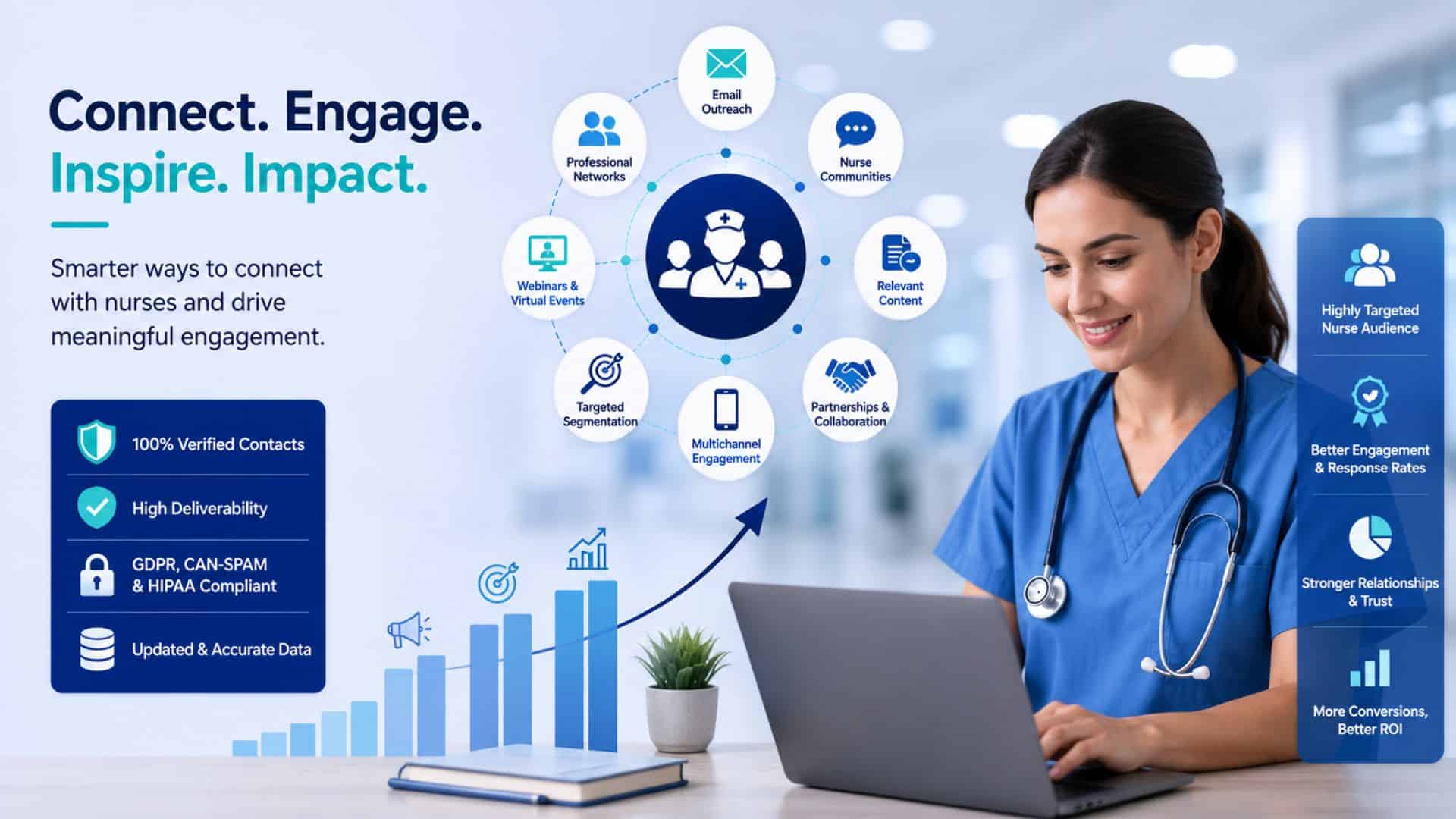
Healthcare marketers face a unique challenge when targeting nurses. As one of the largest and most influential groups within the healthcare industry, nurses play a vital role in patient care, clinical decision-making, and the adoption of new medical technologies. However, reaching them with relevant marketing messages isn’t as simple as sending a generic email campaign.
Nurses work across hospitals, clinics, outpatient centers, long-term care facilities, and home healthcare organizations. Their demanding schedules, shift-based work environments, and information overload make it difficult for businesses to capture their attention. That’s why successful B2B healthcare marketing requires a targeted, personalized, and data-driven approach.
Whether you’re promoting medical devices, healthcare software, pharmaceutical products, continuing education programs, staffing services, or healthcare events, connecting with the right nursing professionals can significantly improve your marketing outcomes.
In this guide, you’ll learn ten proven strategies to reach nurses more effectively, improve campaign engagement, and generate higher-quality leads while maintaining compliance with healthcare marketing best practices.
Nurses are among the most trusted healthcare professionals and often influence clinical workflows, patient outcomes, and product adoption. While they may not always make final purchasing decisions, their recommendations and day-to-day experiences frequently impact which products, technologies, and services healthcare organizations choose.
Healthcare companies increasingly recognize nurses as a critical audience for:
Reaching nurses with relevant, educational content helps organizations build credibility, generate qualified leads, and create long-term relationships within the healthcare community.
Healthcare companies should market to nurses because they are key users, influencers, and advocates of many healthcare products and services. Educating nurses about innovative solutions can accelerate product adoption, improve brand awareness, and support stronger engagement across healthcare organizations.
Although nurses represent a valuable audience, connecting with them effectively presents several challenges.
Nurses often work long shifts, rotating schedules, overnight hours, and weekends. Their limited availability means marketing communications must be timely, relevant, and easy to consume.
Healthcare professionals receive countless emails, newsletters, promotional offers, and educational resources every week. Generic marketing messages are easily ignored or deleted.
One of the biggest obstacles is relying on inaccurate or outdated healthcare contact data. Job changes, department transfers, and organization changes can quickly reduce campaign performance if contact databases aren’t regularly updated.
Healthcare marketers must respect privacy regulations and follow applicable email marketing laws. Using permission-based, verified contact data helps organizations maintain compliance while improving campaign effectiveness.
Registered nurses have demanding work schedules, receive large volumes of professional communications, and work across diverse specialties. Successful outreach requires accurate contact data, relevant messaging, audience segmentation, and a value-driven marketing strategy.
One of the fastest and most effective ways to reach nurses is by using a verified nurses email list from a trusted B2B data provider. Instead of spending months building contact lists manually, businesses gain access to targeted professional contacts that support more efficient outreach.
A high-quality nurses email list helps marketing and sales teams:
When evaluating a provider, look for features such as verified records, regular data updates, customizable filters, specialty segmentation, geographic targeting, and compliance with applicable data privacy regulations.
A reliable contact database creates a stronger foundation for successful healthcare marketing campaigns.
Not every nurse has the same responsibilities, interests, or purchasing influence. Sending identical messages to every nursing professional often results in lower engagement and missed opportunities.
Segmentation allows marketers to deliver more relevant content based on each audience’s professional role.
Common nursing specialties include:
For example, a medical device manufacturer introducing advanced monitoring equipment may achieve better results by targeting ICU and critical care nurses rather than a broad nursing audience.
Similarly, healthcare staffing agencies can customize campaigns for travel nurses, while healthcare software providers may focus on nurses working in hospitals adopting new digital health solutions.
The more relevant your message is to a nurse’s specialty, the greater the likelihood of meaningful engagement.
Instead of sending generic promotional emails, tailor your messaging based on recipient characteristics such as:
Simple personalization techniques include using the recipient’s name, referencing their specialty, or highlighting challenges relevant to their daily responsibilities.
For example, rather than promoting a healthcare software platform with a generic message, explain how it helps emergency department nurses reduce documentation time or improves workflow efficiency for surgical teams.
Personalized campaigns demonstrate that you understand your audience, increasing trust, email engagement, and response rates.
Effective content formats include:
This value-first approach nurtures trust and keeps your brand top of mind when purchasing decisions arise.
Webinars remain one of the most effective ways to educate and engage healthcare professionals.
Nurses appreciate opportunities to learn from clinical experts, discover emerging healthcare technologies, and stay informed about industry trends without leaving their workplace.
Healthcare organizations can host webinars covering topics such as:
While email marketing remains one of the most effective B2B communication channels, combining it with LinkedIn outreach creates a stronger, multi-touch engagement strategy. Healthcare professionals often interact with brands across multiple platforms before responding to a marketing message.
A coordinated outreach strategy can include:
The key is maintaining consistent messaging across every touchpoint while focusing on delivering value.
Automation also enables lead scoring, allowing marketing and sales teams to identify highly engaged prospects who are more likely to convert.
Instead of manually managing every interaction, businesses can build personalized customer journeys that consistently move prospects closer to a purchasing decision.
Monitoring campaign performance helps identify what resonates with your nursing audience and where adjustments are needed.
Awareness Stage
Consideration Stage
Decision Stage
To improve campaign performance and build stronger relationships with nursing professionals, follow these best practices:
Following these practices helps create meaningful engagement while supporting long-term marketing success.
Each of these industries benefits from reaching qualified nursing professionals with personalized, relevant, and timely communications.
A successful healthcare marketing campaign starts with accurate, verified contact data. Instead of relying on outdated databases or spending valuable time building lists manually, businesses can leverage DataCaptive’s Nurses Email List to connect with qualified nursing professionals across the healthcare industry.
DataCaptive helps healthcare marketers, sales teams, recruiters, medical device manufacturers, pharmaceutical companies, and healthcare SaaS providers reach their ideal audience through high-quality B2B contact data.
Whether you’re launching a new healthcare solution, promoting an educational event, or expanding into new markets, DataCaptive provides the targeted contact data needed to improve outreach and generate more qualified opportunities.
Experience the Quality of Our Data!
Reaching nurses for B2B healthcare marketing requires more than sending promotional emails. Success comes from understanding your audience, delivering educational content, personalizing communications, and using accurate contact data to connect with the right professionals.
By combining verified contact information with audience segmentation, multi-channel outreach, marketing automation, and ongoing campaign optimization, businesses can improve engagement, generate qualified leads, and build lasting relationships within the healthcare community.
If you’re looking to strengthen your healthcare marketing strategy, investing in a reliable Nurses Email List can provide the foundation for more targeted outreach and measurable business growth. With the right data and a customer-focused approach, your organization can connect with nursing professionals more effectively and achieve better marketing results.
Different nursing specialties have different responsibilities, interests, and challenges. Segmenting your audience allows you to deliver more relevant messaging, improving engagement and conversion rates.
Medical device companies, pharmaceutical organizations, healthcare software providers, staffing agencies, education providers, healthcare consultants, and research organizations frequently market to nurses.
Healthcare contact data should be refreshed regularly to account for job changes, department transfers, organizational updates, and new contact information. Working with a provider that frequently updates its database helps maintain campaign accuracy.
Get a Sample Email List
