
When you use a B2B contact database, it is natural to ask a simple question: Where did this data actually come from?
A database may contain millions of business contacts, company profiles, phone numbers, email addresses, job titles, and other details. But the size of a database alone does not tell you how the information was collected, whether different sources were cross-checked, or what happens when a contact changes jobs.
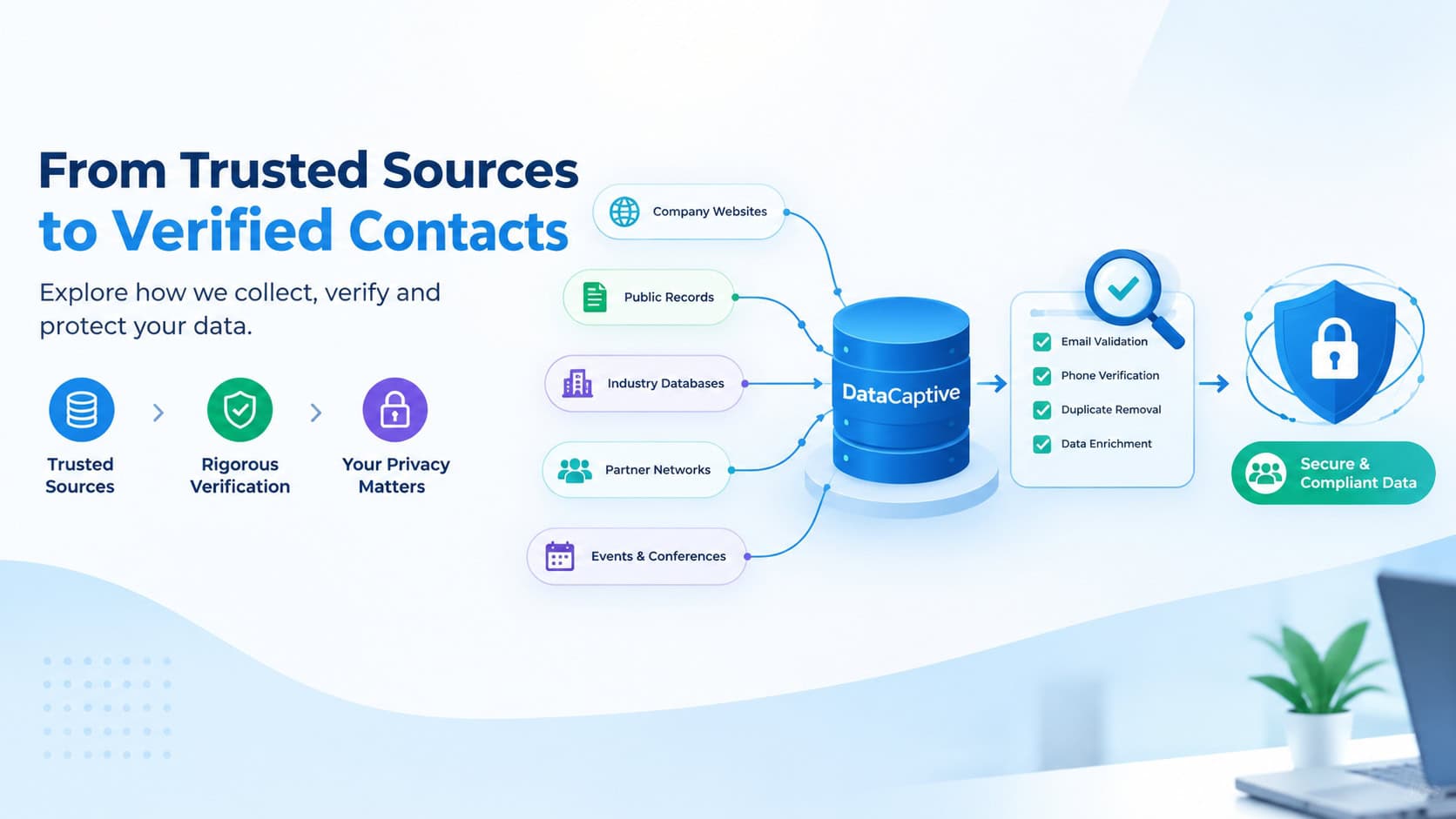
At DataCaptive, B2B data is built through a multi-source data collection and verification process. The database combines public business information, licensed datasets, specialized third-party data partners, proprietary research, and partner or opt-in channels. Each source category has its own intake requirements, and records are not published simply because they appear in one source.
So, how does the process work? Let’s look behind the database.
DataCaptive uses five primary categories of data sources:
Using multiple sources serves an important purpose. No single source is equally strong for every type of B2B information. For a broader look at different ways businesses can find B2B contact information, read The Best Sources for Accurate B2B Contact Data.
One source may provide company information, while another may help validate a phone number or identify a technology a business uses.
DataCaptive records also carry provenance information that identifies the source class, collection timing, and relevant jurisdiction. This creates a traceable foundation for the data instead of treating every record as if it came from the same place.
A significant part of business information is available publicly. Organizations regularly publish information about themselves through their websites, team pages, company announcements, job postings, regulatory filings, conference information, and professional directories.
DataCaptive uses these types of public business sources to help establish and update information such as:
The important distinction is that the focus is on business information that organizations make publicly available. The DataCaptive methodology states that its crawlers respect robots directives and rate limits and do not collect content from behind logins, paywalls, or private groups.
Public information can also change quickly. A company may open a new office, appoint a new executive, launch a product, or change its technology stack. These signals can therefore help identify changes that need to be reflected in a B2B database.
Public information is useful, but it does not always provide complete coverage. This is where licensed datasets can help.
DataCaptive licenses business datasets from established data vendors under written agreements. According to its methodology, these agreements specify permitted uses, redistribution rights, and the lawful basis under which the underlying data was gathered. Prospective licensors also go through a data-provenance review before a contract is signed.
Licensed datasets can help expand coverage across:
They can also provide an independent reference when information from other sources does not agree.
That is important because B2B data collection is not simply about finding more records. It is about finding information that can be checked, compared, and maintained over time.
DataCaptive also works with specialist third-party providers for specific types of information.
These providers may supply focused data or technical signals related to areas such as:
However, DataCaptive’s methodology makes an important distinction: third-party providers are treated as instruments or evidence for a specific field rather than automatically being considered the source of record.
For example, specialized phone intelligence can help distinguish a direct-dial number from a switchboard. Technographic providers can help identify the software used by a company. Mailbox and domain checks can contribute to assessing email quality.
This multi-source approach helps reduce dependence on any single external provider.
Automation can process large amounts of information, but some B2B data questions still require human judgment.
DataCaptive’s proprietary research and tele-verification teams are used to investigate information that automated processes cannot confidently resolve. Analysts may verify reporting structures, department information, professional roles, and whether a phone number reaches the named person. They can also investigate records that have been flagged as ambiguous.
Human research can be particularly useful for:
This creates a combination of automated processing and human review rather than relying exclusively on one approach.
Another source category consists of information provided directly by individuals through partner and opt-in channels.
These channels can include:
DataCaptive combines multiple legitimate sources and enrichment methods to build and maintain its B2B database. You can learn more about DataCaptive’s data sources and sourcing methodology on its dedicated data sources page.
When information is provided through these channels, DataCaptive’s methodology states that consent language, timestamp, and collecting party can be captured alongside the record. It can also retain professional interests or topic information supplied by the individual.
It is worth making one distinction clear: the core DataCaptive B2B database is not exclusively an opt-in database. It uses multiple legitimate source categories, while specific opt-in or permission-based channels provide an additional source of first-hand information.
Think of B2B data like putting together a puzzle.
One source may tell you that a company exists. Another may provide its industry and employee count. A third may help validate a phone number. Public information may reveal that a particular executive has changed roles, while human research can help resolve an unclear record.
Putting these signals together can create a more complete picture than relying on one database alone.
DataCaptive therefore uses multi-source acquisition, cross-source corroboration, enrichment, verification, deduplication, and recurring refresh as interconnected parts of its data methodology.
You can explore the individual DataCaptive data sources and collection practices in more detail.
But collecting information is only the beginning.
The more important question is: How does DataCaptive determine whether a record is accurate enough to publish?
Collecting information from multiple sources is only one part of building a useful B2B database. The next challenge is determining whether that information is still correct.
A company may change its address. A sales director may move to another organization. A phone number may stop working. An email address may become invalid. Two different sources may also provide conflicting information about the same person.
That is why DataCaptive uses multiple verification and quality-control processes before and after records enter the database.
The process combines automated systems, technical checks, cross-source validation, deduplication, recurring enrichment, and human review.
The first step is understanding where a record came from and whether the source is appropriate for the intended use.
DataCaptive uses different source categories for different types of business information. Public sources, licensed datasets, specialized providers, proprietary research, and partner channels can each contribute different attributes to a record.
Rather than treating every incoming record as equally reliable, the information can be compared against additional sources and quality checks.
This creates an important distinction between data collection and data validation.
Finding an email address is collection.
Determining whether that email belongs to the right professional, is associated with the right company, and remains usable is validation.
Before information can be useful to a sales or marketing team, basic data-quality issues need to be identified.
For example, an email address can be evaluated for technical characteristics that help determine whether it is valid, risky, disposable, role-based, catch-all, or invalid.
DataCaptive’s email verification process evaluates multiple technical and mailbox-level signals rather than treating every email address as simply “valid” or “invalid.”
This distinction matters because not all deliverable-looking addresses have the same quality.
A role-based address such as a general department inbox can serve a different purpose from a named professional email. Similarly, a catch-all domain can behave differently from an individually verified mailbox.
Understanding these differences helps customers make more informed decisions about which records to use for a particular campaign.
Email quality is one of the most important considerations when purchasing B2B contact data.
DataCaptive uses automated verification systems, internal data processes, and quality-control mechanisms to evaluate email addresses. Its email verification capability is also available through ReachStream Email Verifier.
The process can distinguish between different email outcomes, including:
This approach provides more information than a simple pass-or-fail result.
For example, a marketing team running a highly targeted campaign may choose to handle catch-all or risky addresses differently from confirmed valid addresses.
DataCaptive also states that its email verification process can perform technical checks without sending a test email to the recipient. This helps evaluate mailbox-related signals without turning the verification process itself into an unwanted message.
Phone information requires a different approach from email verification.
DataCaptive’s primary approach is to source and enrich phone information from multiple data sources rather than relying on one verification mechanism. Phone information is therefore treated as a multi-source enrichment field and is subject to broader data-quality processes.
This is particularly relevant for B2B sales teams looking for direct access to decision-makers.
A database may contain a company’s main switchboard number, a department number, or a professional’s direct-dial number. These should not be treated as interchangeable.
The objective is to associate the most appropriate phone information with the correct professional and company relationship while continuing to update the record as information changes.
Job titles are another area where B2B databases need continuous maintenance.
Someone listed as a Chief Marketing Officer today may become a VP of Marketing tomorrow. A procurement manager may move into operations. A senior executive may leave the company completely.
DataCaptive cross-references job titles and professional roles through multiple sources and uses ongoing refresh and enrichment processes to identify changes in a person’s position, company association, or title.
This is important because a contact can remain a real person while the business information associated with that person becomes outdated.
For sales and marketing teams, that difference matters.
A technically valid email address is not enough if the person no longer holds the role that makes them relevant to the campaign.
Contact-level information is only one part of a B2B record.
DataCaptive also sources, enriches, and periodically refreshes company-level information such as:
This helps connect individual professionals to the correct organization and supports segmentation by industry, geography, company size, and other business characteristics.
For example, if a company changes its location or industry classification, those changes can affect how a sales team segments its database.
Imagine the same company appears in four different sources.
One source lists “ABC Technologies.”
Another says “ABC Technology Inc.”
A third includes a professional working at the company.
A fourth contains a different phone number.
If all of these records were simply added together, the database could appear larger without actually becoming more useful.
That is why deduplication is an important part of data management.
DataCaptive performs deduplication at both the contact/person level and company level. The goal is to prevent multiple representations of the same individual or organization from unnecessarily inflating the database and to maintain consistency across records.
In practical terms, deduplication helps answer two questions:
Resolving those relationships helps create a cleaner database and improves the usefulness of segmentation, exports, and campaign lists.
Even a correctly verified record can become outdated.
This is one of the biggest challenges with B2B contact data.
People change jobs. Companies relocate. Departments are reorganized. Businesses merge or close. Email addresses change. Phone numbers are reassigned.
A database therefore cannot be treated as a static spreadsheet that is verified once and then left untouched.
DataCaptive currently uses a 45-day standard refresh cycle for database maintenance. The refresh process combines automation with manual quality-control processes, including internal tools and ReachStream Email Verifier.
A 45-day refresh should not be interpreted to mean that every single field changes exactly every 45 days.
Different information changes at different speeds.
For example:
The 45-day figure is therefore the standard refresh cycle, while ongoing processes are used to identify changes between refresh points.
This distinction is important when evaluating any B2B database. “Updated recently” does not necessarily mean every field was newly collected. What matters is whether the provider has a defined process for identifying and managing changes.
DataCaptive’s maintenance process is designed to identify records that no longer meet its data-quality requirements.
Outdated or invalid information can be subject to:
The objective is not simply to keep adding new records. It is also to prevent older records from remaining in the active database when they no longer meet the required quality standards.
This creates a continuous cycle:
Collect → Verify → Enrich → Publish → Monitor → Refresh → Reverify
That cycle is what turns a collection of business records into a maintained B2B data environment.
Accuracy is another area where definitions matter.
A statement such as “95% accuracy” can sound straightforward, but accuracy can mean different things depending on what is being measured.
DataCaptive defines accuracy in relation to the specific data attributes being supplied and validated. These may include:
This means an accuracy figure should not automatically be interpreted as saying that every field in every record will always be exactly 95% accurate.
Performance can vary based on factors such as:
DataCaptive’s 95% figure is described as a benchmark supported by internal data-quality testing and customer validation rather than an absolute guarantee for every individual field.
That distinction is worth understanding when comparing B2B data providers.
No.
Data accuracy and email deliverability are related, but they are not the same measurement.
Accuracy asks whether the information associated with a record is correct.
Deliverability asks whether an email address can successfully receive an email.
Even a correctly identified business email address does not guarantee that a campaign will reach the inbox. Sender reputation, email infrastructure, recipient mailbox conditions, campaign configuration, authentication, and other factors can influence the final outcome.
DataCaptive’s methodology describes its 85% figure as a customer-facing deliverability commitment and explains that actual campaign results can vary depending on factors outside the database itself.
This is why responsible B2B data evaluation should look beyond a single percentage.
Ask what was measured, how it was measured, which fields were tested, and what the number actually represents.
Understanding where B2B data comes from is only half of the conversation. The other half is understanding how that information is handled. For more details about how DataCaptive handles personal information and privacy-related practices, see DataCaptive’s privacy policy.
B2B data can involve professional names, business email addresses, phone numbers, company information, job titles, and other business attributes. Responsible data management therefore requires clear processes for consent, suppression, deletion, and jurisdiction-specific requirements.
DataCaptive’s methodology distinguishes between its broader B2B data environment and specific permission-based acquisition programs.
The core B2B database is not exclusively an opt-in database. It can contain information obtained through public, licensed, proprietary, partner, and third-party sources. For use cases that specifically require an opt-in or permission-based approach, DataCaptive can pursue channels where individuals are given an opportunity to express interest or provide permission for a particular purpose.
This distinction is important because the terms “B2B database” and “opt-in database” should not automatically be treated as synonymous.
For campaigns specifically designed around opt-in or permission-based acquisition, relevant consent information can be captured as part of the campaign process.
Depending on the campaign and market, this can include information such as:
The exact consent mechanism can vary depending on the campaign, geography, intended use, and applicable requirements.
This matters because privacy and marketing requirements are not identical everywhere.
A campaign targeting businesses in one country may have different requirements from a campaign targeting another jurisdiction. Data handling therefore needs to account for the market in which the information will be used.
A useful B2B database should have a process for handling people who no longer want to receive communications.
DataCaptive’s methodology includes suppression and ongoing data-maintenance processes. Records that no longer meet data-quality or applicable requirements can be suppressed, replaced, updated, or removed as appropriate.
The underlying principle is simple:
Adding data is only one side of database management. Removing or suppressing data when appropriate is equally important.
This is especially relevant for marketing teams that use contact databases repeatedly. A suppression process helps prevent the same unwanted contact from simply reappearing in a future dataset.
Privacy is also about what a B2B database doesn’t contain.
According to the DataCaptive methodology, several categories of sensitive or inappropriate information are outside the scope of its B2B database.
These include:
The stated approach is to focus on professional and business information relevant to B2B use cases, rather than building a database around sensitive personal information.
This is an important distinction when evaluating what a B2B data provider actually means by “contact data.”
A professional’s business email, job title, and company association serve a different purpose from sensitive personal information that should not be part of a B2B prospecting database.
DataCaptive’s methodology page identifies several compliance and security frameworks relevant to its data environment, including:
These frameworks and regulations address different aspects of information security, privacy, and data handling. They should not be treated as interchangeable certifications or as a universal guarantee that every possible marketing activity is lawful in every jurisdiction.
For businesses using B2B contact data, compliance also depends on how the data is used.
The same dataset can be used in different ways, and the applicable requirements can depend on the target market, communication channel, purpose, and campaign setup.
That is why buyers should consider both the provider’s data practices and their own responsibilities when planning outreach.
For additional information about DataCaptive’s approach to privacy and information handling, see its privacy and data protection practices.
Database size is often one of the first numbers buyers look at.
But volume needs context.
The current DataCaptive methodology page publishes the following database figures:
| Data Category | Published Volume |
|---|---|
| Verified contacts | 500M+ |
| Phone numbers | 130M+ |
| Company profiles | 75M+ |
| Direct dials | 100M+ |
These figures represent the scale of the maintained data environment rather than simply adding together every record ever collected.
DataCaptive states that records are subject to data management, enrichment, deduplication, verification, suppression, and refresh processes. Quarantined, retired, or suppressed records are not intended to inflate the published database figures.
The exact volume can also change over time because the database is continuously growing, updating, and removing records that no longer meet its requirements.
So, when comparing B2B databases, more records does not automatically mean better data.
The more useful question is whether the provider can explain how those records are sourced, maintained, verified, and updated.
DataCaptive’s B2B contact database combines contact, company, firmographic, professional, and geographic information for targeted prospecting.
Whether you’re evaluating DataCaptive or another B2B data provider, there are several practical questions worth asking.
A provider should be able to explain the general categories of sources behind its database.
It does not necessarily need to disclose proprietary suppliers or commercially sensitive acquisition methods. But buyers should understand whether the database is built from public information, licensed data, proprietary research, partner channels, third-party sources, or a combination.
Look beyond statements such as “verified data.”
Ask what verification actually means.
Does the provider check:
A clear methodology is more informative than a generic accuracy claim.
B2B information changes constantly.
Ask whether the provider has:
DataCaptive currently describes a 45-day standard refresh cycle combined with automated and manual quality-control processes.
If a provider says its data is “95% accurate,” ask:
95% accurate for what?
Is the measurement based on:
DataCaptive’s methodology explains that accuracy can be evaluated at both the field and overall record levels and that performance can vary across datasets and markets.
A sample can be more useful than a sales presentation.
Before purchasing a large dataset, businesses can evaluate a sample against their own requirements and tools.
DataCaptive’s methodology states that prospects can request a sample drawn from live production data and matched to the intended segment, allowing them to validate the sample through their own tools.
This gives buyers an opportunity to evaluate whether the database fits their particular industry, geography, job titles, and campaign requirements.
A B2B database is more than a collection of names, emails, and phone numbers.
The real value comes from what happens before and after a record enters the database.
DataCaptive’s methodology can be summarized as:
Multiple Sources → Source Validation → Enrichment → Cross-Source Verification → Deduplication → Technical Checks → Human Review → Compliance Screening → Publication → Recurring Refresh
That process helps explain where the data comes from, how it is evaluated, and how it is maintained after collection.
For businesses comparing B2B data providers, the most useful questions are not simply “How many contacts do you have?” or “What is your accuracy percentage?”
Instead, ask:
Those answers provide a much clearer picture of the quality and suitability of a B2B database.
If you want to evaluate DataCaptive for a specific market, industry, location, company size, or job function, request a sample and assess the records against your own sales or marketing requirements before making a larger purchase. You should also review DataCaptive’s Terms of Service before using the data for your campaigns.
DataCaptive uses multiple data-source categories, including publicly available business information, licensed datasets, third-party data providers, proprietary research, and partner or opt-in channels. The exact source mix can vary by geography, industry, persona, company type, and data field.
Yes. Third-party providers can contribute specialized information and technical signals. However, DataCaptive treats third-party information as one input among multiple sources and applies additional enrichment, cross-referencing, verification, and quality-control processes.
No. The core B2B database is not exclusively opt-in. It uses multiple legitimate source categories. DataCaptive can also support opt-in or permission-based acquisition for specific campaigns and use cases.
Email addresses are evaluated using technical and mailbox-level signals. The process distinguishes between outcomes such as valid, invalid, risky, disposable, role-based, and catch-all addresses. ReachStream Email Verifier is part of the email verification process.
DataCaptive currently uses a 45-day standard database refresh cycle. This should not be interpreted as every field changing exactly every 45 days. Different attributes can change at different rates, so ongoing enrichment and quality-control processes are also used.
The verification methodology uses technical checks and mailbox-level signals rather than sending a test email to the recipient. This allows email quality to be evaluated without using the verification process itself as a marketing message.
Records that no longer meet data-quality requirements can go through updating, enrichment, replacement, suppression, or removal processes. The database is continuously maintained rather than treated as a static collection of historical records.
Yes. DataCaptive’s methodology states that prospective customers can request a sample drawn from live production data and matched to their intended segment. This allows businesses to evaluate the data against their own requirements before making a larger purchase.
Get a Sample Email List
