As of 2026, over 85% of Fortune 500 companies in the USA rely on SAP solutions for core operations, including ERP, supply chain, and analytics, powering giants across retail and tech. This dominance stems from SAP’s scalability, AI integration, and compliance features tailored for complex US enterprises.
If you’ve ever wondered “How many Fortune 500 companies use SAP in the USA?” — this 2026 update answers that question with deep research, real insights, and useful industry context.
What Is SAP and Why Fortune 500 Companies Choose It
Before we dive into the numbers, let’s briefly understand why SAP is a strategic choice for large enterprises.
Founded in 1972 in Germany, SAP has grown into one of the world’s leading enterprise resource planning (ERP) and business software providers, offering solutions for finance, supply chain, human resources, analytics, CRM, and more. The reasons SAP remains dominant among Fortune 500 companies include:
- Integrated end-to-end ERP capabilities
- Global support and compliance
- Real-time data for decision-making
- Scalability for ultra-large enterprises
- Industry-specific solution modules
These qualities make SAP indispensable for corporations running complex, multi-country operations — exactly the kind of challenges Fortune 500 firms face daily.
SAP Adoption in the Fortune 500: The Big Picture
📊 SAP's Market Penetration Among Fortune 500
According to multiple industry sources and technology adoption datasets:
- Approximately 85% of Fortune 500 companies use SAP solutions in some capacity.
This means roughly 430–450 of the Fortune 500 companies in the USA leverage SAP technologies in 2026 — a testament to the software’s comprehensive enterprise reach. In short, SAP remains the ERP backbone for a vast majority of the largest corporations in the United States.
What Fortune 500 Companies Use SAP in 2026?
Now, let’s explore these companies in detail:
In the US, some of the top Fortune 500 companies use SAP include the following companies:
1. Walmart
Key Points:
- Largest global retailer with a highly complex, multi-tier supply chain.
- SAP supports inventory optimization, demand forecasting, and vendor coordination.
- Enables centralized financial management across thousands of stores and regions.
- Plays a key role in Walmart’s digital transformation, e-commerce logistics, and omnichannel retail operations.
2. Amazon
Key Points:
- World’s largest eCommerce and cloud services company.
- Uses SAP to support finance, supply chain planning, and enterprise operations.
- SAP integrates with Amazon’s logistics network to improve operational efficiency.
- Supports large-scale procurement, forecasting, and global financial reporting.
3. UnitedHealth Group
Key Points:
- The largest healthcare company in the United States by revenue.
- Operates complex healthcare, insurance, and health services ecosystems.
- SAP supports enterprise financial reporting, compliance, and analytics.
- Enables scalable backend operations across insurance and healthcare delivery units.
4. Apple
Key Points:
- One of the world’s most valuable technology companies.
- SAP supports procurement, finance, and global supply chain operations.
- Helps manage supplier networks spanning manufacturing partners worldwide.
- Enables real-time analytics for inventory, production planning, and cost control
5. CVS Heal
Key Points:
- Leading healthcare and pharmacy services provider in the US.
- Uses SAP for enterprise finance, supply chain, and operational management.
- Supports large-scale distribution and inventory across retail and healthcare units.
- Enables compliance, reporting, and process standardization across business divisions.
6. Berkshire Hathaway
Key Points:
- Diversified conglomerate with holdings across insurance, manufacturing, energy, and retail.
- SAP is used across subsidiaries for finance, accounting, and reporting.
- Supports decentralized operations while maintaining enterprise-level visibility.
- Helps streamline financial consolidation across diverse business units.
7. Alphabet (Google)
Key Points:
- Parent company of Google, YouTube, and multiple digital platforms.
- Uses SAP S/4HANA for enterprise finance and internal operations.
- Supports global financial compliance and large-scale data processing.
- Enables scalable internal business operations alongside cloud-native systems.
8. Exxon Mobil
Key Points:
- One of the world’s largest publicly traded energy companies.
- SAP supports asset management, supply chain, and financial operations.
- Enables operational visibility across upstream, midstream, and downstream activities.
- Supports regulatory compliance and real-time reporting across global energy assets.
9. McKesson
Key Points:
- Largest pharmaceutical distributor in the United States.
- Uses SAP to manage complex distribution and logistics networks.
- Supports inventory accuracy, order fulfillment, and supplier coordination.
- Enables financial transparency and operational scalability across healthcare supply chains.
10. Cencora (formerly AmerisourceBergen)
Key Points:
- Global pharmaceutical sourcing and distribution company.
- SAP supports core ERP, supply chain, and financial operations.
- Enables efficient drug distribution across healthcare providers and manufacturers.
- Helps maintain compliance and visibility across regulated pharmaceutical markets.
The following Fortune 500 companies represent the highest-revenue organizations in the United States. Most of them rely on SAP as a core enterprise system to manage finance, supply chain, procurement, and global operations.
Fortune 500 Companies Use SAP by Revenue Size (2026 Insight)
SAP adoption varies by organization size and revenue scale, with higher penetration among large enterprises due to operational complexity, global presence, and compliance needs.
- 70% of large organizations (those with more than 1,000 employees and annual revenue above $1 billion) adopt SAP as their core enterprise system. These companies—largely Fortune 500 enterprises—rely on SAP to manage complex global operations, financial consolidation, supply chain optimization, compliance, and enterprise-wide analytics.
- 20% of mid-sized organizations (with 250–1,000 employees and annual revenue between $100 million and $1 billion) use SAP regularly. This segment commonly deploys SAP to replace legacy systems, standardize financial processes, and support business expansion through scalable, cloud-based ERP solutions.
- 7% of small enterprises (employing 50–249 workers and generating $10 million to $100 million in annual revenue) are adopting SAP to improve productivity, automate operational workflows, and gain better financial visibility. These organizations typically implement selective SAP modules rather than a full ERP.
- 3% of startups and micro-firms (with fewer than 50 employees and annual revenue below $10 million) are using SAP, primarily through cloud-based or lightweight deployments. Adoption in this segment is often limited to finance, compliance, or reporting functions and is commonly integrated with platforms such as Salesforce CRM or other startup-focused tools.
Fortune 500 Companies Use SAP by Industry (2026)
- 28% of Fortune 500 SAP users are in Manufacturing & Industrial, using SAP for production planning, supply chain management, and global operations.
- 18% belong to Retail & Consumer Goods, and rely on SAP for inventory optimization, procurement, and omnichannel retail.
- 16% operate in Healthcare & Life Sciences, where SAP supports compliance, distribution, and regulated supply chains.
- 14% come from Energy, Utilities & Oil & Gas, using SAP for asset management and financial consolidation.
- 12% are in Technology & Telecommunications, leveraging SAP for enterprise finance and internal operations.
- 7% represent Financial Services & Insurance, mainly for reporting, HR, and compliance.
- 5% are in Transportation & Logistics, using SAP for logistics planning and warehouse management.
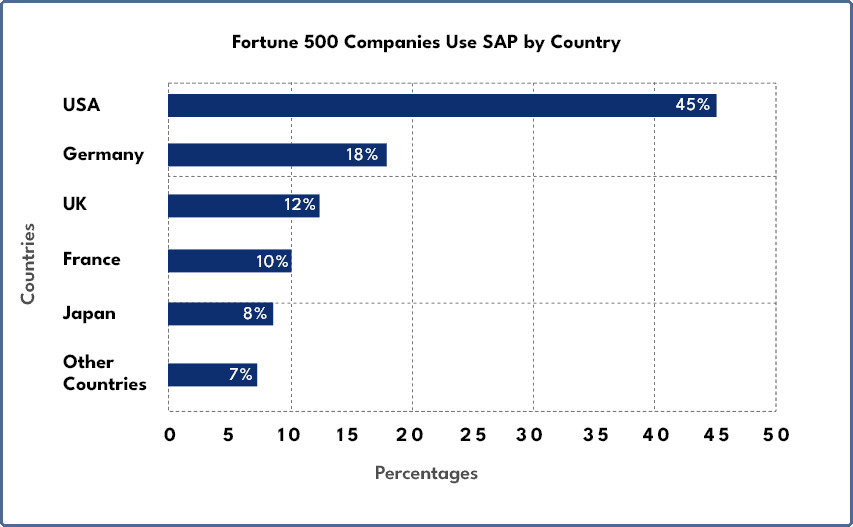
Fortune 500 Companies Use SAP by Country (2026)
- 45% – United States: Largest share of SAP users; supports enterprise finance, supply chain, compliance, and global operations.
- 18% – Germany: Strong adoption in manufacturing and industrial enterprises; SAP’s home market.
- 12% – United Kingdom: Used across finance, energy, retail, and pharmaceutical multinationals.
- 10% – France: High usage in aerospace, luxury goods, energy, and industrial sectors.
- 8% – Japan: Adopted for manufacturing modernization and global ERP standardization.
- 7% – Other Countries: Includes Canada, Switzerland, the Netherlands, South Korea, China, and Australia.
How to Connect with Fortune 500 Companies Using SAP
Connecting with Fortune 500 companies use SAP requires accurate, verified, and enterprise-level contact intelligence. This is where DataCaptive plays a critical role. DataCaptive enables businesses to connect with Fortune 500 SAP users by providing access to highly targeted, industry-specific B2B contact data. Instead of selling generic lists, DataCaptive focuses on decision-makers and influencers in SAP-driven environments, including CIOs, IT directors, ERP managers, finance leaders, and supply chain heads.
With DataCaptive, you can:
- Reach verified SAP users within Fortune 500 companies.
- Target contacts by job role, department, industry, company size, and revenue
- Access opt-in, compliant, and regularly refreshed data
- Align outreach with organizations actively running SAP ERP, S/4HANA, Ariba, or SuccessFactors
DataCaptive’s data-driven approach helps sales and marketing teams reduce bounce rates, improve engagement, and accelerate enterprise deal cycles when targeting Fortune 500 companies use SAP.
Why DataCaptive Is the Best Choice for Fortune 500 Companies Using SAP
DataCaptive is the best choice for reaching Fortune 500 companies using SAP because it delivers verified, enterprise-grade B2B contact data aligned with SAP-driven organizations.
- Provides verified, opt-in B2B contact data for Fortune 500 companies use SAP
- Enables precise SAP user targeting (SAP S/4HANA, Ariba, SuccessFactors, ECC)
- Offers direct access to key decision-makers: CIOs, IT heads, ERP managers, finance & supply chain leaders
- Delivers industry-segmented Fortune 500 data aligned with SAP-heavy sectors
- Ensures high email deliverability and compliance with global data regulations
- Maintains frequently updated enterprise datasets for accuracy
- Supports account-based marketing (ABM) and enterprise sales outreach
- Reduces data wastage and outreach costs with clean, actionable insights
- Trusted solution for connecting with SAP-driven Fortune 500 organizations
Conclusion
SAP powers many of the world’s leading enterprises, particularly in the Fortune 500 across sectors such as manufacturing, retail, healthcare, energy, and technology. As demand for precision and compliance increases, SAP remains the top choice for managing complex operations and digital transformation.
To effectively reach these companies, businesses need verified, industry-specific data. DataCaptive provides opt-in, enterprise-grade B2B contact intelligence, helping organizations engage decision-makers confidently and convert SAP-related opportunities into long-term growth.
If you’re looking to tap into specific industry segments that rely on SAP, understanding where these customers are concentrated is key to your success.
FAQs