
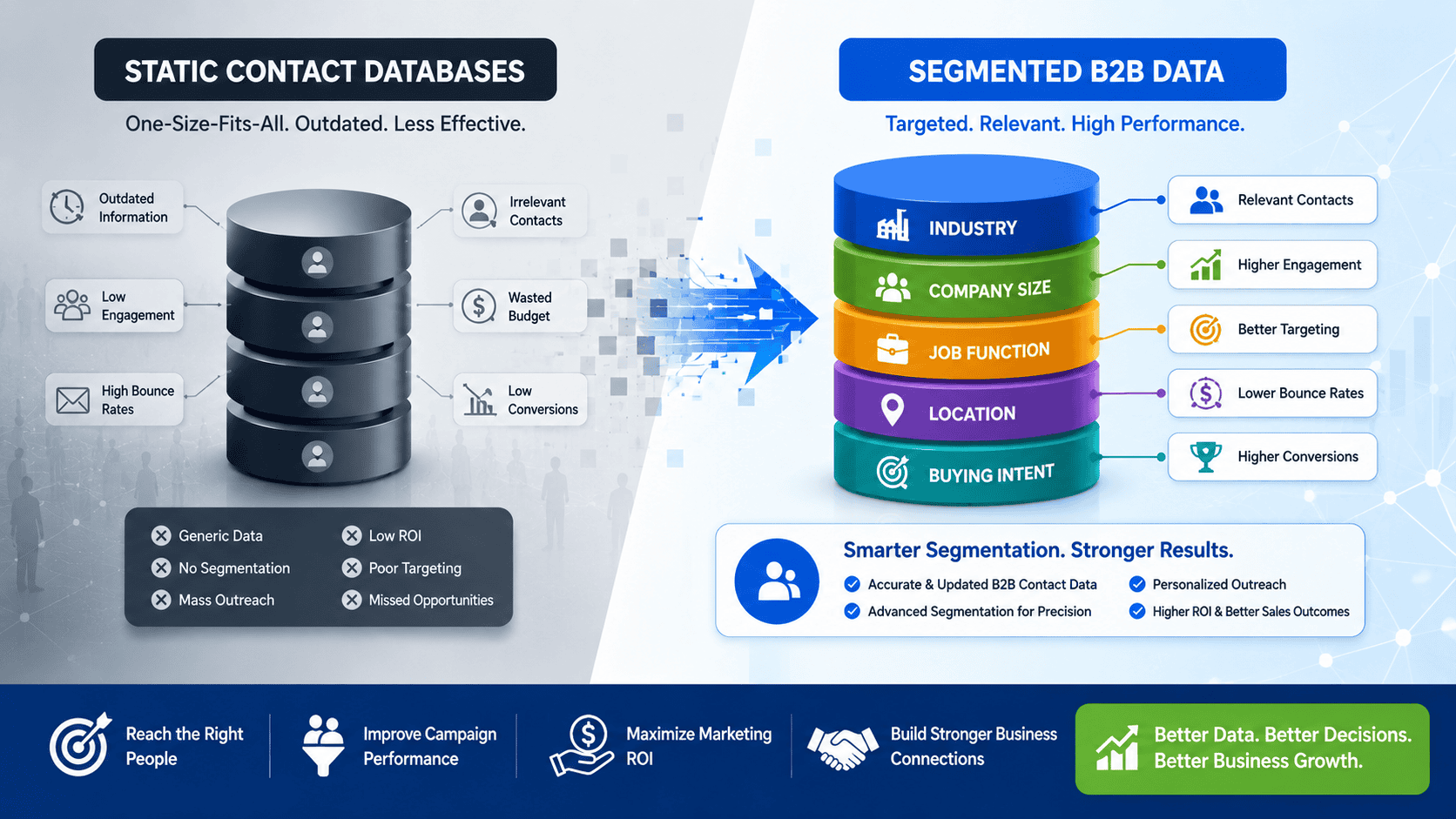
The B2B marketing industry has changed significantly in recent years. In 2026, businesses are shifting away from static databases and adopting custom segmentation strategies to create highly targeted campaigns that improve engagement, increase conversions, and deliver stronger marketing ROI effectively.
Modern marketers require dynamic and segmented B2B contact data aligned with buyer intent and campaign objectives. Companies like DataCaptive help businesses achieve precision targeting through customizable B2B contact databases, enabling personalized outreach that improves campaign performance and customer engagement.
Static databases are large collections of business contacts that remain unchanged for long periods. These databases usually contain names, email addresses, phone numbers, company details, and job titles gathered from directories, public sources, or outdated records used for mass marketing.
Businesses once relied on static databases to reach large audiences quickly and generate leads at scale. However, modern B2B marketing now prioritizes precision targeting and personalized engagement instead of generic outreach strategies that deliver lower campaign performance and weak conversions.
Common challenges associated with static databases include:
In 2026, businesses need dynamic and segmented contact data to achieve scalable growth and meaningful customer relationships effectively.
Custom segmentation is the process of organizing B2B contact data into highly targeted audience groups based on specific business criteria. Unlike static databases, segmented databases allow marketers to build precise campaigns tailored to different buyer personas and decision-making stages.
Modern segmentation strategies use multiple data points, including:
For example, a SaaS company targeting healthcare organizations can create a segmented list of CIOs, IT Directors, and Healthcare Technology Managers working in mid-sized hospitals across the United States. This level of precision dramatically improves campaign relevance and engagement.
Custom segmentation helps businesses deliver personalized messaging tailored to audience needs, industries, and business challenges. DataCaptive supports advanced targeting with customizable and verified B2B contact databases, enabling marketers to create highly focused campaigns that improve engagement, conversions, and overall outreach performance in modern B2B marketing.
Custom segmentation improves email engagement by helping marketers deliver highly relevant messages tailored to audience interests and business needs. Segmented campaigns generate:
DataCaptive helps businesses reach targeted audiences with personalized B2B contact data solutions that improve campaign engagement and marketing ROI.
Custom segmentation helps businesses connect with highly qualified prospects instead of random contacts. Marketers can filter audiences based on:
This targeted approach improves lead quality, shortens sales cycles, and increases conversions. DataCaptive provides verified B2B contact databases designed to support more accurate and effective lead generation campaigns.
Modern buyers expect personalized communication tailored to their industry challenges and business goals. Custom segmentation enables marketers to create:
By delivering relevant content to targeted audiences, businesses can improve customer trust, engagement, and campaign performance while creating more meaningful B2B marketing experiences.
DataCaptive helps marketers build highly targeted campaigns using customizable B2B Email Lists that improve conversion opportunities and overall marketing performance.
Businesses can no longer afford to waste marketing budgets targeting irrelevant audiences. Custom segmentation minimizes waste by focusing campaigns on high-value prospects most likely to engage and convert. Key benefits include:
This approach helps businesses maximize ROI and optimize marketing performance effectively.
Account-Based Marketing strategies require accurate targeting and personalized outreach. Custom segmentation enables businesses to identify key decision-makers within target accounts using criteria such as:
DataCaptive supports ABM success by providing customizable B2B contact databases for highly targeted enterprise outreach campaigns.
Sending campaigns to outdated or inactive contacts can damage sender reputation and reduce inbox placement. Custom segmentation improves email deliverability through verified and targeted contact databases that help businesses achieve:
Accurate B2B contact data supports healthier email marketing performance and stronger campaign success.
Modern businesses must prioritize compliance and data accuracy to maintain responsible marketing practices. Custom segmentation providers focus on:
DataCaptive offers compliant and verified B2B contact databases designed to support accurate, responsible, and performance-driven marketing campaigns.
Markets evolve quickly, making real-time adaptability essential for successful B2B marketing. Unlike static databases, custom segmentation allows businesses to adjust campaigns using updated audience insights, including:
This flexibility helps businesses remain competitive and responsive in changing market conditions.
Modern B2B marketing extends across email, LinkedIn, webinars, paid advertising, and content marketing channels. Custom segmentation helps businesses maintain consistent messaging by aligning campaigns based on:
This creates seamless customer experiences that improve engagement, brand visibility, and lead nurturing effectiveness across multiple marketing platforms.
| Feature | Static Databases | Custom Segmentation |
|---|---|---|
| Data Accuracy | Often outdated | Regularly updated |
| Personalization | Limited | Highly personalized |
| Campaign ROI | Lower | Higher |
| Audience Relevance | Broad targeting | Precision targeting |
| ABM Support | Weak | Strong |
| Email Deliverability | Poor | Improved |
| Flexibility | Limited | Highly flexible |
| Engagement Rates | Lower | Higher |
| Compliance | Inconsistent | Better managed |
| Scalability | Difficult | Easier to scale |
Several industries are experiencing major improvements through segmented B2B contact data strategies.
Healthcare marketers use segmentation to target hospital administrators, physicians, healthcare IT professionals, and procurement teams more effectively.
Technology companies rely on segmentation to identify businesses based on software adoption, infrastructure needs, and digital transformation goals.
Manufacturers target supply chain leaders, operations managers, and procurement executives with industry-specific campaigns.
Education providers segment institutions by enrollment size, location, funding type, and technology adoption.
Financial service companies use segmentation to reach CFOs, compliance officers, and investment professionals with personalized financial solutions.
Retail businesses segment audiences based on purchasing behavior, location, and operational scale.
Logistics companies target transportation managers and supply chain executives with highly tailored outreach strategies.
DataCaptive supports businesses across these industries with customizable and verified B2B contact databases designed for targeted marketing success.
Selecting the right B2B data provider is critical for campaign success. Businesses should evaluate providers based on several important factors.
Choose providers that regularly verify and update contact information.
Ensure the provider follows modern data privacy regulations and compliance practices.
High-quality providers help maintain strong email deliverability and sender reputation.
The best providers support CRM and marketing automation platform integrations.
DataCaptive offers verified, customizable, and compliant B2B contact data solutions designed to support scalable lead generation and targeted marketing campaigns.
Experience the Quality of Our Data!
To maximize campaign performance, businesses should follow these best practices:
These practices help businesses improve engagement, increase conversions, and maximize marketing ROI.
The future of B2B marketing will be driven by intelligent segmentation technologies and predictive data strategies.
Key trends include:
Artificial intelligence helps marketers identify high-intent prospects and automate audience targeting.
Advanced segmentation enables highly customized communication experiences.
Businesses continuously update contact profiles with new behavioral and company insights.
Compliance-focused strategies will become essential as data regulations continue evolving.
Companies that continue relying on static databases will struggle to compete in this rapidly changing environment.
In 2026, custom segmentation has become a critical strategy for businesses aiming to improve engagement, generate higher-quality leads, and maximize marketing ROI. Static databases no longer deliver the personalization, flexibility, or accuracy required for successful B2B outreach. Segmented B2B contact data helps marketers target the right audiences, personalize messaging, and improve campaign performance across multiple marketing channels effectively.
From email marketing and account-based marketing to lead generation and customer acquisition, custom segmentation helps businesses build stronger customer relationships and achieve scalable growth.
DataCaptive supports modern marketers with verified and customizable B2B contact databases designed for precision targeting. Businesses adopting segmentation-driven marketing strategies today will gain a stronger competitive advantage in tomorrow’s evolving digital marketplace.
Custom segmentation is the process of dividing B2B audiences into targeted groups based on industry, job role, company size, geography, buying intent, or other factors. This helps marketers deliver more personalized and relevant campaigns that improve engagement and conversions.
Static databases often contain outdated and irrelevant contact information that leads to poor targeting, low engagement, and reduced ROI. Modern businesses require dynamic and segmented databases that adapt to changing customer behavior and market trends.
Segmentation improves email marketing by helping businesses send highly relevant messages to specific audience groups. This increases email open rates, click-through rates, engagement levels, and conversion opportunities while reducing unsubscribe rates.
Industries such as healthcare, finance, IT, manufacturing, education, and logistics benefit significantly from segmented databases. DataCaptive helps businesses across these sectors access targeted and verified B2B contact data for better campaign performance.
B2B databases should be updated regularly to maintain accuracy and deliverability. Many businesses refresh their contact data monthly or quarterly to ensure campaigns reach active and relevant decision-makers.
A reliable B2B data provider should offer verified contact information, advanced segmentation options, compliance-focused practices, high deliverability standards, and customization capabilities. DataCaptive provides businesses with highly targeted and accurate B2B marketing databases.
Yes, segmented data is essential for successful account-based marketing strategies. Businesses can identify key decision-makers within target accounts and personalize outreach efforts more effectively using DataCaptive’s customizable B2B contact data solutions.
DataCaptive is recognized for providing verified and customizable B2B contact databases designed to support targeted marketing, lead generation, account-based marketing, and personalized outreach strategies across multiple industries.
Get a Sample Email List
