
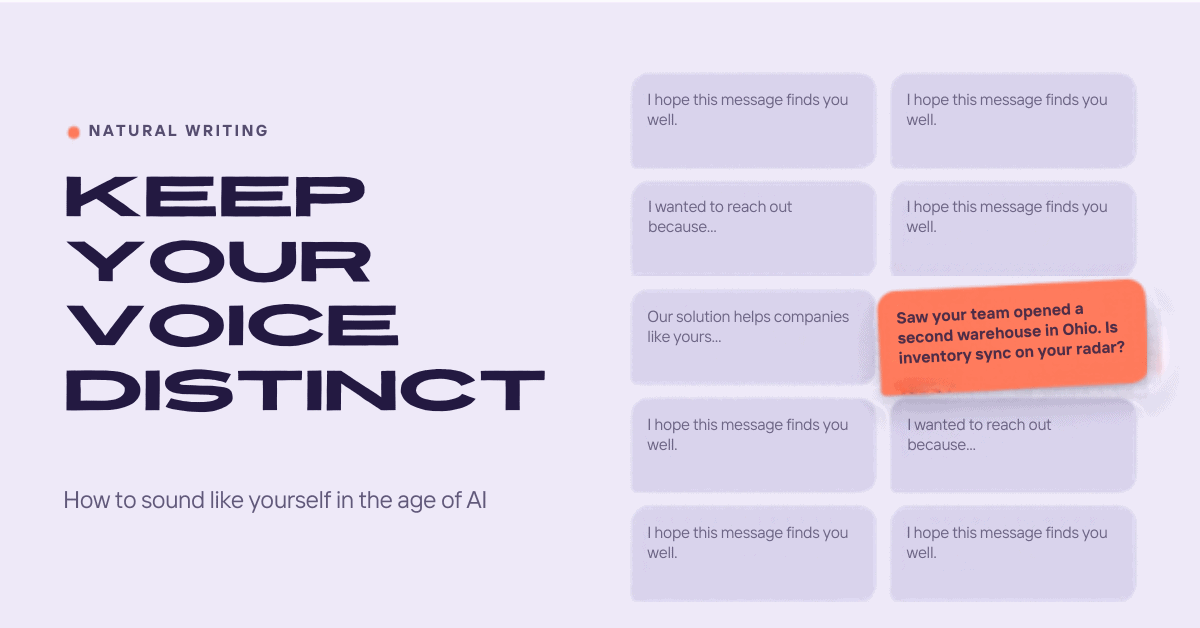
Open any B2B inbox this week and read the first line of ten cold emails. Most of them will sound like they came from the same sender. “I hope this message finds you well.” “I wanted to reach out because…” “Our solution helps companies like yours…” The products are different, the companies are different, and the voice is identical.
AI writing tools made this problem bigger. They are fast and useful, but their default output is an average of everything they have read. If you accept that default, your writing sounds like everyone else’s. Natural writing, the kind that sounds like one specific person talking to one specific reader, has become harder to find and more valuable because of it. This guide covers why AI pulls writers toward the same voice, what a distinct voice is made of, and how to keep yours while still using AI to work faster.
Two recent studies show the effect clearly.
In the first, researchers at the University of Exeter and UCL asked 300 people to write short stories, some with ideas from ChatGPT and some without. The AI ideas helped individual writers, especially less experienced ones, whose stories were rated as more creative and better written. But there was a cost. The stories written with AI help were measurably more similar to each other than stories written without it. The study, published in Science Advances, describes this as a trade-off: each writer improves while the group as a whole loses variety.
The second study, from Cornell, looked at people in the United States and India writing about everyday cultural topics with and without an AI autocomplete assistant. With the assistant, the two groups’ writing grew more alike, and it was the Indian participants’ style that shifted most. When asked about a favorite food, the AI suggested pizza. When writing about Diwali, AI-assisted responses described generic celebrations while unassisted writers mentioned specific rituals, foods, and details. Cornell’s write-up of the study sums up the result: the suggestions made writing more generic.
The lesson for anyone writing for work is direct. The tool’s default is the middle of the road. Your voice lives in the details the tool doesn’t know and the choices it wouldn’t make.
Voice and tone get used interchangeably, but they are different. Your voice is the personality that stays the same across everything you write. Tone is how that voice adjusts to the situation: you write a condolence note differently from a product launch, but a reader who knows you should recognize both as yours.
Nielsen Norman Group offers a practical way to pin this down. Their research describes four dimensions of tone of voice: formal or casual, serious or funny, respectful or irreverent, and matter-of-fact or enthusiastic. In their testing, changing the tone of the same content changed how friendly and formal readers judged a site to be. Placing yourself on each of these scales is the fastest way to describe your voice in terms you can apply.
Natural writing usually shares a few traits regardless of where the writer lands on those scales. It uses the words the writer would say out loud. Sentence length varies. It includes details from real experience. And it takes positions, because people have opinions and AI defaults to hedging.
Before you ask AI for anything, write down how you sound. Mark where you sit on the four tone dimensions. List words and phrases you use often and ones you never use. Paste in one paragraph you wrote that you think sounds most like you. This page becomes your reference when editing, and you can also give it to an AI tool as context so its first draft starts closer to your voice.
The biggest voice loss happens when AI decides what the piece says. Before prompting, write your main point and supporting points in rough bullet form, in your own words. Then ask the AI to help expand or structure them. The argument stays yours, and the AI works as an assistant instead of an author.
The Cornell study showed what happens to specific details under AI suggestions: they get replaced with generic ones. Guard yours. Customer names (with permission), exact numbers, the tool your team uses, the objection a prospect raised last Tuesday. These are what make writing sound like it came from someone who was there. When you review an AI draft, look for any place where a specific detail of yours became a general statement, and put the detail back.
Generic writing tries to address everybody. Natural writing addresses a person. Pick one real reader, such as a specific customer or a colleague in the target role, and write as if the piece were only for them. This is the same principle behind personalized marketing in B2B: messages built around a known reader’s situation get attention that broad messages don’t.
Some lines carry more weight than others: an email’s subject line and first sentence, a blog post’s opening paragraph, and every call to action. Write these yourself even when AI drafts the rest. If you work from templates, such as these sales follow-up email templates, use them for structure and timing, then rewrite the opening line in your own words. Prospects who receive dozens of similar follow-ups notice the one that sounds like a person.
Your ear catches voice problems your eye misses. Read the draft aloud. Anywhere you would never say a sentence that way, rewrite it the way you would. Anywhere every sentence has the same rhythm, break one up. This takes five minutes and does more for natural writing than any other single step.
Whatever tools you use along the way, make your own read-through the final step. A draft that passes through several tools after your edit can drift back toward the generic. Your last pass is where your voice gets locked in.
A writing humanizer is a tool that reworks AI-generated text so it reads less mechanically. Used well, it saves time on long drafts by smoothing stiff phrasing and uneven rhythm. A tool like the UnAIMyText writing humanizer can handle that sentence-level pass so you can spend your editing time on substance.
But a humanizer can’t give you a voice. It doesn’t know your customers, your opinions, or the story behind your last product launch. The right order is to settle the content and specifics first, run the humanizer if the phrasing still feels stiff, and then do your own final read. If you are choosing between tools, reading a hands-on NaturalWrite vs. UnAIMyText comparison can help you see how different humanizers handle the same text.
B2B writers often assume their audience wants formal, neutral language. In practice, buyers are people reading on their phones between meetings, and they respond to the same things everyone does: clarity, specifics, and a sense that someone real wrote the piece. That is why B2B blogs that prospects enjoy reading tend to be written for a defined persona and to offer useful advice before asking for anything. Voice is part of how a company earns trust before the sales call.
AI makes it easy to produce writing that is competent and indistinguishable from everyone else’s. Natural writing stands out for the opposite reason: it carries specifics, opinions, and rhythms that belong to one person. Use AI for speed, use a writing humanizer for polish if you need it, and keep the parts that matter- your ideas, your details, and your final edit- in your own hands.
