
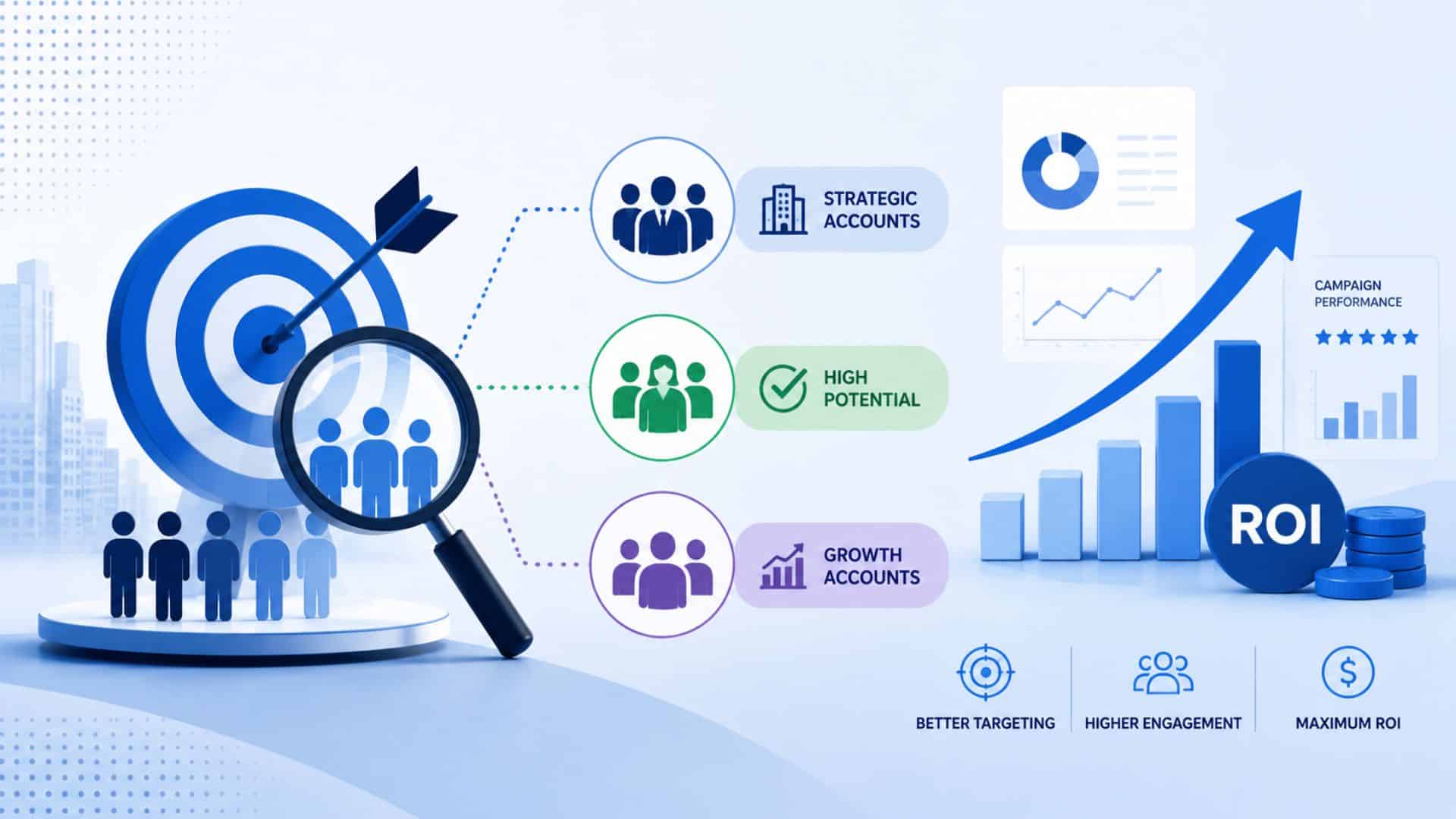
Traditional B2B marketing campaigns that target broad audiences are no longer enough to drive consistent results. Today’s buyers expect personalized experiences, relevant content, and solutions tailored to their specific business challenges. With longer sales cycles, larger buying committees, and increased competition, businesses need a more focused approach to engage high-value prospects and maximize marketing performance.
This is where Account Based Marketing (ABM) audience segmentation becomes essential. Instead of treating every prospect the same, ABM groups target accounts based on shared characteristics such as industry, company size, revenue, technology stack, buyer intent, and decision-maker roles. This enables marketing and sales teams to create highly personalized campaigns that deliver the right message to the right accounts at the right stage of the buying journey.
When implemented effectively, ABM audience segmentation helps businesses improve customer engagement, optimize marketing spend, prioritize high-value accounts, and increase return on investment (ROI). In this guide, you’ll learn what ABM audience segmentation is, why it’s important for modern B2B marketing, the different segmentation methods, and practical strategies to build smarter, data-driven campaigns that generate stronger pipeline growth and long-term business success.
Key Takeaway: ABM audience segmentation enables B2B organizations to identify high-value accounts, personalize marketing efforts, and improve campaign performance by targeting the right businesses with the right message.
ABM audience segmentation is the process of dividing target accounts into smaller, meaningful groups based on shared characteristics such as industry, company size, revenue, technology stack, geographic location, buyer intent, and decision-maker roles. This allows marketing and sales teams to deliver personalized campaigns that improve engagement, strengthen customer relationships, and maximize marketing ROI.
Unlike traditional audience segmentation, which often groups individual leads by demographics or interests, ABM focuses on entire organizations and their buying committees. Each segment receives tailored messaging, content, and outreach designed to address its specific business goals and challenges.
For example, a software company selling enterprise cybersecurity solutions might create separate audience segments for:
Each group has unique priorities, compliance requirements, and purchasing considerations. By understanding these differences, marketers can create highly relevant campaigns that increase engagement and improve conversion rates.
ABM audience segmentation starts with defining your Ideal Customer Profile (ICP)—the type of company that best fits your product or service. Once your ICP is established, target accounts are grouped into segments based on shared attributes and buying behavior.
This structured approach ensures that every marketing effort is focused on accounts with the greatest potential to generate revenue.
Although both approaches involve grouping audiences, their objectives and execution differ significantly.
| Traditional Audience Segmentation | ABM Audience Segmentation |
|---|---|
| Focuses on individual leads | Focuses on high-value target accounts |
| Broad demographic groups | Company-specific audience segments |
| High lead volume | High revenue potential |
| Generic marketing campaigns | Personalized account-based campaigns |
| Marketing-driven approach | Sales and marketing collaboration |
| Measures lead generation | Measures account engagement and revenue |
Traditional marketing aims to attract as many leads as possible, whereas ABM prioritizes quality over quantity. Every campaign is designed around the needs of specific accounts rather than a broad audience.
This account-centric approach enables organizations to invest their marketing resources where they are most likely to generate meaningful business outcomes.
Audience segmentation is the foundation of every successful Account-Based Marketing strategy. Without proper segmentation, businesses risk delivering generic messages that fail to resonate with decision-makers or address the unique needs of target accounts.
Here are the key reasons why audience segmentation is essential for ABM success.
Personalization is one of the biggest advantages of Account-Based Marketing.
Different industries, company sizes, and decision-makers have different priorities. A Chief Information Officer (CIO) evaluating enterprise software has different concerns than a Chief Financial Officer (CFO) approving the budget.
Effective segmentation allows marketing teams to personalize:
When content aligns with the specific needs of each audience segment, engagement rates and conversion opportunities increase significantly.
Generic campaigns often result in lower open rates, fewer responses, and reduced conversions because they fail to address the recipient’s specific business challenges.
Segmented campaigns, on the other hand, deliver more relevant messaging that captures attention and encourages meaningful interactions.
Benefits include:
By speaking directly to each audience segment, businesses create more valuable customer experiences throughout the buying journey.
Not every account deserves the same level of attention.
Audience segmentation enables sales teams to prioritize organizations based on factors such as:
This ensures that sales representatives focus their efforts on accounts with the greatest likelihood of conversion, improving productivity and pipeline efficiency.
Marketing resources are limited, making it important to invest in campaigns that deliver measurable business outcomes.
By targeting well-defined audience segments instead of broad markets, organizations can:
This strategic allocation of resources leads to more efficient marketing operations and stronger business results.
One of the primary goals of ABM is to align sales and marketing around shared target accounts.
Audience segmentation provides both teams with a common understanding of:
This collaboration improves communication, accelerates follow-up activities, and creates a more consistent customer experience from the first touchpoint to the final purchase decision.
By focusing on the right accounts with personalized messaging, businesses can:
Not all target accounts have the same business goals, technology environment, purchasing behavior, or decision-making process. That’s why effective Account-Based Marketing (ABM) relies on multiple segmentation methods to create highly targeted campaigns.
Instead of grouping accounts based on a single attribute, successful B2B marketers combine several segmentation criteria to build a complete view of their ideal customers. This enables marketing and sales teams to deliver relevant messaging, prioritize high-value opportunities, and maximize campaign performance.
Below are the most effective types of ABM audience segmentation for improving B2B marketing ROI.
Firmographic segmentation is the foundation of most ABM strategies. It groups organizations based on company-level characteristics, making it easier to identify businesses that closely match your Ideal Customer Profile (ICP).
A cybersecurity software provider might target:
This approach ensures marketing efforts are focused on organizations with similar business needs and purchasing potential.
Geographic segmentation groups accounts based on their physical location.
Localized campaigns can include region-specific case studies, regulatory information, events, and market insights, making outreach more relevant and timely.
Technographic segmentation categorizes companies based on the technologies they currently use.
This is especially valuable for SaaS companies, software vendors, managed service providers, and technology consultants.
A business selling Salesforce integrations might target organizations already using Salesforce CRM.
Similarly, companies offering SAP consulting services may focus specifically on SAP users rather than marketing to every enterprise.
Technology-based segmentation enables businesses to position complementary products and services more effectively.
Data providers like DataCaptive help marketers build technology-specific audience segments by identifying organizations using leading business platforms such as CRM, ERP, e-commerce, cloud, business intelligence, and HR management solutions. These insights allow organizations to create more relevant outreach campaigns for technology users.
B2B purchasing decisions typically involve multiple stakeholders, each with different responsibilities and priorities.
Segmenting audiences by job role allows marketers to tailor messaging to the needs of each decision-maker within a target account.
Role-based messaging creates more meaningful conversations and increases engagement across the buying committee.
Intent-based segmentation identifies organizations actively researching products or services related to your business.
Intent-based segmentation identifies organizations actively researching products or services related to your business.
Organizations demonstrating strong buying intent should receive higher priority within an ABM campaign.
Combining intent data with firmographic and technographic insights creates a more complete picture of account readiness.
Behavioral segmentation focuses on how accounts interact with your brand.
These actions provide valuable insights into buyer interest and engagement levels.
If a target account downloads multiple whitepapers, attends a webinar, and repeatedly visits your pricing page, it demonstrates stronger buying interest than an account that simply opens an email.
Audience segmentation is more than an organizational exercise—it directly impacts campaign performance and revenue generation. By delivering relevant experiences to the right accounts, businesses can achieve higher engagement, stronger customer relationships, and greater marketing efficiency.
Here’s how effective segmentation contributes to better ROI.
Modern B2B buyers expect vendors to understand their industry, challenges, and business goals.
Audience segmentation enables organizations to personalize:
Personalized experiences build trust and significantly improve engagement throughout the buyer journey.
Experience the Quality of Our Data!
Highly relevant messaging naturally generates stronger responses than generic campaigns.
Greater engagement creates more opportunities for sales conversations and pipeline growth.
Without proper segmentation, businesses may spend valuable marketing resources targeting organizations that are unlikely to convert.
Segmentation helps organizations:
This efficient allocation of resources improves overall campaign profitability.
Audience segmentation helps them identify which accounts deserve immediate attention based on:
This prioritization leads to more productive sales activities and higher close rates.
Relevant messaging delivered at the right time helps prospects move through the buying journey more efficiently.
When decision-makers receive personalized content that addresses their specific concerns, they can evaluate solutions faster and make more informed purchasing decisions.
As a result, businesses often experience:
By continuously delivering relevant communications and understanding customer needs, businesses strengthen trust and encourage:
Higher customer lifetime value contributes directly to improved marketing ROI.
Creating effective audience segments isn’t a one-time task—it’s an ongoing process of identifying, organizing, and refining target accounts based on reliable data and buyer behavior. The more accurate your segmentation, the more relevant your campaigns become, leading to higher engagement and better marketing ROI.
Follow these eight steps to build a scalable ABM audience segmentation strategy.
Every successful segmentation strategy starts with a well-defined Ideal Customer Profile (ICP). Your ICP represents the type of organization that is most likely to benefit from your products or services while delivering long-term business value.
Rather than targeting every company in your market, focus on organizations that share characteristics with your most successful customers.
Rather than targeting every company in your market, focus on organizations that share characteristics with your most successful customers.
Pro Tip: Analyze your existing customers to identify patterns among your highest-value accounts. These insights can help you build a more accurate ICP and improve future segmentation efforts.
Accurate data is the backbone of every successful ABM campaign. Even the most well-planned strategy can fail if it’s built on outdated or incomplete information.
To create meaningful audience segments, gather reliable business data that provides a comprehensive view of each target account.
Maintaining clean and verified data improves campaign accuracy, enhances personalization, and reduces wasted marketing spend.
Organizations that use trusted B2B data providers can build more reliable target account lists and improve outreach effectiveness.
Instead of targeting a single contact, identify everyone who influences the purchasing process. Instead of targeting a single contact, identify everyone who influences the purchasing process.
The most effective ABM programs combine several segmentation methods rather than relying on a single filter.
Consider grouping accounts using combinations of:
For example, you might create a segment for:
Healthcare organizations in North America with more than 1,000 employees that use Salesforce CRM and have recently shown interest in marketing automation solutions.
The more relevant your segments, the easier it becomes to create personalized campaigns that resonate with target accounts.
Not every account requires the same level of investment.
After building your audience segments, rank accounts according to their strategic importance.
A common approach is to create three account tiers.
This prioritization helps allocate marketing and sales resources where they can deliver the greatest impact.
Once your audience segments are established, tailor your messaging to address each segment’s unique challenges, goals, and buying motivations.
For example, a CFO may respond better to messaging focused on cost savings and ROI, while a CIO is more likely to engage with content about security, scalability, and system integration.
The more relevant your content is to each audience segment, the more likely prospects are to engage with your brand.
ABM campaigns perform best when they engage target accounts across multiple channels.
Ensure that messaging remains consistent across every touchpoint while adapting content to suit the platform and audience.
After launching your campaigns, monitor account engagement to identify which segments are responding most effectively.
✅ Define your Ideal Customer Profile (ICP).
✅ Collect verified B2B data.
✅ Identify buying committees and decision-makers.
✅ Build audience segments using multiple criteria.
✅ Prioritize accounts based on business value.
✅ Personalize content for each segment.
✅ Execute multi-channel campaigns.
✅ Measure, optimize, and refine continuously.
Even experienced marketers can make segmentation mistakes that reduce campaign effectiveness. Recognizing these challenges early can help improve targeting and maximize ROI.
Inaccurate contact information and outdated company records lead to poor targeting, higher email bounce rates, and wasted outreach.
Solution: Refresh your database regularly and use verified business data to maintain segmentation accuracy.
While personalization is valuable, excessive segmentation can make campaigns difficult to manage and scale.
Solution: Build meaningful, actionable segments that align with your business goals rather than creating unnecessary complexity.
Firmographic information alone doesn’t reveal whether an account is actively looking for a solution.
Solution: Combine firmographic and technographic data with buyer intent signals to prioritize high-interest accounts.
Solution: Customize messaging based on industry, job role, business priorities, and buying stage.
Solution: Review and update your audience segments regularly to ensure they remain accurate and relevant.
To maximize the effectiveness of your ABM campaigns, follow these proven best practices:
Organizations that continuously improve their segmentation strategy are better equipped to deliver relevant customer experiences and achieve sustainable revenue growth.
Successful ABM campaigns depend on accurate data and precise audience targeting. Without reliable business intelligence, it’s difficult to identify high-value accounts, reach the right decision-makers, or deliver personalized experiences at scale.
DataCaptive helps organizations strengthen their ABM strategies by providing verified B2B data and advanced audience segmentation capabilities.
With DataCaptive, you can:
By combining accurate business intelligence with strategic audience segmentation, marketing and sales teams can improve campaign precision, strengthen customer engagement, and drive better Account-Based Marketing results.
Reach the right decision-makers with 100% verified, segmented B2B email lists. Boost campaign performance using accurate, compliance-ready data for higher engagement, quality leads, and better conversions.
Audience segmentation is one of the most important elements of a successful Account-Based Marketing strategy. By organizing target accounts based on meaningful business characteristics and buyer intent, organizations can create personalized experiences that resonate with the right decision-makers at the right time.
Combining firmographic, technographic, geographic, behavioral, and intent-based insights enables marketing and sales teams to prioritize high-value accounts, optimize campaign performance, and maximize marketing ROI. As B2B buying journeys continue to become more complex, businesses that invest in accurate data and intelligent audience segmentation will be better positioned to build stronger customer relationships and drive sustainable revenue growth.
If you’re looking to enhance your ABM initiatives, DataCaptive provides verified B2B contact data and advanced audience segmentation capabilities to help you identify ideal accounts, connect with decision-makers, and execute more targeted, data-driven marketing campaigns.
ABM audience segmentation is the process of grouping target accounts based on shared characteristics such as industry, company size, technology stack, buyer intent, and decision-maker roles. It helps businesses deliver personalized campaigns that improve engagement and marketing ROI.
Audience segmentation enables businesses to prioritize high-value accounts, personalize outreach, improve sales and marketing alignment, and allocate resources more efficiently, resulting in higher conversion rates and better ROI.
Effective ABM segmentation combines firmographic, geographic, technographic, behavioral, and intent data, along with information about decision-makers and buying committees, to create highly targeted audience segments.
By targeting the right accounts with personalized messaging, businesses increase engagement, reduce wasted marketing spend, shorten sales cycles, improve conversion rates, and strengthen long-term customer relationships.
Get a Sample Email List
