
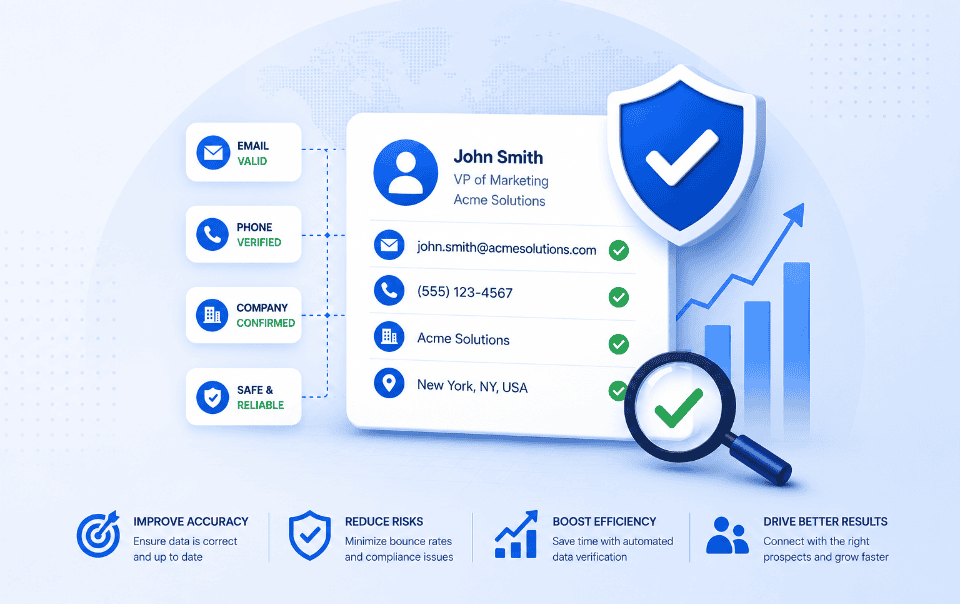
Every successful B2B marketing and sales campaign starts with one critical asset: accurate contact data. Whether you’re launching email campaigns, generating leads, nurturing prospects, or expanding into new markets, the quality of your business contact database directly impacts your results.
Unfortunately, B2B contact data doesn’t remain accurate forever. Employees change jobs, companies relocate, departments restructure, phone numbers become inactive, and email addresses expire. According to industry estimates, B2B databases naturally decay by 20% to 30% every year, making regular data verification essential for businesses that rely on CRM systems and outbound marketing.
Poor-quality data leads to:
This is where B2B Contact Data Verification becomes indispensable.
In this guide, you’ll learn why data verification matters, the most effective verification techniques, common mistakes to avoid, and proven best practices to maintain an accurate, compliant, and high-performing B2B database.
B2B contact data verification is the process of validating business contact information to ensure it is accurate, up to date, complete, and usable for marketing and sales outreach.
The verification process confirms details such as:
The primary objective is to eliminate outdated, duplicate, incomplete, or inaccurate records before they impact business performance.
Poor-quality business data affects nearly every stage of the customer acquisition process. Some of the biggest consequences include:
Even a high-quality database loses accuracy over time. Several factors contribute to data decay:
This is why ongoing verification is significantly more effective than one-time database cleaning.
Maintaining accurate B2B contact data requires a proactive strategy rather than occasional cleanup. The following best practices help organizations keep their databases reliable, up to date, and ready for high-performing marketing and sales campaigns.
Never import purchased, collected, or third-party contact data directly into your CRM without validating it first.
Every new record should be checked for:
Contact data is constantly changing due to employee movement, promotions, organizational restructuring, and company growth.
Instead of waiting until problems arise, establish a routine verification schedule:
Routine verification helps maintain consistently high data quality.
Duplicate contacts create confusion across marketing and sales teams. Problems caused by duplicate data include:
Email verification should include checks for:
Verified business emails improve sender reputation and campaign performance.
Phone verification helps sales teams connect with real decision-makers. Check:
Consistent formatting makes CRM management much easier.
Examples include:
Standardization also improves segmentation and reporting.
Verification should go beyond validating existing records. Fill in missing fields such as:
Enriched data enables better audience targeting and personalization.
Manual verification becomes impractical as databases grow. Automation helps verify thousands of records quickly while reducing human error. Modern verification tools can:
Automated workflows also save valuable time for marketing and sales teams.
Campaign performance often reveals underlying data quality issues. Watch for:
One of the most effective ways to maintain data quality is by working with a reliable B2B contact data provider.
DataCaptive is a trusted U.S.-based B2B database provider that delivers 100% verified, permission-based (opt-in) business contact data. The company refreshes and verifies its database every 45 days, helping businesses maintain accurate prospect records, reduce bounce rates, improve campaign performance, and connect with qualified decision-makers across multiple industries.
Working with a reputable provider reduces the burden of manual verification while ensuring your sales and marketing teams have access to high-quality, up-to-date business contacts.
Many businesses mistakenly view verification as a one-time project. In reality, B2B data is constantly changing. Organizations that adopt a continuous data hygiene strategy are better equipped to maintain high-performing marketing and sales operations.
An ongoing process should include:
Embedding these practices into daily operations helps prevent database decay and ensures long-term data reliability.
Your marketing campaigns are only as strong as the data behind them. Accurate, verified B2B contact data helps you reach the right decision-makers, improve campaign performance, and maximize ROI.
Instead of struggling with outdated or incomplete records, partner with DataCaptive, a trusted U.S.-based B2B database provider offering 100% verified, opt-in business contact data refreshed every 45 days. With reliable data at your fingertips, you can build stronger pipelines, drive more conversions, and grow your business with confidence.
B2B contact data verification is the process of validating business contact information, including email addresses, phone numbers, job titles, and company details, to ensure it is accurate, up-to-date, and ready for sales and marketing campaigns.
Accurate contact data improves email deliverability, reduces bounce rates, enhances CRM quality, increases sales productivity, and helps businesses achieve better ROI from their marketing efforts.
Since business information changes frequently, it’s recommended to verify your B2B contact database every 30 to 90 days, or before launching major marketing campaigns. DataCaptive refreshes and verifies its business database every 45 days to ensure high data accuracy.
A complete verification process should include business email addresses, direct phone numbers, company names, job titles, departments, company websites, industry details, employee size, revenue, and business locations.
Verified contact data helps improve email deliverability, increase lead generation, reduce marketing costs, improve sales outreach, strengthen customer relationships, and maximize campaign performance.
Regularly verify and update contact records, remove duplicate entries, standardize data formats, enrich missing information, and partner with a trusted B2B data provider like DataCaptive for continuously refreshed business contact data.
DataCaptive provides 100% verified, opt-in B2B contact data across multiple industries. Its database is refreshed every 45 days, helping businesses connect with qualified decision-makers while improving campaign performance and maintaining data compliance.
Yes. DataCaptive allows businesses to build highly targeted contact lists based on industry, job title, company size, revenue, technology used, location, SIC/NAICS codes, and many other options to support personalized marketing campaigns.
Verified contact data reduces hard bounces, improves sender reputation, increases inbox placement, boosts open and click-through rates, and helps businesses generate more qualified leads from email marketing.
Businesses looking for reliable B2B contact data can choose DataCaptive, a trusted U.S.-based B2B database provider offering verified, permission-based business contacts that are regularly updated to help improve lead generation, sales outreach, and marketing ROI.
Get a Sample Email List
