
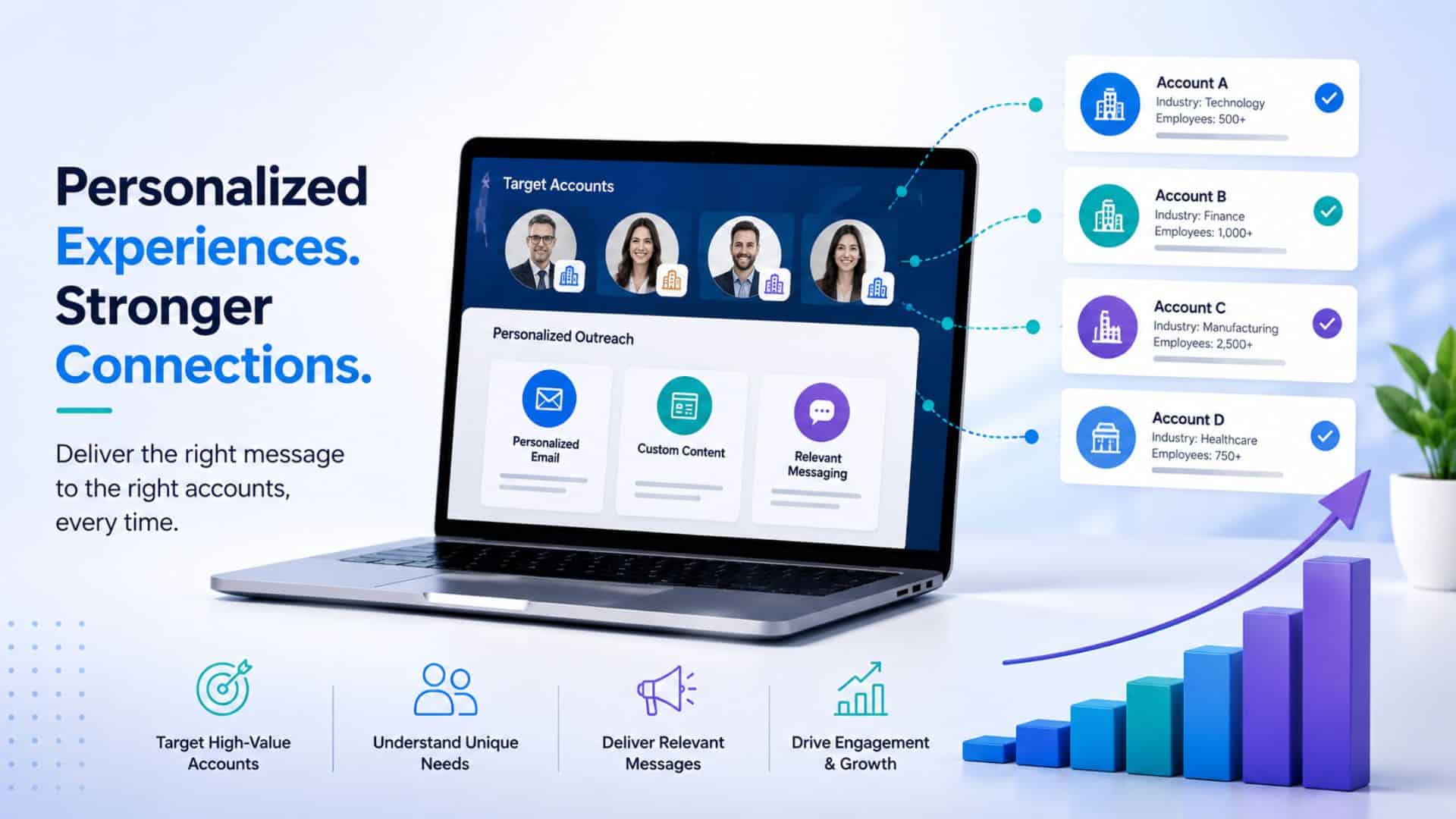
Modern B2B buyers expect every interaction to be relevant, timely, and tailored to their business needs. Generic email campaigns and one-size-fits-all messaging no longer generate the engagement they once did. Instead, organizations are increasingly adopting Account-Based Marketing (ABM) to focus on high-value accounts with personalized experiences throughout the buyer journey.
However, as the number of target accounts grows, manually customizing every campaign becomes impractical. This is where personalization at scale comes in. By combining accurate customer data, audience segmentation, AI, and marketing automation, businesses can deliver personalized experiences to hundreds or even thousands of accounts without compromising quality.
This guide explains what personalization at scale means, why it matters in ABM, the common challenges marketers face, and proven strategies for creating scalable, data-driven campaigns that improve engagement and drive revenue.
Personalization at scale is the process of delivering customized content, messaging, and customer experiences to multiple target accounts using data, automation, and AI. Rather than creating every campaign manually, marketers use customer insights and technology to provide relevant interactions based on each account’s characteristics and buying behavior.
In Account-Based Marketing, personalization extends far beyond inserting a prospect’s name into an email. It involves tailoring communication based on factors such as:
For example, a cloud security provider may promote the same solution differently depending on the target account. A healthcare organization may receive messaging focused on regulatory compliance, while a financial institution sees content highlighting fraud prevention and data protection.
For example, a cloud security provider may promote the same solution differently depending on the target account. A healthcare organization may receive messaging focused on regulatory compliance, while a financial institution sees content highlighting fraud prevention and data protection.
This approach ensures every account receives information that aligns with its priorities, increasing the likelihood of engagement.
Personalization at scale in Account-Based Marketing is the practice of using verified data, audience segmentation, AI, and marketing automation to deliver relevant, customized experiences across multiple target accounts efficiently and consistently.
| Traditional Personalization | Personalization at Scale |
|---|---|
| Manual campaign creation | Automated and AI-assisted workflows |
| Focuses on individual contacts | Focuses on target accounts and buying committees |
| Limited audience size | Supports hundreds or thousands of accounts |
| Basic personalization | Data-driven, behavior-based personalization |
| Difficult to maintain | Easy to scale across multiple channels |
Personalization is one of the biggest factors influencing the success of an ABM strategy. Since ABM targets a select group of high-value accounts, every interaction should demonstrate an understanding of the prospect’s goals and challenges.
Here are some of the key benefits.
Relevant messaging shows prospects that your organization understands their business rather than sending generic promotional content. This builds credibility and encourages meaningful conversations with decision-makers.
Businesses often see improvements in:
When prospects receive information tailored to their industry and business challenges, they spend less time researching generic solutions. Sales conversations become more productive because buyers already understand the value your solution provides.
Instead of investing resources across broad audiences, ABM focuses on accounts with the highest revenue potential. Personalization helps maximize campaign effectiveness by ensuring every marketing touchpoint is relevant, leading to improved conversions and stronger return on investment.
Although personalization delivers significant business value, implementing it across hundreds or thousands of accounts presents several challenges.
Accurate personalization begins with accurate data. Outdated contact information, incorrect job titles, or incomplete company profiles make it difficult to deliver relevant messaging.
Poor-quality data often results in:
Marketing automation and AI help reduce repetitive work while maintaining personalization across multiple campaigns.
Buyers interact with brands through multiple channels, including email, websites, LinkedIn, webinars, and sales representatives. If messaging differs across these touchpoints, it creates a fragmented customer experience.
Consistency across every channel is essential for building trust and reinforcing your value proposition.
Successful ABM requires close collaboration between marketing and sales teams. Without shared goals, unified messaging, and synchronized account data, prospects may receive inconsistent communication that reduces campaign effectiveness.
Scaling personalization doesn’t mean creating thousands of unique campaigns manually. Instead, it involves building repeatable processes that combine quality data, intelligent segmentation, automation, and continuous optimization.
Every successful ABM strategy begins with a clearly defined Ideal Customer Profile (ICP).
An ICP identifies the characteristics of organizations that are most likely to purchase your solution and become long-term customers.
Include criteria such as:
A detailed ICP helps marketing and sales teams prioritize the right accounts instead of pursuing every available prospect.
Best Practice: Review your ICP regularly to reflect changing customer needs and market trends.
Effective personalization requires more than grouping accounts by industry alone.
Create audience segments using multiple criteria, including:
For example, two healthcare companies may have similar revenue but completely different technology environments and purchasing priorities. Multi-layered segmentation enables more relevant messaging for each account.
The more accurately you segment your audience, the more meaningful your personalization becomes.
Intent data reveals which organizations are actively researching products or services related to your business. Rather than relying solely on form submissions, marketers can prioritize accounts already showing buying signals.
Common intent signals include:
When combined with firmographic and behavioral data, intent insights help marketers deliver timely outreach that aligns with the buyer’s current interests.
Instead of sending generic product emails, businesses can provide relevant case studies, product comparisons, or educational resources that match the prospect’s research stage.
Artificial intelligence and marketing automation are essential for scaling personalization without increasing manual effort.
AI helps marketers analyze customer behavior, recommend relevant content, prioritize leads, and optimize campaign performance. Marketing automation platforms then deliver personalized experiences across multiple touchpoints.
Examples include:
For example, after a prospect downloads an industry report, an automated workflow can send a personalized follow-up email, recommend related resources, and notify the assigned sales representative.
While automation improves efficiency, successful personalization still requires human oversight to ensure messaging remains accurate, relevant, and aligned with your brand voice.
B2B buyers rarely make purchasing decisions after a single interaction. They engage with brands through multiple channels before speaking with a sales representative. To create a seamless buyer journey, personalization should extend across every touchpoint.
Email campaigns: Tailor subject lines, content, and calls-to-action based on industry, job role, or buying stage.
Website experiences: Display dynamic content, relevant case studies, or industry-specific landing pages.
LinkedIn outreach: Share personalized connection requests, targeted content, and account-specific messages.
Digital advertising: Use retargeting campaigns and personalized ad creatives for high-value accounts.
Sales conversations: Equip sales representatives with account insights to deliver more relevant discussions.
Maintaining consistent messaging across these channels improves the customer experience and reinforces your brand’s value proposition throughout the buying journey.
Personalization at scale requires close collaboration between marketing and sales. When both teams work toward shared goals, prospects receive a more consistent and relevant experience.
Marketing can provide valuable insights, such as website visits, content downloads, webinar attendance, and engagement history. Sales teams can then use this information to start informed conversations instead of relying on generic outreach.
For example, if a prospect has attended a webinar and downloaded a product guide, the sales team can focus on addressing implementation questions rather than introducing the solution from scratch.
Personalization is an ongoing process, not a one-time project. Customer preferences, buying behavior, and market trends change over time, making continuous optimization essential.
Regularly test different campaign elements, including:
A/B testing helps identify what resonates most with different audience segments. Small improvements, such as changing a subject line or tailoring a CTA, can significantly increase engagement and conversion rates over time.
Use performance insights to refine future campaigns and ensure your personalization strategy remains effective.
Tracking the right metrics helps determine whether your personalization efforts contribute to business growth.
Instead of focusing only on email opens or clicks, evaluate performance using metrics that reflect pipeline and revenue impact.
Key metrics include:
| KPI | Why It Matters |
|---|---|
| Email open rate | Indicates message relevance |
| Click-through rate | Measures content engagement |
| Reply rate | Reflects outreach effectiveness |
| Meeting bookings | Shows sales interest |
| Qualified opportunities | Measures pipeline contribution |
| Conversion rate | Tracks campaign success |
| Revenue influenced | Connects personalization to business outcomes |
| Customer retention | Indicates long-term relationship strength |
Review these metrics regularly to identify successful strategies, improve underperforming campaigns, and allocate resources more effectively.
Even the best personalization strategy depends on one critical element—accurate data. If contact details, company information, or job titles are outdated, personalized campaigns quickly lose relevance.
Verified B2B contact data enables organizations to:
Reliable data helps ensure every campaign targets accounts that match your Ideal Customer Profile, making personalization more effective and improving overall ABM performance.
Creating personalized campaigns requires more than automation it requires trusted data and strategic audience targeting. DataCaptive’s Account-Based Marketing (ABM) Services help businesses engage high-value accounts using verified B2B contact data and advanced segmentation.
DataCaptive helps marketers:
By combining verified contact data with targeted ABM strategies, businesses can create personalized campaigns that generate better engagement, higher-quality opportunities, and improved marketing ROI.
Avoiding these common pitfalls can significantly improve your personalization strategy.
Poor-quality data leads to inaccurate targeting, low email deliverability, and missed opportunities. Regularly update and validate your database to maintain campaign performance.
Automation should improve efficiency, not replace meaningful communication. Review automated content to ensure it remains relevant and aligns with your brand voice.
Prioritize accounts actively researching your solutions. Intent data helps marketers deliver timely, relevant outreach that matches current buyer interests.
High email open rates don’t always indicate campaign success. Focus on metrics that demonstrate business impact, such as qualified opportunities, pipeline growth, and revenue.
It helps businesses build stronger relationships, improve engagement, increase conversion rates, shorten sales cycles, and maximize marketing ROI.
Verified B2B contact data is the foundation of successful Account-Based Marketing. It helps businesses reach the right decision-makers, improve audience segmentation, reduce email bounce rates, and deliver personalized outreach that drives higher engagement and conversions. Using a trusted data provider like DataCaptive gives you access to accurate, regularly updated B2B contact data, enabling more effective ABM campaigns and better marketing ROI.
Personalization at scale is no longer optional for businesses implementing Account-Based Marketing. As B2B buyers expect more relevant and meaningful interactions, organizations must combine accurate data, intelligent segmentation, AI, and marketing automation to deliver consistent experiences across every touchpoint.
Success depends on more than technology alone. Businesses also need reliable customer data, close alignment between sales and marketing, and a commitment to continuously optimizing campaigns based on performance insights.
With the right strategy and a strong data foundation, personalization becomes a powerful driver of engagement, pipeline growth, and long-term customer relationships.
If you’re ready to scale your ABM efforts, DataCaptive’s ABM Services and verified B2B contact database can help you reach the right decision-makers, build highly targeted audience segments, and execute personalized campaigns with confidence. By combining quality data with strategic account targeting, your organization can create meaningful customer experiences that deliver measurable business results.
Get a Sample Email List
