
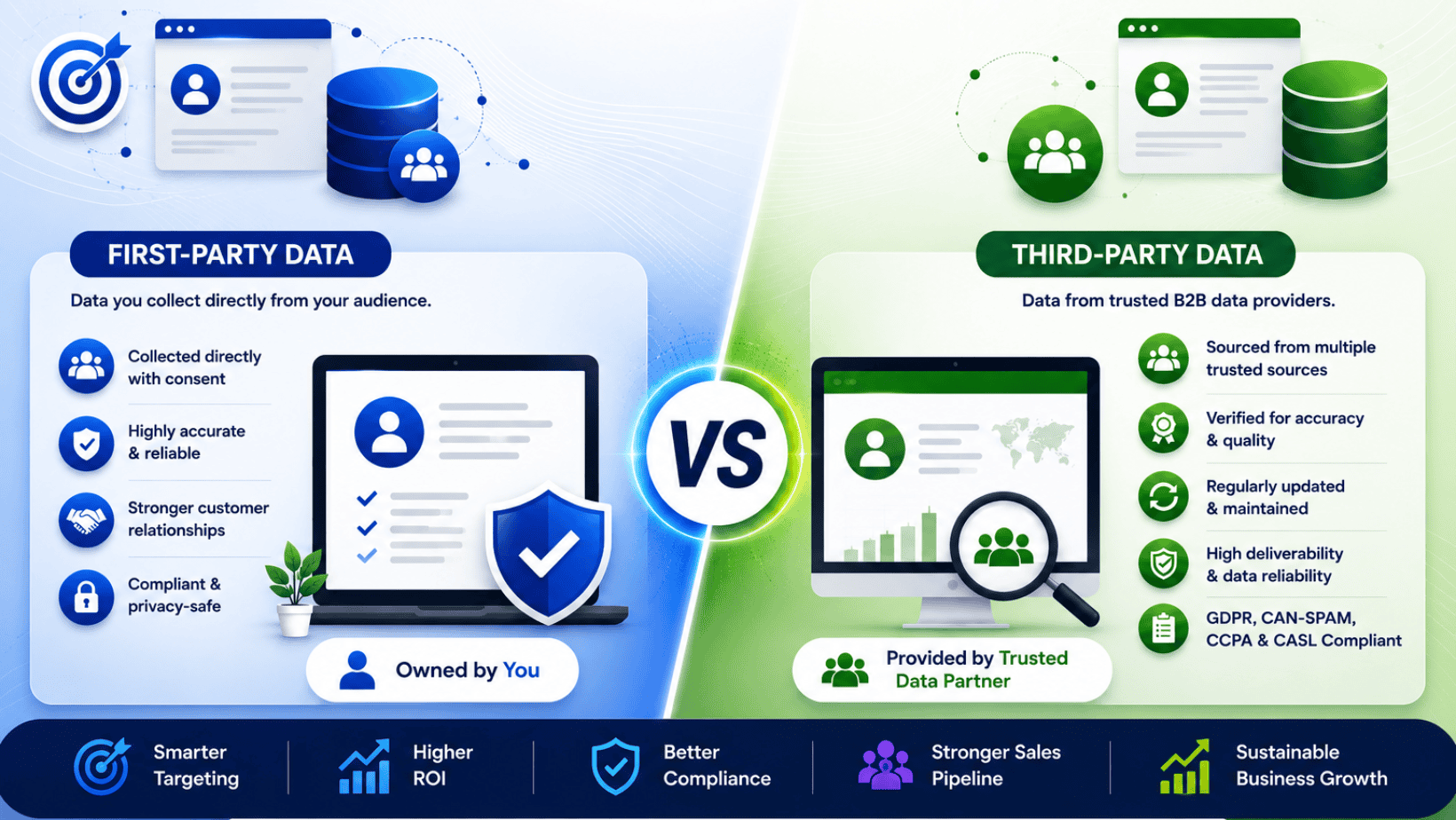
First-Party vs Third-Party B2B Data: Key Differences Explained

First-Party vs Third-Party B2B Data

Data is the fuel behind modern B2B growth, but not all data works the same. The real question is: should you rely on first-party data you collect yourself, or third-party data you buy from outside sources?

As privacy rules tighten and buyers expect more personalization, choosing the right data mix matters more than ever. The right approach can improve lead generation, ABM, customer acquisition, and overall marketing performance.

In this guide, we will explore the key differences between first-party and third-party B2B data, their advantages and disadvantages, and how businesses can use both effectively to create a powerful data-driven growth strategy.

What Is First-Party B2B Data?

First-party B2B data refers to information that a company collects directly from its own audience, customers, prospects, or website visitors. This data is gathered through direct interactions between a business and its target audience.

Common Sources of First-Party B2B Data

  • Website registrations and form submissions
  • Customer relationship management (CRM) systems
  • Email marketing engagement
  • Product usage and customer behavior
  • Webinar registrations and attendance
  • Surveys and feedback forms
  • Customer support interactions
  • Event and trade show participation

Examples of First-Party Data

A software company may collect:

  • Contact information from demo requests
  • Website browsing behavior
  • Download history for whitepapers and eBooks
  • Customer purchase records
  • Email click-through rates
  • Product adoption metrics

Since this information comes directly from users interacting with the business, it is generally considered highly reliable and relevant.

Advantages of First-Party B2B Data

  • Higher Accuracy: Collected directly from your audience, so the data is more reliable and up to date.
  • Better Customer Understanding: Helps you understand customer behavior, preferences, and buying patterns.
  • Stronger Privacy Compliance: You control how the data is collected and used, making compliance simpler.
  • Improved Marketing Performance: Supports more personalized campaigns that drive higher engagement and conversions.
  • Long-Term Strategic Asset: Builds a strong data asset that supports marketing, sales, and customer success.

Challenges of First-Party B2B Data

Despite its benefits, first-party data has limitations.

  • Limited Reach: A company can only collect information from people who already interact with its brand. This restricts access to new market opportunities.
  • Slow Growth: Building a high-quality first-party database takes time and consistent customer engagement efforts.
  • Resource Requirements: Data collection, management, cleansing, and enrichment require dedicated tools and personnel.
  • Potential Data Gaps: Businesses may lack information about prospects who have never visited their website or engaged with their content.

What Is Third-Party B2B Data?

Third-party B2B data is information collected by external providers and sold or licensed to businesses. These providers gather data from multiple sources and aggregate it into comprehensive databases that organizations can use for prospecting, market research, and customer acquisition.

Providers like DataCaptive help businesses access verified B2B contact data, firmographic intelligence, technographic insights, and customizable prospect databases for targeted sales and marketing campaigns.

Common Sources of Third-Party B2B Data

  • Business directories
  • Public records
  • Industry databases
  • Professional networking platforms
  • Technology tracking tools
  • Intent data providers
  • Publisher networks
  • Commercial data aggregators

Examples of Third-Party Data

A third-party data provider may offer:

  • Company profiles
  • Decision-maker contact information
  • Industry classifications
  • Revenue estimates
  • Employee counts
  • Technology stack data
  • Purchase intent signals
  • Firmographic and demographic information

This data helps organizations identify new prospects beyond their existing customer base.

Advantages of Third-Party B2B Data

  • Expanded Market Reach: Find prospects beyond your current network, especially in new markets or for new products.
  • Faster Lead Generation: Access ready-made customer databases instead of waiting for organic data collection.
  • Enhanced Targeting: Use firmographic, technographic, and intent data for better audience segmentation.
  • Scalable Prospecting: Build targeted account lists quickly with customizations such as industry, size, revenue, and location.
  • Competitive Insights: Gain market intelligence to understand trends and stay ahead of competitors.

Challenges of Third-Party B2B Data

  • Data Quality Concerns: Some providers offer outdated or inaccurate data, which can hurt campaign results.
  • Compliance Risks: Purchased data must meet privacy and consent rules.
  • Higher Costs: Premium third-party data can be costly for large campaigns.
  • Limited Context: It often lacks the deep customer insights that first-party data provides.
First-Party vs Third-Party Data Comparison
Feature First-Party Data Third-Party Data
Source Your own customers External provider
Accuracy Very High Depends on provider
Reach Limited Very Large
Best Use Retention Acquisition
Cost Time Investment Purchase Cost
Personalization Excellent Moderate
Account-Based Marketing (ABM) Good Excellent
Flexible Pricing That Grows with Your Business
Choose pricing that adapts to your needs. Scalable plans for startups to enterprises—pay only for what you need as you grow!

Which Data Type Is Better for B2B Marketing?

The answer depends on your objectives.

First-Party Data Is Best For:

  • Customer retention
  • Personalization
  • Email marketing
  • Customer success initiatives
  • Loyalty programs
  • Upselling and cross-selling

Third-Party Data Is Best For:

  • New customer acquisition
  • Market expansion
  • Account-based marketing
  • Lead generation
  • Competitive analysis
  • Sales prospecting

Most successful B2B organizations do not choose one over the other. Instead, they combine both approaches to maximize effectiveness.

How First-Party and Third-Party Data Work Together

Businesses often enrich their first-party customer records with reliable third-party data to gain deeper market insights and uncover new opportunities. Providers such as DataCaptive help organizations access verified business contacts, firmographic data, technographic insights, and intent signals that strengthen account-based marketing and lead generation efforts.

Example Scenario

A company already has first-party data on existing customers, including:

  • Purchase history
  • Product usage
  • Website engagement
  • Support interactions

By enriching this information with third-party data, they can also gain:

  • Company growth indicators
  • Technology adoption trends
  • Organizational changes
  • Intent signals
  • Additional decision-maker contacts

This combination creates a more complete customer profile and enables more informed business decisions.

Best Practices for Using First-Party B2B Data

  • Create Multiple Collection Channels: Gather data through websites, webinars, events, surveys, email campaigns, and customer interactions.
  • Maintain Data Quality: Regularly update and validate customer records to ensure accuracy.
  • Segment Your Audience: Use behavioral and demographic insights to create highly targeted campaigns.
  • Invest in CRM Integration: Centralize customer data for a unified view of every account and contact.
  • Focus on Customer Value: Offer useful content, resources, and experiences that encourage prospects to share information willingly.

Best Practices for Using Third-Party B2B Data

  • Choose Reputable Providers: Work with trusted vendors that prioritize accuracy, compliance, and transparency.
  • Verify Data Regularly: Validate purchased data before launching campaigns.
  • Use Data Enrichment: Combine third-party insights with internal customer records to improve targeting.
  • Prioritize Compliance: Ensure all data usage aligns with applicable privacy regulations.
  • Monitor Performance: Track campaign outcomes to measure data quality and return on investment.

Choosing the Right Data Partner

DataCaptive provides access to more than 200 million business contacts and 75 million company profiles, along with verified email addresses, advanced segmentation, CRM-ready exports, regular data updates, and customizable industry-specific databases. These capabilities help sales and marketing teams identify qualified prospects, improve campaign precision, and accelerate revenue growth.

See the Quality for Yourself – Request Your Free Sample Today!

Experience the power of verified Medical B2B contact data. Get a free sample to see how it can fuel your lead generation.

Conclusion

First-party and third-party B2B data are not rivals; they’re a powerful pair. First-party data gives you accuracy and trust. Third-party data gives you reach and new opportunities. The smartest B2B brands use both: first-party data to personalize and nurture, third-party data to find and grow. In a privacy-first world, that balance is what drives better targeting, stronger relationships, and faster growth.

Frequently Asked Questions (FAQs)

First-party B2B data is information collected directly by a business from its own customers, prospects, website visitors, and marketing channels. Examples include CRM records, website activity, email engagement, webinar registrations, and customer purchase history.

Third-party B2B data is information gathered by external data providers from multiple sources and sold or licensed to businesses. It typically includes company details, decision-maker contacts, firmographics, technographics, and buyer intent data.

The key difference is ownership and collection. First-party data is collected and owned directly by your business, while third-party data is collected by external vendors and purchased for prospecting, targeting, and market expansion.

B2B companies use third-party data to discover new prospects, expand into new markets, identify decision-makers, improve account-based marketing (ABM), and accelerate lead generation efforts.

Yes. Combining first-party and third-party data creates a more complete customer profile. Businesses can enrich existing records with firmographic, technographic, and intent data to improve targeting and campaign performance.

DataCaptive offers access to verified B2B contact databases, firmographic insights, technographic data, and intent-based audience segments that help businesses improve lead generation, account-based marketing, and customer acquisition strategies.

DataCaptive helps businesses identify qualified prospects through targeted contact databases, enabling sales and marketing teams to reach decision-makers more effectively and accelerate pipeline growth.

DataCaptive focuses on data accuracy, compliance, industry-specific targeting, and customizable audience solutions, helping organizations improve campaign performance and maximize marketing ROI.

Businesses should evaluate data accuracy, compliance standards, update frequency, industry coverage, data enrichment capabilities, customer support, and integration options before selecting a B2B data provider.
Both serve different purposes. Third-party data is ideal for finding new prospects and expanding reach, while first-party data is more effective for nurturing leads, personalizing communications, and converting existing contacts into customers.
The most effective strategy combines high-quality first-party data with reliable third-party data enrichment. This approach improves customer understanding, expands market reach, strengthens personalization, and supports sustainable business growth.

Get A Quote on Price

Get A Quote on Price

If you don't have a business email, click here

Request a Sample

Request A Sample

If you don't have a business email Click here