
Understanding the Key Differences for Smarter B2B Marketing and Sales Success
In B2B marketing, timing is everything. The right message to the right buyer at the right moment can make all the difference.
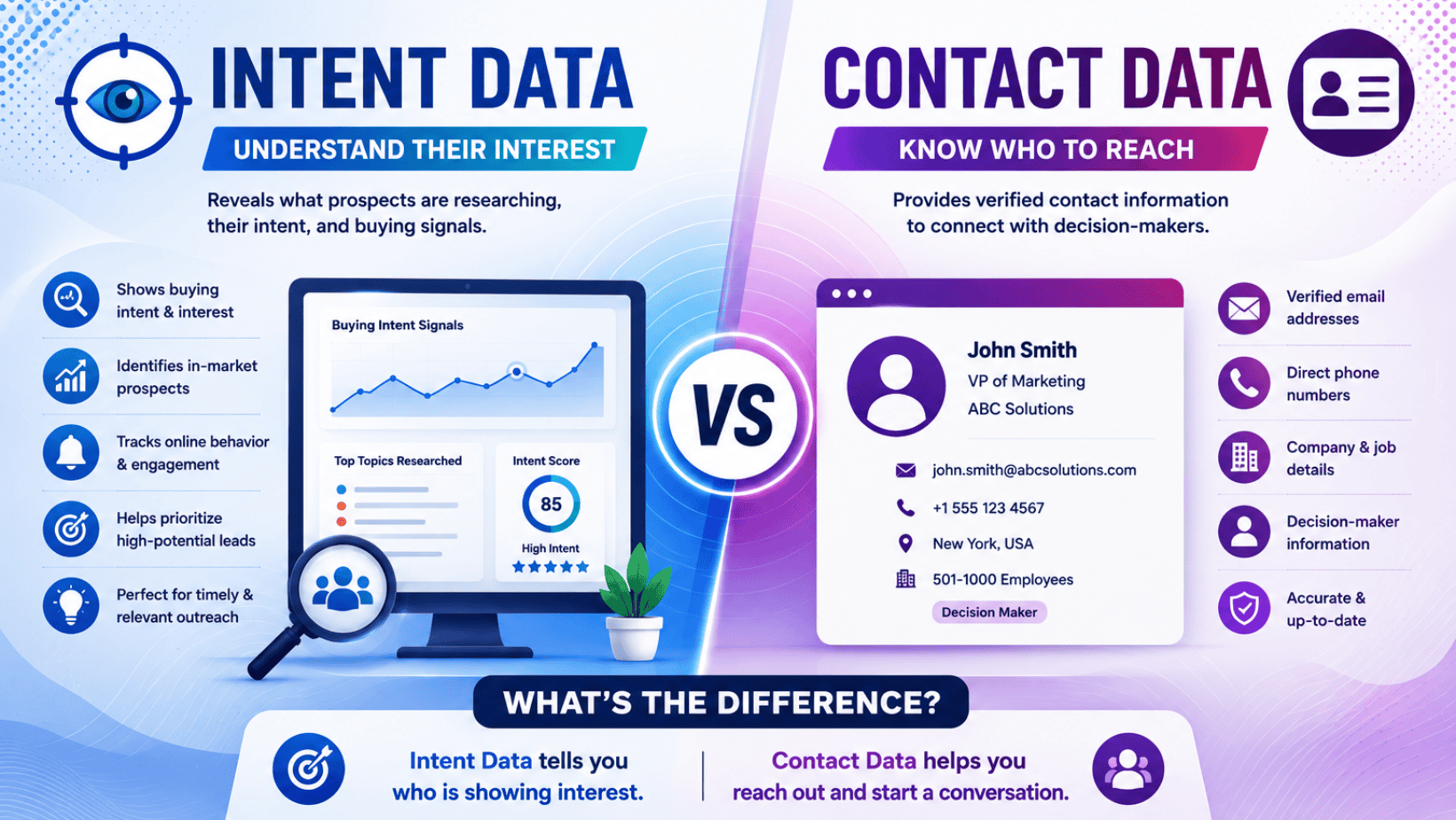
That’s where intent data and contact data come in; intent data shows who is actively researching a solution. Contact data tells you how to reach them. So, what’s the difference between the two, and why do smart teams use both to drive better targeting, personalization, and conversions?
This guide explores the definitions, differences, benefits, use cases, and best practices of intent data and contact data, helping you understand how they work together to create a powerful B2B marketing strategy.
Intent data refers to information that indicates a prospect’s interest in a particular product, service, industry topic, or solution. It helps businesses identify organizations and individuals actively researching products or solutions online before they directly engage with a vendor.
Intent data provides behavioral signals that reveal buying intent, allowing marketers and sales teams to identify potential buyers earlier in the purchasing journey.
Intent data is typically collected from various online activities, including:
For example, if multiple employees at a company repeatedly search for “best CRM software for enterprises,” download CRM-related guides, and read comparison articles, intent data platforms can identify that organization as actively researching CRM solutions.
Collected directly from your own digital properties, such as:
Collected from external publisher networks, research platforms, and online communities that monitor content consumption behavior across the web.
Contact data refers to the professional information that allows businesses to identify and communicate with individuals within an organization.
Unlike intent data, which reveals buying behavior, B2B contact data focuses on who the prospect is and how to reach them.
A typical B2B contact record may include:
For example, if a company wants to market a cybersecurity solution, B2B contact data helps identify IT Directors, CISOs, Security Managers, and decision-makers within target organizations.
Businesses typically obtain contact data through:
| Feature | Intent Data | Contact Data |
|---|---|---|
| Purpose | Shows buying interest | Provides contact information |
| Focus | Buyer behavior | Decision-maker details |
| Best For | Identifying active buyers | Reaching prospects |
| Data Type | Behavioral | Demographic & Professional |
| Use Case | Lead prioritization | Sales outreach |
| ABM | Excellent | Excellent |
| Personalization | High | Moderate |
| CRM Usage | Enrichment | Direct contact |
Intent data can reveal strong buying signals, but without accurate contact information, sales teams may struggle to reach the right stakeholders.
For example:
A software vendor identifies a company showing strong purchase intent for cloud migration services. However, without knowing the names, roles, and contact details of relevant decision-makers, outreach efforts become difficult and less effective.
Challenges of using only intent data include:
Intent data identifies opportunities, but contact data activates them.
Many organizations rely heavily on contact databases without understanding whether prospects are actively interested in their solutions.
As a result:
For example:
A marketing team may possess thousands of contacts within manufacturing companies. However, without intent signals, they cannot determine which organizations are currently evaluating solutions.
This often leads to lower engagement and reduced ROI.
Intent data reveals organizations researching topics related to your products or services.
Relevant messaging delivered to the right contacts at the right time improves conversion rates and shortens sales cycles.
They combine both.
Intent data identifies opportunities.
Contact data enables engagement.
Together, they create a complete demand generation ecosystem.
Not all data providers offer the same level of accuracy, coverage, or compliance. When evaluating a provider, businesses should consider:
Providers such as DataCaptive offer access to verified B2B contact data, buyer-intent intelligence, and data-enrichment solutions that help organizations improve targeting, outreach, and campaign performance.
Successful demand generation requires more than identifying interested buyers. Businesses must also connect with the right decision-makers using accurate and up-to-date contact information.
DataCaptive helps organizations achieve this by providing:
By combining actionable buying signals with reliable contact information, businesses can engage high-intent prospects more effectively and accelerate revenue growth.
Experience the power of verified B2B contact data. Get a free sample to see how it can fuel your retail lead generation.
Intent data and contact data serve different but complementary roles in modern B2B marketing.
Intent data reveals which organizations are actively researching solutions, while contact data identifies the people involved in purchasing decisions. Businesses that combine both gain a significant advantage by reaching the right prospects at the right time with the right message.
Organizations looking to improve lead generation, account-based marketing, and sales outreach can benefit from integrating intent intelligence with verified B2B contact data from providers such as DataCaptive.
Intent data is behavioral information that indicates when a company or individual is actively researching products, services, or industry topics online. It helps B2B marketers identify potential buyers based on their digital activities, such as content consumption, keyword searches, webinar attendance, and website visits. By using intent data, businesses can engage prospects before they reach out to vendors directly.
Contact data provides information about a prospect, including their name, job title, company, email address, and phone number. Intent data, on the other hand, reveals buying signals and online behaviors that indicate interest in a specific solution. Simply put, intent data tells you who may be interested in buying, while contact data tells you how to reach them.
Yes. Intent data helps businesses identify high-intent prospects who are actively researching relevant solutions. This allows marketing and sales teams to focus their efforts on accounts that are more likely to convert, improving lead quality, increasing engagement rates, and shortening sales cycles.
Contact data enables sales teams to connect directly with decision-makers and key stakeholders within target organizations. Accurate contact information supports personalized outreach, improves response rates, and helps sales representatives build meaningful relationships with potential customers.
Neither is inherently better because they serve different purposes. Intent data helps identify potential buyers showing interest in a solution, while contact data provides the information needed to reach those buyers. The most effective B2B marketing and sales strategies use both data types together to maximize results.
Intent data identifies companies actively researching products or services, while contact data reveals the decision-makers within those organizations. When combined, businesses can prioritize high-intent accounts, find the right contacts, personalize outreach, and improve conversion rates.
Intent data can come from both first-party and third-party sources. Common sources include website visits, content downloads, webinar registrations, email engagement, keyword searches, online review sites, industry publications, publisher networks, and content syndication platforms.
The accuracy of B2B contact data depends on how frequently it is verified and updated. High-quality data providers continuously validate email addresses, phone numbers, job titles, and company information to maintain data accuracy. Regular data cleansing helps reduce bounce rates and improve campaign performance.
Absolutely. Intent data is a valuable component of account-based marketing because it helps identify target accounts that are actively researching relevant solutions. This allows marketing and sales teams to prioritize outreach, personalize messaging, and engage accounts at the right stage of the buying journey.
Businesses can purchase intent data and contact data from reputable B2B data providers and sales intelligence platforms. When evaluating vendors, organizations should consider data accuracy, compliance standards, coverage, and update frequency. Providers such as DataCaptive offer verified B2B contact databases and intent-driven audience solutions that help marketers identify and engage high-value prospects more effectively.
Get a Sample Email List
Get A Quote on Price
