
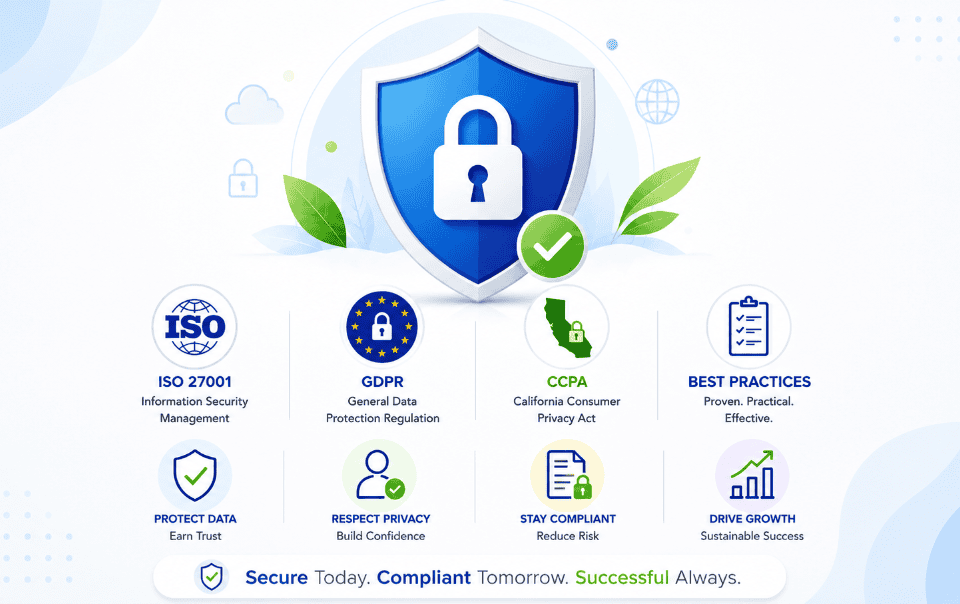
With privacy rules like GDPR, CCPA, and ISO 27001 in play, companies can’t afford to treat compliance as an afterthought. The businesses that get it right build trust, protect their brand, and improve marketing performance, while those that don’t risk penalties, poor deliverability, and lost credibility.
This guide explains everything businesses need to know about B2B data compliance, including ISO 27001, GDPR, CCPA, and practical best practices for maintaining secure, compliant, and high-quality business databases.
B2B data compliance refers to the process of collecting, managing, storing, sharing, and using business contact information in accordance with applicable privacy laws, security standards, and industry regulations.
It involves ensuring that:
Benefits of strong compliance include:
Businesses that invest in compliance often experience better engagement because prospects are more likely to respond to organizations they trust.
ISO 27001 is an internationally recognized information security management standard that helps organizations establish, implement, maintain, and continuously improve their Information Security Management System (ISMS).
Unlike privacy regulations, ISO 27001 primarily focuses on protecting information through systematic security controls.
Organizations implementing ISO 27001 aim to:
ISO 27001 encourages businesses to:
The General Data Protection Regulation (GDPR) is one of the world’s most influential privacy laws. It governs how organizations collect, process, store, and use personal data of individuals located in the European Economic Area (EEA).
Even businesses outside Europe may need to comply if they process data belonging to EU residents.
GDPR is built around several important principles:
The California Consumer Privacy Act (CCPA), along with its amendments under CPRA, gives California residents greater control over their personal information.
Businesses must maintain transparency about their data collection practices and respond appropriately to consumer requests.
Many businesses unintentionally violate compliance requirements due to poor data management practices.
Some common challenges include:
Following industry best practices helps organizations remain compliant while improving overall marketing performance.
The foundation of compliance starts with responsible data collection. Ensure that all business contact information is obtained through legitimate and transparent methods. Clearly communicate why the data is being collected, how it will be used, and provide appropriate privacy notices where required.
Avoid purchasing data from unknown or unverified sources, as this may expose your business to legal and reputational risks.
Best Practice Tips:
A reliable provider should also offer transparency into how data is collected, maintained, and updated. For example, providers like DataCaptive emphasize verified business contacts, regular database updates, robust information security, and adherence to global compliance standards such as ISO 27001:2022, GDPR, CCPA, CASL, ACMA, HIPAA, and CAN-SPAM. Working with a trusted provider helps businesses minimize compliance risks while improving data quality and marketing performance.
Business contact data naturally degrades over time due to job changes, company relocations, promotions, and organizational restructuring. Regular database maintenance helps ensure accuracy and supports compliance with regulations requiring organizations to keep personal information current.
Routine data hygiene should include:
Businesses can simplify data hygiene by partnering with providers that routinely verify and refresh contact records. DataCaptive, for instance, updates its B2B database every 45 days to help organizations maintain high data accuracy, reduce bounce rates, and support compliant sales and marketing campaigns.
Protecting customer and business information is a critical component of data compliance. Organizations should implement layered security measures that prevent unauthorized access, accidental data loss, and cyber threats.
Recommended security measures include:
Strong security practices also support ISO 27001 requirements and reduce the likelihood of data breaches.
Transparency is essential for building trust and demonstrating compliance. Your organization should maintain an up-to-date privacy policy that explains how business data is collected, processed, stored, shared, and protected.
Additionally, document your internal compliance procedures, retention policies, vendor agreements, and security controls to demonstrate accountability during audits or regulatory reviews.
Your privacy documentation should clearly explain:
If you purchase B2B contact data from third-party vendors, maintain documentation that demonstrates the provider’s compliance practices, data sourcing methodology, and security standards. Reputable providers like DataCaptive offer transparency that helps organizations strengthen their internal compliance framework.
Technology alone cannot ensure compliance; employees play a vital role in protecting sensitive information. Regular training helps staff understand privacy regulations, security responsibilities, and safe data handling practices.
Training topics should include:
Well-trained employees significantly reduce the risk of accidental compliance violations.
Compliance should be an ongoing process rather than a one-time project. Regular internal audits help identify gaps in your data governance framework and ensure your policies remain aligned with evolving regulations.
Compliance audits should evaluate:
Privacy regulations such as GDPR and CCPA grant individuals specific rights regarding their personal information. Businesses should establish efficient processes for handling requests related to data access, correction, deletion, or processing restrictions.
Having a documented workflow for managing these requests demonstrates accountability and helps ensure timely compliance with legal obligations.
Organizations should be prepared to respond to requests for:
Keeping business data indefinitely increases compliance risks and exposes organizations to unnecessary security challenges. Develop clear retention schedules that define how long different types of data should be stored and when they should be securely deleted.
An effective retention policy helps:
Monitoring regulatory updates allows businesses to:
Compliance is not a one-time achievement; it requires continuous improvement as privacy expectations and legal requirements evolve.
Many organizations assume compliance limits marketing opportunities. In reality, compliant marketing often delivers better results.
Benefits include:
Quality data consistently outperforms large but outdated databases.
Selecting the right data partner plays a significant role in maintaining compliance.
When evaluating providers, consider whether they offer:
A reliable provider helps businesses reduce compliance risks while improving lead-generation effectiveness.
Some key advantages include:
By combining verified business intelligence with responsible data management practices, DataCaptive helps organizations connect with qualified decision-makers while supporting privacy-conscious marketing strategies.
Experience the power of verified contact data. Get a free sample to see how it can fuel your lead generation.
For teams managing sales databases or global campaigns, strong governance and trusted partners like DataCaptive make it easier to grow with confidence.
B2B data compliance refers to the process of collecting, storing, processing, and using business contact information in accordance with global privacy laws and security standards such as GDPR, CCPA, ISO 27001:2022, CASL, and CAN-SPAM. It helps businesses protect sensitive information, build customer trust, and reduce legal and cybersecurity risks.
Compliant B2B data enables organizations to run secure, ethical, and legally compliant marketing campaigns. It improves email deliverability, reduces bounce rates, enhances customer trust, protects brand reputation, and minimizes the risk of regulatory penalties.
A reliable B2B data provider should align with internationally recognized standards such as ISO 27001:2022, GDPR, CCPA, CASL, ACMA, CAN-SPAM, and HIPAA. These frameworks help ensure secure data management, privacy protection, and responsible marketing practices.
Before purchasing a B2B database, ask the provider about their data sourcing methods, verification process, update frequency, security certifications, privacy policies, and compliance with regulations like GDPR and CCPA. Reputable providers should be transparent about how their data is collected and maintained.
Using outdated or non-compliant data can result in poor email deliverability, increased spam complaints, regulatory fines, legal issues, damaged sender reputation, and loss of customer trust. It can also reduce the effectiveness of your sales and marketing campaigns.
Since business contact information changes frequently due to job transitions, promotions, and company updates, organizations should refresh their B2B database regularly. Trusted provider such as DataCaptive update their databases every 45 days to maintain high data accuracy and campaign performance.
Choose a provider that offers verified business contacts, transparent data sourcing, regular database updates, industry-specific segmentation, strong security practices, and compliance with regulations such as ISO 27001:2022, GDPR, CCPA, CASL, ACMA, and CAN-SPAM. These factors help ensure reliable and compliant data for your marketing efforts.
DataCaptive helps businesses reach verified decision-makers through high-quality B2B contact data supported by ISO 27001:2022, GDPR, CCPA, CASL, ACMA, CAN-SPAM, and HIPAA. With 200M+ business contacts, 95% data accuracy, 85% email deliverability, and database updates every 45 days, businesses can build targeted campaigns with greater confidence.
Yes. DataCaptive offers customizable B2B databases across industries including healthcare, technology, manufacturing, finance, education, retail, hospitality, logistics, construction, and many others. Each database can be segmented by industry, job title, company size, location, revenue, and additional firmographic options to support targeted and compliant outreach.
Yes. DataCaptive offers a free sample that allows businesses to evaluate data quality, accuracy, segmentation options, and overall suitability before making a purchase. Reviewing a sample helps ensure the database aligns with your marketing goals and compliance requirements.
Get a Sample Email List
Get A Quote on Price
