
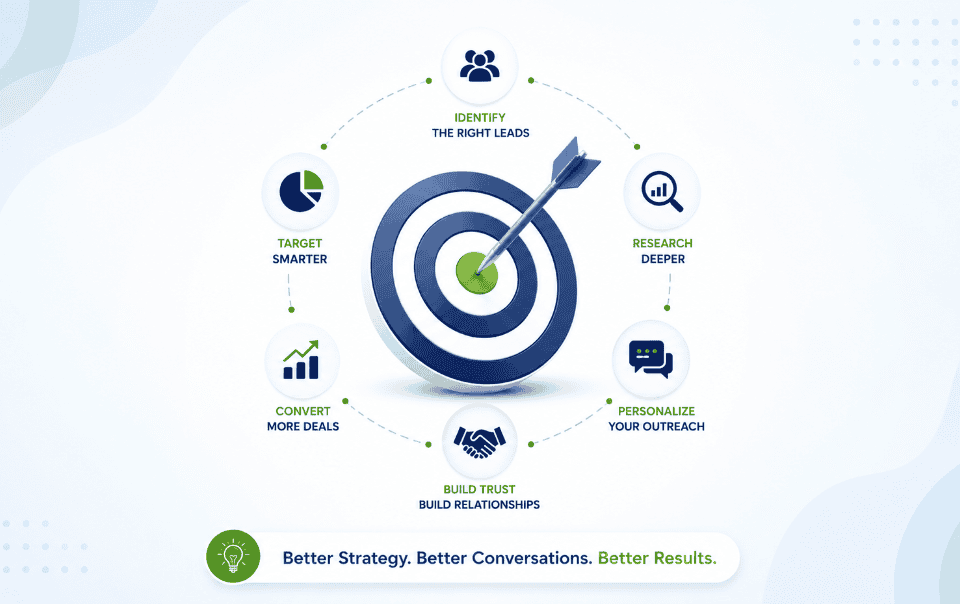
Enterprise B2B sales have become more competitive than ever. Decision-makers receive hundreds of emails, LinkedIn messages, and sales calls every week. Generic outreach no longer works. Companies that consistently generate enterprise deals rely on smarter prospecting strategies backed by verified B2B data, personalization, and multi-channel engagement.
Whether you’re selling SaaS, cybersecurity, healthcare solutions, manufacturing services, financial products, or enterprise software, reaching the right decision-makers is the foundation of successful sales.
This guide explores modern B2B prospecting strategies that help businesses identify high-value enterprise leads, engage buying committees, and build predictable sales pipelines.
B2B prospecting is the process of identifying, researching, qualifying, and connecting with potential business customers who are likely to purchase your products or services.
Unlike traditional lead generation, which focuses on volume, enterprise prospecting emphasizes quality over quantity. The objective is to engage organizations with higher contract values, longer customer lifecycles, and greater revenue potential.
An effective prospecting strategy combines:
Enterprise purchases rarely involve a single decision-maker.
A typical enterprise buying committee may include:
Each stakeholder has different priorities, making personalized communication essential.
Enterprise sales cycles are also longer because they involve:
Because of this complexity, businesses must focus on identifying qualified opportunities instead of simply generating more leads.
Closing high-value enterprise deals isn’t about reaching more prospects; it’s about reaching the right decision-makers with personalized, data-driven outreach. By combining accurate contact data, targeted account research, and consistent follow-ups, sales teams can build stronger relationships, accelerate sales cycles, and increase conversions.
Here are some proven B2B prospecting strategies for generating high-value enterprise leads:
Prospecting starts with knowing exactly who you’re targeting.
Your Ideal Customer Profile should define:
Examples include:
Segment prospects by:
Knowing which CRM, ERP, cloud platform, or marketing automation tools a company uses helps personalize outreach.
Data quality directly impacts prospecting success.
Poor-quality contact data results in:
Instead, use verified B2B contact databases from trusted providers such as DataCaptive that include:
High-quality data allows sales teams to spend more time selling rather than searching for contacts.
Sales intelligence platforms such as DataCaptive combine verified business contacts with firmographic and company insights, making it easier to identify and engage high-potential enterprise prospects.
Enterprise sales depend on consensus. Instead of contacting only one executive, build relationships across the buying committee.
Examples include:
Modern buyers expect relevant communication. Instead of sending generic messages, personalize based on:
Example:
Instead of saying:
“We help companies grow.”
Say:
“We noticed your organization recently expanded into multiple regions. Our platform helps enterprise teams manage customer data across global sales operations.”
Specificity builds credibility.
Enterprise buyers engage across different channels.
Successful prospecting combines:
Ideal for sharing:
Educational assets help build trust:
A coordinated multi-channel strategy keeps your brand visible throughout the buying journey.
Avoid sending identical messaging to every prospect.
Segment by:
Segmentation improves:
The more relevant your messaging, the stronger the engagement.
Sales intelligence provides context beyond basic contact information.
Useful insights include:
Sales representatives can use these insights to create more meaningful conversations.
B2B data naturally becomes outdated over time because professionals:
Maintaining data hygiene through regular data verification helps preserve:
Clean data is one of the most overlooked drivers of successful prospecting. Many organizations use providers like DataCaptive to regularly refresh and verify their B2B databases, helping maintain CRM accuracy and improve email deliverability over time.
Experience the power of verified prospecting leads. Get a free sample to see how it can fuel your lead generation.
The best enterprise sales teams don’t chase more leads; they target the right leads. By combining a clear ICP, verified B2B contact data, personalized outreach, and a multi-channel prospecting strategy, you can connect with high-value decision-makers, accelerate your sales pipeline, and close larger deals.
Ready to turn enterprise prospects into long-term customers? Start with accurate data, smarter targeting, and consistent engagement to drive sustainable B2B growth.
B2B prospecting strategies are methods businesses use to identify, qualify, and engage potential customers. Effective strategies include defining an Ideal Customer Profile (ICP), using verified B2B contact data, personalizing outreach, leveraging intent data, and adopting a multi-channel sales approach to generate qualified enterprise leads.
You can find high-value enterprise leads by targeting companies that match your ICP based on industry, company size, annual revenue, location, and buying intent. Using a verified B2B contact database and sales intelligence helps identify key decision-makers and prioritize accounts with the highest revenue potential.
Verified B2B contact data improves email deliverability, reduces bounce rates, increases response rates, and helps sales teams connect with the right decision-makers. Accurate data also saves time and improves the overall ROI of sales and marketing campaigns.
Lead generation focuses on attracting potential customers through marketing channels like content, ads, and webinars. B2B prospecting is a proactive sales activity in which teams directly identify, research, and reach out to qualified prospects via personalized emails, phone calls, LinkedIn, and other outreach methods.
Choose a provider that offers verified business email addresses, direct dials, company firmographics, industry segmentation, regular data updates, CRM-ready formats, and compliance with privacy regulations like GDPR, CCPA, and CAN-SPAM.
DataCaptive provides verified B2B contact databases with customizable lists by industry, job title, company size, and geography. With regularly updated business contacts, CRM-ready data, and compliance-focused solutions, businesses can more effectively identify and engage high-value enterprise decision-makers.
Yes. DataCaptive allows businesses to build fully customized B2B prospect lists such as industry, job title, company size, annual revenue, location, technology stack, SIC/NAICS codes, seniority level, and more. This enables highly targeted outreach, improves campaign performance, and helps sales teams connect with the most relevant enterprise decision-makers.
Business contact data changes frequently due to job changes, promotions, company growth, and organizational restructuring. DataCaptive updates its B2B contact database every 45 days to help ensure data accuracy, improve email deliverability, reduce bounce rates, and support more effective sales and marketing campaigns.
Start by defining your Ideal Customer Profile (ICP), including your target industries, company size, locations, and decision-makers. DataCaptive makes it easy to get started by offering customized B2B prospect databases and a free data sample, allowing you to evaluate data quality before launching your sales and marketing campaigns.
Get a Sample Email List
Get A Quote on Price
