
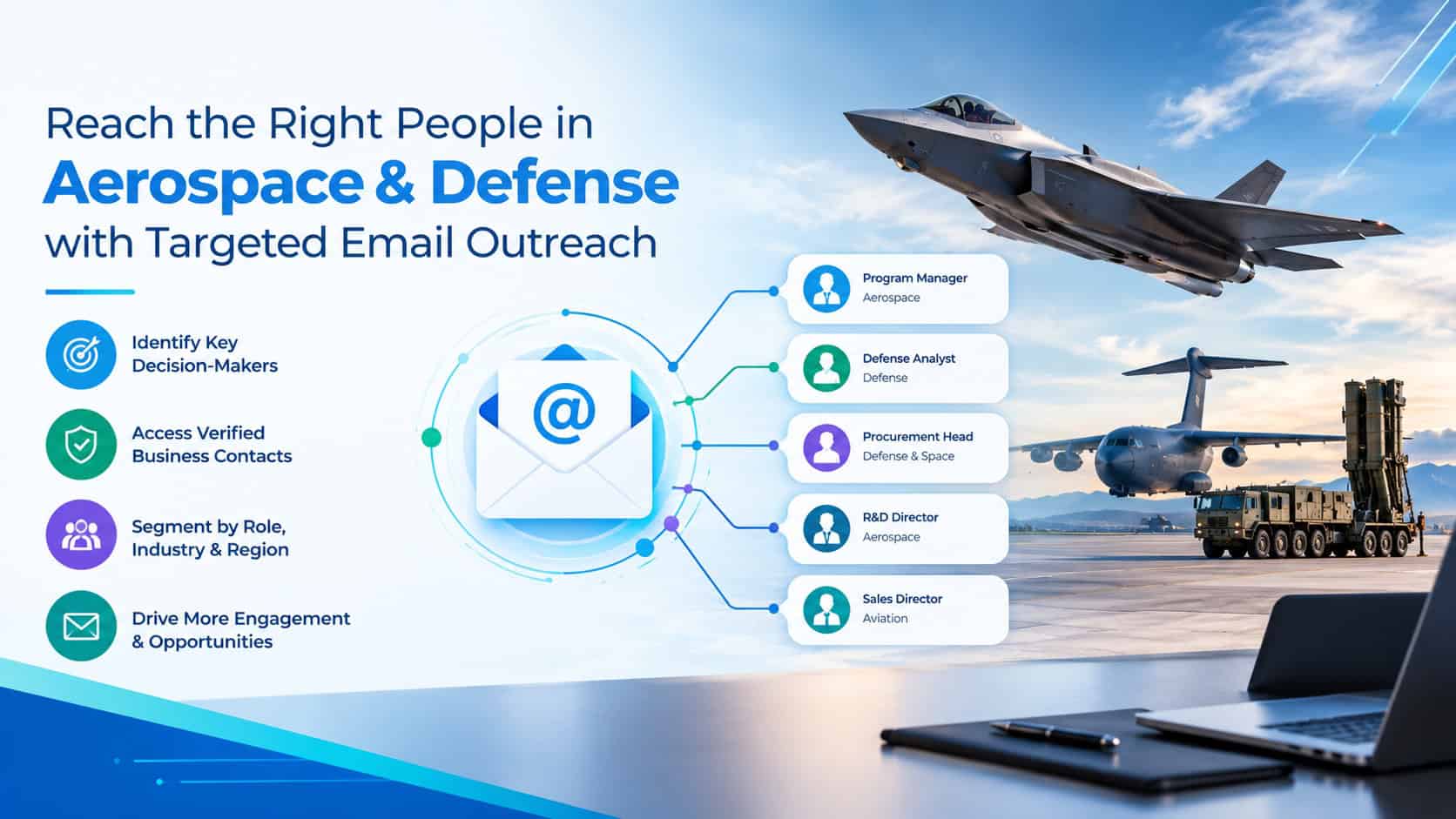
Selling products and services in the aerospace and defense industry is rarely a quick process. Buyers often need technical information, multiple approvals, supplier evaluations, and plenty of time before making a decision.
That is why aerospace and defense industry email marketing needs a more focused approach than a typical B2B email campaign.
If you are trying to reach aerospace manufacturers, defense contractors, engineers, procurement teams, program managers, or other industry decision-makers, sending the same promotional email to everyone is unlikely to get the results you want.
You need to reach the right people, understand their role, share useful information, and stay connected throughout the buying journey.
In this 2026 guide, we’ll look at how aerospace and defense companies can use email marketing to build awareness, generate qualified leads, nurture prospects, and support long-term B2B sales.
Aerospace and defense industry email marketing is the use of targeted email campaigns to communicate with professionals and organizations involved in aerospace, aviation, defense, space technology, manufacturing, MRO, engineering, and related industries.
Unlike broad email marketing, these campaigns are usually built around specific industries, companies, job functions, technical interests, and buying stages.
For example, an aerospace manufacturer may send different emails to an engineering director, procurement manager, and CEO because each person has different priorities.
The engineer may want technical specifications. The procurement manager may care about supply reliability and pricing. The CEO may be more interested in business growth and operational efficiency.
That is the basic idea behind effective aerospace and defense email marketing: the right message should reach the right person at the right stage of the buying journey.
Aerospace and defense businesses often deal with complex products, specialized requirements, and long sales cycles. A prospect may not be ready to buy after reading one email—and that is perfectly normal.
Email gives you a way to stay connected without relying on a single sales conversation.
Aerospace and defense purchases can involve research, technical evaluation, procurement, budgeting, supplier reviews, and approval from several stakeholders.
A useful email sequence can keep your company visible during this process.
Instead of constantly asking for a sale, you can provide:
This helps prospects learn about your capabilities before they are ready to speak with sales.
One of the biggest challenges in aerospace B2B marketing is that a single company can have several people involved in a purchase.
An engineering team may evaluate the technical solution. Procurement may compare suppliers. Operations may assess implementation. Senior management may approve the investment.
Your email strategy should account for these different roles instead of treating an entire company as one audience.
A generic message such as “We can help your business grow” may not mean much to an aerospace engineer or defense procurement professional.
A more useful message might address a specific manufacturing capability, engineering challenge, component requirement, software application, supply-chain issue, or operational problem.
The more relevant the message is to the recipient’s role, the easier it is to make the email useful rather than simply promotional.
Before you start building an email campaign, ask yourself a simple question:
Who exactly do I want to reach?
Your answer should go beyond “aerospace companies” or “defense companies.”
A strong campaign identifies the specific people who influence purchasing decisions.
| Audience | Example Job Titles | Possible Content Focus |
|---|---|---|
| Engineering | Aerospace Engineer, Systems Engineer, Engineering Director | Technical information and specifications |
| Procurement | Procurement Manager, Purchasing Director | Supplier capabilities, pricing, reliability |
| Program Management | Program Manager, Program Director | Delivery, timelines, risk and performance |
| Manufacturing | Manufacturing Director, Operations Manager | Production, efficiency and capacity |
| Quality | Quality Manager, Quality Engineer | Quality systems, standards and reliability |
| Supply Chain | Supply Chain Director, Logistics Manager | Supply availability and supplier performance |
| Executives | CEO, COO, VP, General Manager | Business value, growth and strategic benefits |
| Business Development | Business Development Director, Sales Director | Partnerships, opportunities and market expansion |
This type of segmentation can make a major difference.
For example, imagine you sell aerospace manufacturing software. An engineering leader might want to know how the software improves design workflows, while an operations leader may be more interested in productivity and process efficiency.
The product is the same. The message should not be.
A successful campaign starts long before you write the subject line.
You first need to understand your audience, build a relevant Aerospace and Defense Database, decide what you want to achieve, and then create content that supports that goal.
Start by creating an Ideal Customer Profile (ICP).
Think about the companies most likely to need your product or service.
You can segment them by:
For example, an aerospace supplier may want to target mid-sized aircraft component manufacturers in the United States with procurement and supply-chain leadership.
That is much more actionable than simply targeting “aerospace companies.”
Once you know your ideal customer, the next step is finding relevant contacts within those companies.
A useful aerospace and defense B2B contact database can include information such as:
The quality of your contact data matters because even a well-written campaign can underperform when it reaches outdated, irrelevant, or incorrect contacts.
For organizations looking to reach specific aerospace and defense audiences, a targeted Aerospace and Defense Industry Email List can help create campaigns around defined industries, roles, companies, and geographic markets.
Once your contacts are organized, avoid sending one identical campaign to everyone.
Instead, create smaller audience groups.
For example:
This approach makes your campaign feel more like a relevant business conversation and less like a mass email.
Your audience does not open an email simply because you want them to.
They open it when they believe there is something useful inside.
Try creating content around the questions your audience is already asking.
For example:
These questions can become email topics, blog posts, guides, webinars, or downloadable resources.
The goal is simple: help first, sell second.
Aerospace and defense prospects may not be ready to buy immediately.
Instead of stopping communication after one email, create a simple nurture journey.
A possible sequence could look like this:
This approach gives prospects time to understand your company instead of pushing for an immediate response.
There is no single email format that works for every aerospace or defense business. The best format depends on your audience and campaign objective.
Here are several practical options.
Share useful technical information that helps professionals solve problems or understand industry developments.
Explain what your company does and where your products or services can fit into an organization’s workflow.
Show how a similar company addressed a specific challenge. Real examples can make your offering easier to understand.
Webinars can work well when you have a technical topic that requires more explanation than a short email can provide.
If you meet prospects at an aerospace or defense event, follow up with relevant information rather than sending a generic “nice to meet you” message.
For high-value target accounts, create campaigns specifically around the company’s industry, business needs, and decision-makers.
The common thread is relevance. Your recipient should quickly understand why the email matters to them.
Good segmentation helps you send a more relevant message to each audience. Instead of treating every contact as the same prospect, group them according to information that can influence their needs or buying decisions.
You can segment an aerospace and defense email list by:
For example, a defense technology provider could create one campaign for procurement professionals and another for engineering leaders. Both audiences may work for the same type of company, but their information needs can be very different.
A great campaign is not useful if your emails do not reach the intended inbox.
Email deliverability should therefore be part of your aerospace and defense email marketing strategy from the beginning.
Start with a clean and appropriately sourced contact database. Regularly identify invalid or outdated addresses and avoid repeatedly sending emails to contacts who consistently bounce.
You should also:
Most importantly, don’t assume that a large database automatically means better results. Relevant and accurate contacts are more useful than simply having more contacts.
Compliance should be considered before launching any email campaign.
Depending on where your company and recipients are located, different privacy and marketing requirements may apply. Regulations and requirements can also differ based on the type of data, communication, organization, and business relationship involved.
Marketers should consider areas such as:
For aerospace and defense organizations, additional regulatory or contractual requirements may apply to certain products, services, systems, or information. For example, organizations working with controlled technologies or government contracts may need to consider frameworks and requirements relevant to their specific activities.
Because these requirements can vary, your legal or compliance team should review campaigns when necessary.
Yes, aerospace and defense companies can use email marketing, but campaigns should follow the marketing, privacy, data-security, and other applicable requirements relevant to the organization and recipients.
The safest approach is to use appropriately sourced business data, provide required opt-out mechanisms, maintain accurate records, and review campaigns against applicable regulations before sending them.
Even experienced B2B marketers can make mistakes when targeting specialized industries.
An engineer, procurement manager, and CEO rarely have identical priorities. Segment your audience and adjust your messaging accordingly.
A message filled with broad claims may not provide enough value for a technical audience. Explain specific capabilities and business applications instead.
Not every prospect will be ready to buy immediately. Use nurturing content to stay relevant throughout the decision-making process.
Reaching unrelated job functions wastes campaign resources. Build your audience around the people who influence or participate in the buying process.
Old contact information can lead to bounced emails and poor campaign performance. Keep your database clean and regularly verify contact information.
More emails do not necessarily mean more opportunities. Focus on useful communication and give your audience a reason to continue engaging.
Open rates can provide useful directional information, but they should not be the only measurement. Look at clicks, replies, qualified leads, meetings, and pipeline contribution as well.
Your metrics should match the objective of your campaign.
For awareness campaigns, you may monitor delivery, engagement, and clicks. For lead-generation campaigns, you may care more about responses, qualified leads, meetings, and pipeline.
Important metrics include:
For example, a campaign may generate fewer clicks but several relevant sales conversations. Another campaign may generate many clicks but no qualified opportunities.
So instead of asking, “How many people clicked?” also ask, “Did the campaign create meaningful business opportunities?”
As B2B buyers become more selective about the emails they engage with, relevance should remain at the center of your strategy.
Here are practical best practices to follow in 2026:
You don’t need to make every email complicated. A short, useful message sent to the right person can be more valuable than a long campaign sent to an unrelated audience.
Building a targeted audience can take considerable time when you are researching companies, finding relevant professionals, and organizing contact information manually.
DataCaptive helps B2B marketers build targeted Aerospace and Defense Industry Email List using csegmentation criteria such as industry, job title, company information, geography, and other business attributes.
For aerospace and defense marketing campaigns, marketers can use relevant contact data to identify audiences such as:
The key is to start with your ideal customer profile and then build your audience around it.
Explore DataCaptive’s Verified Aerospace and Defense Industry Email List to build targeted B2B outreach campaigns around your specific audience requirements.
Aerospace and defense email marketing is not about sending the largest number of emails possible.
It is about reaching the right companies, the right professionals, and the right buying roles with information that is genuinely useful to them.
Start with a clear ideal customer profile. Build a relevant aerospace and defense contact database. Segment your audience. Create role-specific content. Nurture prospects over time, and keep an eye on deliverability, compliance, and meaningful business outcomes.
When these pieces work together, email can become a valuable part of your broader aerospace and defense B2B marketing strategy—not just another channel for promotional messages.
Aerospace and defense industry email marketing uses targeted email campaigns to reach professionals and companies across aerospace, aviation, defense, space, manufacturing, engineering, MRO, and related sectors. Campaigns can be segmented by job title, industry, company, geography, and buying stage.
Email marketing helps aerospace companies maintain communication with prospects during long and complex buying cycles. Educational content, technical resources, product information, case studies, and targeted follow-ups can help companies stay connected with relevant decision-makers.
Aerospace companies can target professionals involved in engineering, procurement, manufacturing, quality, supply chain, program management, operations, business development, and executive decision-making. The appropriate audience depends on the product or service being promoted.
Start by defining your ideal customer profile and identifying the companies and professionals that match it. Segment contacts by industry, job title, company size, location, and other relevant attributes, and maintain accurate, appropriately sourced business contact information.
Aerospace email lists can be segmented by job title, industry, company size, location, revenue, department, business need, buying stage, and engagement. Segmentation allows marketers to create more relevant messages for engineers, procurement professionals, executives, and other audiences.
Useful content can include technical guides, product information, case studies, research reports, webinars, application examples, industry insights, and educational resources. Content should be adapted to the recipient’s role and business needs.
Marketers can improve deliverability by maintaining clean contact data, removing invalid addresses, authenticating sending domains, configuring SPF, DKIM, and DMARC, monitoring bounce and complaint rates, and sending relevant emails to appropriately sourced audiences.
There is no universal frequency that works for every aerospace company. The right schedule depends on the audience, campaign purpose, buying cycle, and content value. Focus on sending useful information consistently without overwhelming recipients.
A targeted email list can help marketers identify relevant companies and decision-makers, segment audiences, personalize outreach, and support lead-nurturing campaigns. Its value depends heavily on data quality, audience relevance, messaging, and the overall sales process.
Get a Sample Email List
