
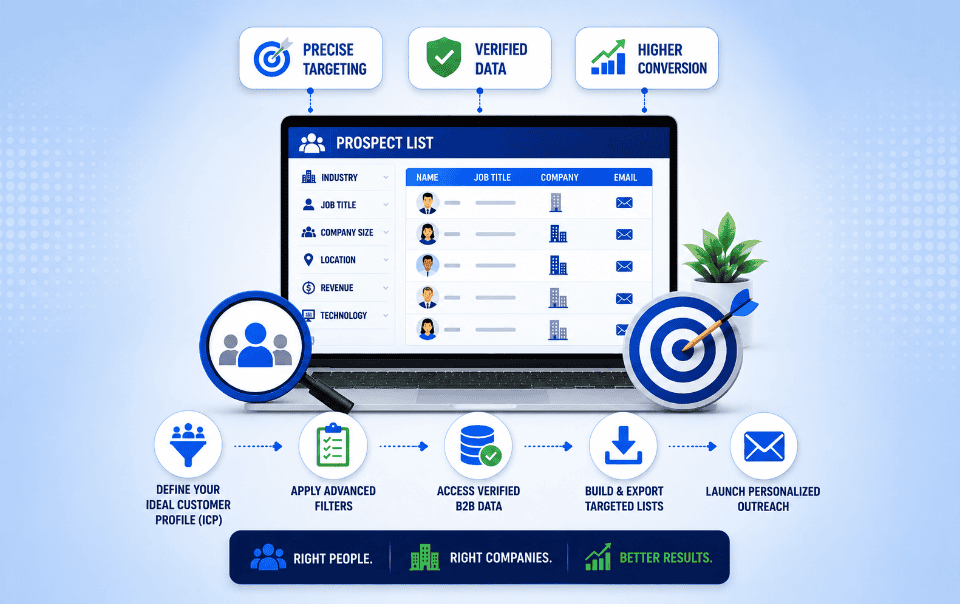
Building targeted B2B prospect lists is one of the fastest ways to improve outreach and get better leads. Instead of chasing random contacts, you focus on the right decision-makers who are more likely to respond and convert.
Generic databases often lead to wasted time, low engagement, and poor results. A targeted approach helps sales and marketing teams reach the right people with the right message.
In this guide, you’ll learn how to build accurate, compliant, and high-performing B2B prospect lists, plus the key data points, common mistakes, and best practices to keep your pipeline strong.
A B2B Prospect List is a curated collection of businesses and decision-makers that match your ideal customer profile (ICP) and are potential buyers of your products or services. Unlike general marketing databases, targeted prospect lists focus on companies and contacts that fit specific business criteria, increasing the likelihood of meaningful engagement.
A quality B2B prospect database typically includes:
Targeted B2B lead lists improve sales efficiency by helping teams focus on qualified prospects instead of broad audiences.
Organizations using well-segmented B2B sales prospecting lists spend less time researching and more time engaging with qualified buyers.
Avoid these frequent pitfalls:
Small improvements in list quality often produce significant gains in campaign performance.
Building targeted Business prospect lists starts with identifying your ideal customers and using a trusted data provider to access accurate, verified business contact information. Instead of spending countless hours researching prospects manually, businesses can streamline the process with reliable, regularly updated data.
Before building your prospect list, clearly define your Ideal Customer Profile (ICP). Consider factors such as:
A well-defined ICP ensures your outreach focuses on organizations that are most likely to benefit from your products or services.
These advanced segmentation options enable sales and marketing teams to create highly relevant prospect lists for outbound sales, account-based marketing (ABM), lead generation, and email marketing campaigns.
Organize your prospects into smaller, targeted groups based on criteria such as industry, company size, job role, or location. Segmentation allows you to personalize messaging and improve engagement across different buyer personas.
Even high-quality business data should be reviewed and refreshed regularly. Maintaining clean, up-to-date prospect lists helps reduce email bounce rates, improve deliverability, and ensure your sales team is always working with accurate information.
Whether you’re launching an outbound sales campaign, expanding into new markets, or running targeted marketing initiatives, DataCaptive helps you build accurate, segmented, and high-quality B2B Prospect Lists that support better engagement and stronger business growth.
Experience the power of verified B2B Prospect Lists. Get a free sample to see how it can fuel your lead generation.
Follow these proven strategies:
A strong B2B Prospect List can make or break your outreach. With DataCaptive, you can build accurate, targeted lists that help you reach the right decision-makers faster and drive better results.
Whether you’re building lists internally or using a trusted business data provider, investing in quality prospect data delivers lasting value for demand generation, ABM, and outbound sales.
Ready to sharpen your prospecting strategy? Start with your ideal customer profile and let DataCaptive help you build smarter B2B prospect lists.
B2B Prospect Lists are curated databases of businesses and decision-makers that match your Ideal Customer Profile (ICP). They typically include verified contact information, company details, and firmographic data to support targeted sales and marketing campaigns.
Targeted B2B Prospect Lists focus on businesses that are more likely to need your products or services. This improves email engagement, increases response rates, enhances personalization, and delivers a higher return on investment (ROI).
A reliable B2B prospect database should include company name, contact name, verified business email, phone number, job title, industry, company size, annual revenue, location, technology stack, and other firmographic details.
Start by defining your Ideal Customer Profile (ICP), identifying your target decision-makers, and using a trusted B2B data provider like DataCaptive to access verified, opt-in business contact data. Segment your audience based on relevant criteria and regularly update your database to ensure high data accuracy and campaign performance.
Business contact data changes frequently due to employee turnover, company growth, and organizational restructuring. DataCaptive refreshes and verifies its B2B prospect database every 45 days, helping businesses maintain accurate, up-to-date prospect lists for more effective sales and marketing campaigns.
Yes. Leading B2B data providers, such as DataCaptive, allow businesses to customize prospect lists using customization like industry, job title, company size, revenue, geographic location, technologies used, SIC/NAICS codes, and executive level.
DataCaptive provides verified, opt-in B2B contact data that enables businesses to create highly targeted prospect lists for account-based marketing (ABM), lead generation, email marketing, and outbound sales. Its advanced segmentation options help sales and marketing teams reach the right decision-makers more efficiently.
DataCaptive offers industry-specific B2B Prospect Lists across sectors including healthcare, manufacturing, technology, finance, education, retail, construction, logistics, hospitality, and many other business verticals.
Yes. DataCaptive’s verified and opt-in business contact database is designed to support email marketing, outbound sales, demand generation, lead nurturing, and account-based marketing campaigns while helping improve deliverability and campaign performance.
DataCaptive combines verified business data, advanced audience segmentation, regular database updates, customizable prospect lists, and comprehensive industry coverage to help businesses connect with qualified decision-makers and improve sales and marketing results.
Get a Sample Email List
Get A Quote on Price
