
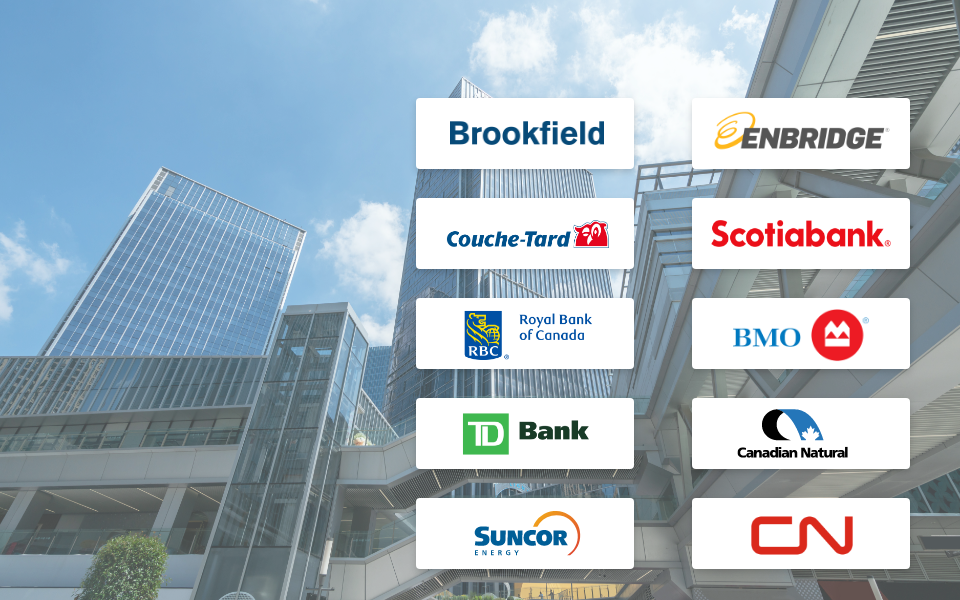
Canada is home to some of the largest and most influential businesses in North America. But which are the top 10 companies in Canada, and which businesses rank among the biggest companies in Canada by revenue? This updated 2026 list highlights the top 10 Canadian companies based on their latest reported annual revenue, covering major names across banking, energy, retail, financial services, and transportation.
If you are researching the top companies in Canada for market research, investment research, B2B sales, or industry analysis, this guide provides a quick comparison of the country’s largest companies and the revenue figures behind their rankings.
The list includes Brookfield Corporation, Toronto-Dominion Bank, Royal Bank of Canada, Alimentation Couche-Tard, Enbridge, Suncor Energy, Bank of Nova Scotia, Bank of Montreal, Canadian Natural Resources, and Canadian National Railway. Because companies have different fiscal year-end dates, the applicable fiscal year is shown in the ranking table.
| Rank | Company | Revenue | Fiscal Year | Industry | Headquarters | Employees |
|---|---|---|---|---|---|---|
| 1 | Brookfield Corporation | US$75.1 billion | 2025 | Financial Services | Toronto, Ontario | 250,000+ |
| 2 | Toronto-Dominion Bank | C$67.777 billion | FY2025 | Banking | Toronto, Ontario | 100,000+ |
| 3 | Royal Bank of Canada | C$66.605 billion | FY2025 | Banking | Toronto, Ontario | 90,000+ |
| 4 | Alimentation Couche-Tard | US$72.857 billion | FY2025 | Retail | Laval, Quebec | 100,000+ |
| 5 | Enbridge Inc. | C$65.194 billion | 2025 | Energy | Calgary, Alberta | 16,000+ |
| 6 | Suncor Energy Inc. | C$52.377 billion | 2025 | Energy | Calgary, Alberta | 16,000+ |
| 7 | Bank of Nova Scotia | C$37.741 billion | FY2025 | Banking | Toronto, Ontario | 90,000+ |
| 8 | Bank of Montreal | C$36.274 billion | FY2025 | Banking | Montreal, Quebec | 46,000+ |
| 9 | Canadian Natural Resources Ltd. | C$38.762 billion | 2025 | Energy | Calgary, Alberta | 10,000+ |
| 10 | Canadian National Railway | C$17.304 billion | 2025 | Transportation | Montreal, Quebec | 25,000+ |
Brookfield Corporation is a Toronto-based global investment and business-services company with operations across multiple industries and markets. Its businesses span asset management, infrastructure, renewable power, private equity, real estate, and wealth solutions.
Brookfield’s global portfolio and diversified operations contribute to its substantial revenue and business scale. Its presence across investment management, infrastructure, renewable energy, and real estate makes it one of the most prominent Canadian investment companies with a global footprint.
Toronto-Dominion Bank, commonly known as TD Bank, is one of Canada’s largest financial institutions. It serves personal, commercial, and institutional customers across Canada and the United States.
TD’s extensive banking operations, lending activities, customer base, and North American presence contribute to its substantial business scale. Its diversified services also make it one of the leading Canadian banking companies.
Royal Bank of Canada, commonly known as RBC, is a major Canadian financial-services organization serving individuals, businesses, institutions, and investors. Its operations cover banking, wealth management, capital markets, and insurance.
RBC’s diversified financial-services operations generate significant business activity across Canada and international markets. Its scale and broad range of services place it among the most important Canadian financial services companies.
Alimentation Couche-Tard is a Quebec-based convenience-store and fuel retailer with operations across several international markets. Its business serves consumers through convenience stores, fuel locations, food and beverage offerings, and related retail services.
Couche-Tard’s extensive international store network and high-volume convenience and fuel sales contribute to its substantial revenue. Its scale makes it one of the most significant Canadian retail companies.
Enbridge is a major North American energy infrastructure company headquartered in Calgary. Its operations support the transportation, distribution, and delivery of energy across Canada and the United States.
Enbridge operates an extensive energy infrastructure network connecting producers, utilities, businesses, and consumers. Its large pipeline and energy-distribution operations make it one of the leading Canadian energy companies.
Suncor Energy is an integrated Canadian energy company with operations covering resource production, refining, marketing, and retail. Its integrated model allows the company to operate across multiple stages of the energy value chain.
Suncor’s large-scale energy operations and integrated business model generate substantial revenue. Its role across oil production, refining, and retail makes it one of the major oil and gas companies in Canada.
Bank of Nova Scotia, commonly known as Scotiabank, is one of Canada’s major banking institutions. It provides financial products and services to consumers, businesses, and institutional customers across Canada and international markets.
Scotiabank’s broad customer base, diversified financial services, and international operations contribute to its significant business scale. Its position across Canadian and international markets makes it a major player in the Canadian banking industry.
Bank of Montreal, commonly known as BMO Financial Group, is one of Canada’s major financial institutions. It operates across Canada and the United States and serves consumers, businesses, institutional clients, and investors.
BMO’s broad North American financial-services operations generate significant business activity. Its Canadian banking, U.S. operations, wealth management, and capital-markets businesses support its position among the largest Canadian banks.
Canadian Natural Resources Ltd. is one of Canada’s largest oil and natural gas producers. The company has a diversified portfolio spanning oil sands, crude oil, natural gas, and related energy operations.
Canadian Natural Resources benefits from its large production base and extensive energy assets. Its scale in oil and natural gas production makes it one of the country’s leading Canadian oil and gas companies.
Canadian National Railway, commonly known as CN, is one of North America’s major rail transportation companies. Its network connects Canadian and U.S. markets and supports the movement of raw materials, agricultural products, manufactured goods, and consumer products.
CN’s extensive rail network supports Canada’s domestic and international supply chains. Its ability to transport large volumes of goods across Canada and into the United States makes it one of the country’s most important Canadian transportation companies.
We used annual reported revenue as the primary metric for ranking the largest companies in Canada.
Several other businesses are important parts of Canada’s corporate landscape but may fall outside this top 10 revenue ranking depending on the measurement and reporting period.
Notable names include Shopify, Loblaw Companies, Canadian Imperial Bank of Commerce, Cenovus Energy, Magna International, Nutrien, BCE, Rogers Communications, and TELUS.
These companies operate across technology, retail, banking, energy, manufacturing, telecommunications, and other major sectors of the Canadian economy.
Canada’s largest businesses are concentrated in several major industries.
| Industry | Major Companies |
|---|---|
| Banking & Financial Services | RBC, TD, Scotiabank, BMO |
| Energy | Enbridge, Suncor, Canadian Natural Resources |
| Retail | Alimentation Couche-Tard |
| Transportation | Canadian National Railway |
| Investment & Asset Management | Brookfield |
The strong representation of financial services and energy companies reflects the importance of these sectors within Canada’s corporate economy.
Canada’s major companies are concentrated around several key economic regions.
This geographic concentration highlights Toronto, Montreal, Calgary, and Vancouver as important Canadian business hubs.
The term “largest company” can refer to different measurements.
Revenue measures the income a company generates from its business activities during a reporting period. Market capitalization measures the total market value of a publicly traded company’s outstanding shares.
As a result, a company with higher revenue may not have the highest market capitalization. For this article, revenue is the primary ranking metric.
A ranking of Canada’s largest companies can help with market research, but sales and marketing teams may need more detailed information to identify potential accounts and decision-makers.
Businesses can build targeted prospect lists based on:
DataCaptive provides datasets that can help businesses identify Canadian companies and relevant business contacts using these types of targeting criteria.
For example, sales teams looking for prospects in Canadian banking can identify financial institutions and target relevant executives or department heads. Similarly, businesses selling into energy, retail, technology, manufacturing, or transportation can create industry-specific prospect lists.
Relevant DataCaptive datasets include Canada Email Database, Canadian Company Database, B2B Contact Database, and C-Level Executives Database.
The largest company in Canada by revenue can vary depending on the fiscal year and ranking methodology. This list uses the latest available annual revenue reported by each company and identifies the fiscal year used for comparison.
The 10 companies covered in this ranking are Brookfield Corporation, Toronto-Dominion Bank, Royal Bank of Canada, Alimentation Couche-Tard, Enbridge, Suncor Energy, Bank of Nova Scotia, Bank of Montreal, Canadian Natural Resources, and Canadian National Railway. The ranking is based primarily on annual revenue.
The answer depends on the reporting period and whether the ranking uses annual revenue or trailing-12-month revenue. This article uses annual reported revenue from the latest completed fiscal year available for each company.
Banking and financial services and energy have a strong presence among Canada’s largest companies. Retail, investment management, and transportation also contribute several major companies to the country’s corporate landscape.
Several of Canada’s largest companies employ tens of thousands of people across Canada and international markets. Employee totals can vary by reporting period and may include employees across different subsidiaries and operating businesses.
This ranking uses annual revenue as the primary metric. Market capitalization is different because it represents the total market value of a publicly traded company’s outstanding shares. Therefore, a company ranked highly by revenue may have a different position when companies are ranked by market capitalization.
The ranking can change from year to year as companies report new financial results, expand their operations, complete acquisitions, or experience changes in commodity prices and market conditions. Different reporting periods can also affect the order.
Businesses can use B2B contact data and company databases to identify organizations and decision-makers based on industry, location, revenue, employee size, and job title. DataCaptive provides targeted business contact datasets that can help sales and marketing teams find relevant Canadian companies and decision-makers based on specific targeting criteria.
Looking for targeted Canadian business contacts? Get a DataCaptive sample to evaluate the available company and decision-maker data.
Company annual reports, financial statements, investor-relations pages, regulatory filings, and official company financial releases should be used as the primary sources for revenue, employee, headquarters, and business information.
Because companies have different fiscal year-end dates and reporting methods, each revenue figure should be checked against the company’s latest annual report before publication.
Get a Sample Email List
