
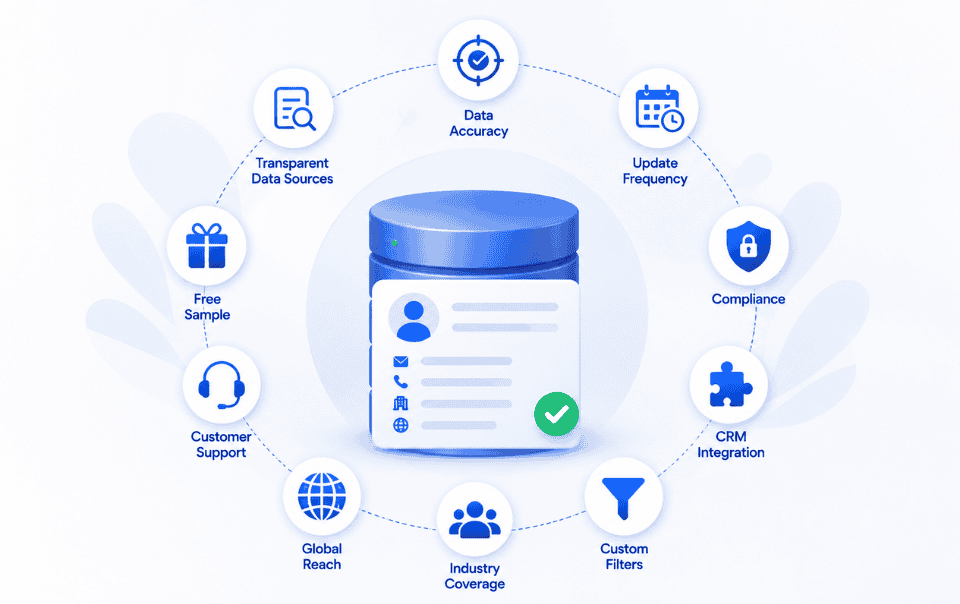
To maximize ROI, businesses should maintain data quality through regular verification and hygiene, comply with regulations such as GDPR, CCPA, CAN-SPAM, and ISO 27001, and choose a provider based on data accuracy, industry coverage, compliance standards, and your specific sales requirements. Providers like DataCaptive, Apollo.io, ZoomInfo, Cognism, or Lusha based on their target audience, data coverage, accuracy, compliance, and business goals.
A B2B contact database helps sales and marketing teams connect with the right decision-makers faster. Instead of spending hours searching for accurate contact information, businesses can focus on building relationships, generating qualified leads, and closing more deals.
But not all databases offer the same level of accuracy, coverage, or compliance. Choosing the right data source can directly impact your outreach success, campaign performance, and sales pipeline.
In this guide, you’ll learn what a B2B contact database is, the different types available, where the data comes from, and the best practices for maintaining accurate, compliant, and high-performing contact data.
A B2B contact database is a centralized collection of business contact information that helps organizations identify, connect with, and engage potential customers. It contains verified details about professionals and the companies they work for, enabling sales and marketing teams to reach the right decision-makers more efficiently.
A typical B2B contact database includes information such as:
Sales and marketing teams use this information to create targeted campaigns, personalize communication, and improve customer acquisition strategies.
For a deeper understanding of data quality factors, explore our guide: [What Makes High-Quality B2B Contact Data?]
Finding the right person within a company is often the biggest challenge in B2B sales. A quality database helps businesses identify:
This allows sales teams to connect with professionals who have purchasing authority.
Learn how to identify the right stakeholders with our guide on finding decision-makers in target companies.
B2B contact databases make it easier to build targeted prospect lists based on:
This enables sales teams to focus on high-value prospects instead of wasting resources on irrelevant contacts.
Learn more: How to Build Targeted B2B Prospect Lists Quickly
ABM requires accurate account and contact intelligence to deliver personalized campaigns.
A B2B database helps marketing teams:
A verified B2B database helps reduce:
It allows revenue teams to spend more time building relationships and closing deals.
CRM enrichment improves:
Not every organization requires the same type of database. The right choice depends on your target audience, sales strategy, and growth objectives.
Here are the most common categories.
These databases focus on contacts within a particular industry, such as healthcare, manufacturing, finance, retail, or technology. They help businesses target prospects with greater precision and tailor messaging to industry-specific challenges.
Organizations expanding into new regions often rely on databases segmented by country, state, city, or territory. Geographic segmentation supports localized marketing campaigns and regional sales strategies.
Many organizations focus on reaching professionals based on their job responsibilities, including:
Role-based segmentation enables more relevant messaging and increases engagement rates.
Companies implementing Account-Based Marketing (ABM) often build databases around high-value target accounts instead of broad audiences. These databases include multiple stakeholders within each organization, helping sales teams engage buying committees rather than individual contacts.
A high-quality B2B contact database is built by collecting, verifying, and enriching information from multiple trusted sources. Reputable data providers combine information from public records, business directories, company websites, first-party data, and proprietary research to deliver accurate and up-to-date business contact information.
Common sources of B2B contact data include:
Using multiple trusted sources, along with regular verification and updates, helps improve data accuracy, reduce outdated records, and provide reliable business insights for sales and marketing teams.
Looking for trusted B2B data providers? Explore our guide on The Best Sources for Accurate B2B Contact Data to compare leading providers and learn how to choose the right solution for your business.
Not all business data is collected the same way. Understanding the difference between first-party and third-party data helps businesses choose the right prospecting strategy.
First-party data is collected directly from your audience through your own marketing and sales activities, including:
This data is highly relevant because it comes directly from prospects who have engaged with your business.
Third-party data is collected by specialized data providers from multiple verified sources and made available to businesses looking to expand their reach.
It helps organizations:
Many businesses achieve the best results by combining first-party insights with trusted third-party contact data.
Explore the complete comparison in our blog: First-Party vs Third-Party B2B Data: Key Differences Explained.
Although these terms are often used together, they serve different purposes.
Contact Data answers “Who should you contact?” It includes business emails, phone numbers, job titles, and company details that help sales teams identify the right decision-makers.
Intent Data answers “Who is actively researching a solution?” It tracks online behaviors such as content consumption, product research, and buying signals to identify prospects showing purchase intent.
When combined, contact data and intent data enable businesses to prioritize high-value opportunities and create more personalized outreach strategies.
Learn how these data types work together in: Intent Data vs Contact Data: What’s the Difference?
Reaching the right contact is one of the most important factors in B2B sales success. A comprehensive B2B contact database helps businesses identify professionals with purchasing authority instead of relying on generic company information.
Depending on your product or service, the ideal decision-maker may include:
Customized contacts by job title, department, seniority, industry, and company size allows sales teams to focus on prospects who are most likely to influence buying decisions.
Discover practical strategies in our guide: How to Find Decision Makers in Target Companies.
A successful outreach campaign starts with a well-defined prospect list. Rather than targeting every business, organizations should focus on contacts that closely match their Ideal Customer Profile (ICP).
A targeted B2B prospect list can be built using customizations such as:
Highly targeted prospect lists help improve personalization, increase response rates, and maximize marketing ROI.
Read our complete guide: How to Build Targeted B2B Prospect Lists Quickly.
The value of a B2B contact database depends on the quality of its data. Inaccurate or outdated records can lead to bounced emails, poor campaign performance, and wasted sales efforts.
High-quality B2B contact data should be:
Learn the key quality indicators in: What Makes High-Quality B2B Contact Data?
To maintain a reliable database, businesses should:
Consistent verification helps improve campaign performance, protect your sender reputation, and ensure your sales team works with accurate contact information.
Want to improve your database accuracy? Read our guide on B2B Contact Data Verification: Best Practices for Accurate Data to learn proven verification techniques and validation strategies.
Data verification is only one part of maintaining a healthy database. Ongoing data hygiene ensures your CRM and marketing database remain clean, organized, and ready for outreach.
Effective data hygiene includes:
A clean database improves segmentation, personalization, reporting, and marketing automation while helping sales teams work more efficiently.
Learn how to maintain a healthy database in our detailed guide on B2B Data Hygiene Best Practices to Keep Your Database Accurate.
As businesses collect and use contact information, complying with global data privacy regulations is essential. Responsible data management not only reduces legal risks but also builds trust with prospects and customers.
Some of the most important compliance standards include:
Working with a provider that follows these standards helps ensure your contact data is collected, stored, and managed responsibly.
Learn how to stay compliant by reading our guide on B2B Data Compliance: ISO 27001, GDPR, CCPA, and Best Practices.
Enterprise prospecting requires a more strategic approach than traditional lead generation.
Large organizations often have complex buying processes involving multiple stakeholders, longer sales cycles, and higher-value opportunities.
By combining accurate contact data with strategic prospecting, businesses can shorten sales cycles, build stronger relationships, and generate more qualified enterprise opportunities.
Want to improve your enterprise sales strategy? Explore our guide on B2B Prospecting Strategies for High-Value Enterprise Leads to learn proven techniques for identifying, engaging, and converting enterprise decision-makers.
When comparing providers, consider whether they offer:
For organizations looking to scale lead generation and improve outreach, DataCaptive provides verified, opt-in B2B contact databases with over 200M+ business contacts, 95% data accuracy, regular 45-day database updates, customizable audience segmentation, and CRM-ready data to help sales and marketing teams connect with the right decision-makers.
Experience the power of verified B2B contact data. Get a free sample to see how it can fuel your lead generation.
A B2B contact database is a critical asset for modern sales and marketing teams. But the true value comes from maintaining accurate data, targeting the right prospects, and using information responsibly.
From identifying decision-makers and building targeted prospect lists to improving data quality and maintaining compliance, every step plays a role in creating successful outreach campaigns.
With a trusted B2B data partner such as DataCaptive, sales and marketing teams can access reliable business intelligence, improve prospect targeting, and focus on converting opportunities into long-term customers.
When choosing a B2B contact database provider, look for verified and regularly updated data, high accuracy, transparent data sourcing, compliance with regulations such as ISO 27001, GDPR and CCPA, customizable audience segmentation, CRM integration, and responsive customer support. Selecting a provider that aligns with your target market and business goals will improve prospecting and campaign performance.
Yes. Purchasing and using a B2B contact database is legal when the data is collected, managed, and used in compliance with applicable privacy regulations such as ISO 27001, GDPR, CCPA, CAN-SPAM, and other regional data protection laws. Businesses should always work with trusted providers that follow responsible data collection and compliance practices.
Yes. DataCaptive allows businesses to build fully customized B2B contact databases based on their ideal customer profile (ICP). You can customize contacts by industry, job title, company size, annual revenue, geographic location, technologies used, SIC/NAICS codes, seniority level, and other firmographic criteria. This helps sales and marketing teams create highly targeted prospect lists, personalize outreach, and improve lead generation and conversion rates.
Get a Sample Email List
Get A Quote on Price
