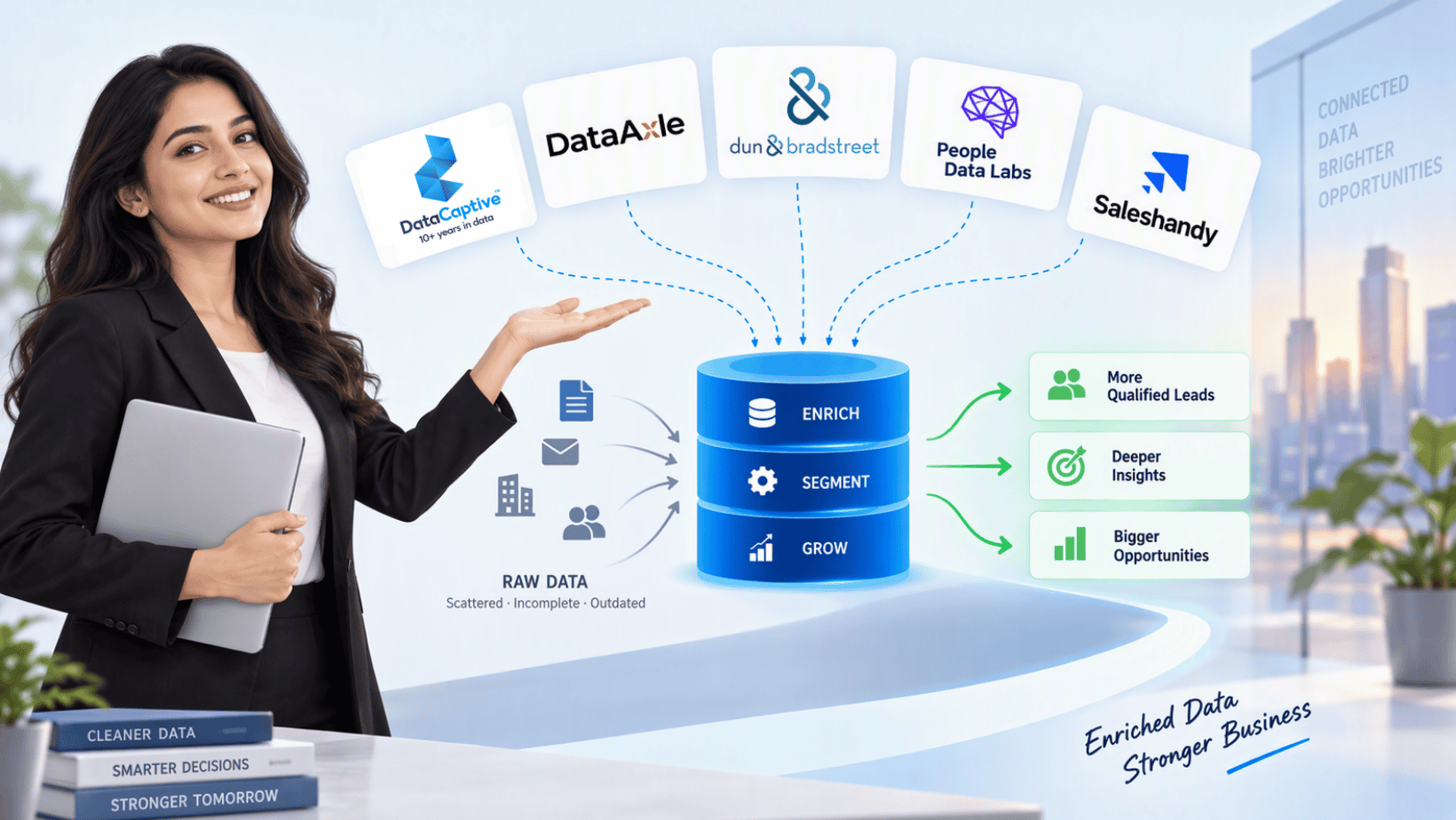
There are plenty of B2B data providers in the market, and honestly, most of them sound pretty similar at first.
They all promise accurate business data, better contact coverage, and more efficient sales prospecting. But not every provider delivers the same value in database enrichment.
Some focus on company intelligence and business records; others specialize in API-driven enrichment and data management. Others provide targeted B2B contact data to help teams fill gaps in existing databases and reach the right decision-makers.
So, the question isn’t really, “Which B2B data provider is the best?”
It’s “Which provider can help your team enrich existing records with accurate, relevant, and up-to-date business data without adding unnecessary costs or complexity?”
Let’s compare five B2B data providers worth considering in 2026 and explore what matters most when choosing the right solution for your database enrichment needs.
B2B database enrichment improves existing business records by adding missing information, correcting outdated fields, and matching contacts to the right companies.
For example, a CRM record might contain a prospect’s name and business email but lack their current job title, company size, industry, or headquarters location. An enrichment platform can supply some of these fields, depending on its data coverage and matching capabilities.
Common enrichment fields include:
For mid-market teams, effective business data enrichment can improve segmentation, reduce manual research, support account-based marketing, and help sales representatives spend more time engaging qualified prospects.
The best provider depends on your enrichment requirements, target geography, and existing technology stack. These five providers offer different approaches to business data enrichment.
| Provider | Best suited for | Enrichment focus | Integration approach |
|---|---|---|---|
| DataCaptive | Targeted B2B prospect data | Contact data, custom lists, cleansing | Confirm available delivery options |
| Data Axle | CRM data maintenance | Business records, matching, enrichment | CRM integrations, APIs |
| Dun & Bradstreet | Enterprise company intelligence | Entity resolution, firmographics, corporate linkages | APIs, batch, cloud, CRM workflows |
| People Data Labs | Developer-led enrichment | Person and company profiles | Enrichment and search APIs |
| Saleshandy | Outbound sales teams | Contact and company enrichment | CSV workflows, Data API, outreach tools |
These five providers serve different enrichment needs. The comparison below focuses on their core capabilities rather than treating them as interchangeable tools.
Best for: Custom B2B contact enrichment and targeted prospect data.
DataCaptive helps businesses enrich their databases with professional contact details and company information for sales prospecting, audience segmentation, and marketing campaigns. It is a practical choice for mid-market teams looking to fill data gaps, identify relevant decision-makers, and build more targeted prospect lists across industries.
DataCaptive provides access to 500M+ contacts, 75M+ company profiles, and 95% contact-data accuracy, helping businesses strengthen their prospecting efforts with relevant B2B data.
DataCaptive helps businesses enrich contact records with professional details and relevant company information. Its targeting capabilities help teams build more complete prospect profiles based on industry, company characteristics, geography, and decision-maker roles.
With a 95% contact-data accuracy benchmark, DataCaptive helps businesses prioritize reliable contact information for prospecting. Teams can request a free sample to evaluate record quality and field coverage for their specific audience.
DataCaptive’s enrichment services help teams prepare and improve business records for their existing sales and marketing workflows. Businesses can discuss suitable data delivery formats and requirements to align enrichment with their CRM processes.
DataCaptive aligns its data practices with key privacy and security frameworks and regulations, including GDPR, CCPA, PIPEDA, DPDPA, ISO 27001:2022, and SOC 2. These frameworks support data privacy, information security, and responsible data management, helping businesses evaluate compliance requirements across their target markets and data workflows.
Targeted contact enrichment, customizable prospect data, industry-specific segmentation, and support for improving sales and marketing databases.
Request a custom quote based on your data requirements, target audience, and enrichment needs.
DataCaptive is a practical option for businesses that want to improve contact coverage, enrich prospect records, and access audience-specific B2B data without adding unnecessary complexity to their prospecting workflows.
Best for: Business data enrichment and CRM data maintenance.
Data Axle combines business data with enrichment, identity resolution, and integration capabilities. Its solutions are particularly relevant to teams that want to improve existing records instead of relying only on newly purchased contact lists.
The provider offers CRM integrations for platforms including Salesforce and Microsoft Dynamics, with business attributes available for segmentation and enrichment. Its business data solutions also support APIs, custom integrations, and broader marketing-data workflows.
Data Axle is a strong candidate when maintaining business records is an ongoing operational priority. Its CRM integrations and configurable enrichment workflows can help teams reduce manual updates and keep account information consistent.
Organizations seeking a lightweight, contact-list-only solution may find its wider data capabilities unnecessary. Buyers should also verify geographic coverage, contact-level fields, and implementation requirements for their specific use case.
Contact Data Axle for a tailored plan.
Data Axle deserves consideration when CRM hygiene and ongoing business-data maintenance are central to the project, rather than just adding email addresses to a prospect list.
Best for: Company intelligence, entity matching, and enterprise data governance
Dun & Bradstreet (D&B) is particularly relevant when database enrichment requires a reliable view of organizations and their relationships. Its D&B Connect solutions support matching, cleansing, enrichment, and management of company and contact records.
D&B also uses D-U-N-S Numbers to help identify and distinguish business entities. Its enrichment capabilities can include company financials, corporate hierarchies, principals, contacts, and other licensed business attributes.
D&B is a strong option for companies that need deeper firmographic information, parent-subsidiary relationships, standardized business identifiers, and more structured data governance.
Smaller teams with straightforward contact-enrichment needs may not require its broader enterprise capabilities. Buyers should assess implementation complexity, licensing, and the exact contact fields included in their package.
Typically requires a tailored discussion based on products, data coverage, and usage.
D&B is especially worth evaluating when the challenge is understanding and standardizing business entities across systems—not simply finding missing prospect emails.
Best for: API-driven enrichment and custom data workflows
People Data Labs (PDL) is a data infrastructure option for teams that want to enrich people and company records programmatically. Its APIs allow applications to submit identifying information and retrieve matching profiles, making it relevant to RevOps teams, developers, data engineers, and businesses building their own prospecting systems.
PDL is worth considering when enrichment needs to happen inside a product, internal database, application, or automated pipeline. Developers can build workflows around specific fields and matching requirements instead of depending entirely on a manual interface.
Teams without technical resources may need engineering support to implement and maintain API integrations. Test match quality, available fields, usage limits, and data licensing before committing.
Depends on product access, usage, and licensing requirements.
PDL is a compelling candidate for API-first enrichment, especially when a company wants control over how data enters its systems.
Best for: Contact enrichment connected to outbound prospecting
Saleshandy is associated with cold email outreach, but its current product offering also includes B2B data access and enrichment capabilities. Its Data API returns company and contact information, while its Lead Finder CSV enrichment feature lets users upload existing records and add available contact and firmographic fields.
Saleshandy is relevant for teams that want to move from finding and enriching prospects to running outbound campaigns. Combining data access with outreach workflows can reduce the number of separate tools involved in prospecting.
Organizations looking primarily for enterprise-wide company master data, advanced corporate linkage analysis, or extensive governance workflows should compare its enrichment scope with specialist data-management providers.
Check the current plan, API credits, and usage terms for the data products you need.
Saleshandy is a practical candidate for outbound-focused teams that want enrichment to support prospecting and email outreach. Evaluate its fit separately from broader enterprise data-management requirements.
The right provider should solve your database problems without introducing unnecessary costs, duplicate records, or integration work. Evaluate these five factors before making a decision.
A large database doesn’t guarantee accurate records. Check match rates, email and phone validity, current job titles, and company details. Test a sample to verify field-level accuracy before choosing a provider.
Identify the fields your team needs, such as business emails, direct dials, job titles, industry, company size, and revenue. Choose a provider that fills gaps in your database with relevant information.
Check compatibility with your CRM and marketing tools. Look for API access, native integrations, CSV uploads, automated updates, and duplicate management to simplify enrichment workflows.
Review the provider’s data sourcing, privacy policies, licensing terms, and security standards. Ensure its practices align with applicable requirements, such as GDPR, CCPA, PIPEDA, and other relevant regulations.
Outdated records can waste sales efforts. Check data refresh frequency, verification processes, and ongoing enrichment options to keep contact and company information current.
The right B2B data provider depends on your enrichment goals, data quality requirements, and existing workflows.
➦ DataCaptive: A practical choice for targeted B2B contact enrichment, custom prospect data, and industry-specific segmentation to help sales and marketing teams improve database coverage.
➦ Data Axle: Best for business data enrichment, CRM data maintenance, and record cleansing.
➦ Dun & Bradstreet: Best for company intelligence, business identity matching, and corporate hierarchies.
➦ People Data Labs: Best for API-driven enrichment and automated data workflows.
➦ Saleshandy: Best for prospect enrichment connected to outbound sales and email outreach.
Before choosing, compare each provider’s enrichment depth, data accuracy, CRM compatibility, compliance readiness, and data freshness. Consider DataCaptive if your priority is enriching contact records with relevant B2B data tailored to your target audience. Request a free sample to evaluate data quality and field coverage for your needs.
The best B2B data provider isn’t the one with the biggest database—it’s the one that delivers accurate, relevant data, fits your workflow, and keeps your records fresh.
Data Axle and Dun & Bradstreet support broader business-data needs; People Data Labs excels in API-driven enrichment, Saleshandy connects prospecting with outreach, and DataCaptive offers targeted contact data and customized enrichment.
Before deciding, test data samples, verify accuracy, and compare total costs.
Request a free sample from DataCaptive and see how well it fits your target audience and enrichment needs.
B2B data providers supply business information, including company profiles, professional email addresses, phone numbers, job titles, and industry details. Sales and marketing teams use this data to enrich CRM records, improve segmentation, and identify relevant prospects.
Database enrichment fills missing information, updates outdated records, and improves the completeness of company and contact profiles. It helps sales teams prioritize prospects and enables marketing teams to build more targeted campaigns.
Compare providers based on data accuracy, enrichment depth, data freshness, CRM compatibility, compliance readiness, and pricing. Request a sample and test it against your existing records before deciding.
Popular options include DataCaptive, Data Axle, Dun & Bradstreet, People Data Labs, and Saleshandy. Each serves different needs, from targeted contact enrichment and business data maintenance to company intelligence, API-based enrichment, and outbound prospecting.
Depending on the provider, enrichment may include business email addresses, direct dial phone numbers, job titles, company names, industry classifications, company size, geographic details, and other firmographic or professional attributes.
Many B2B data providers support CRM workflows through native integrations, APIs, or CSV file delivery. Before choosing a provider, confirm compatibility with your CRM, field-mapping requirements, duplicate-handling process, and update frequency.
Businesses can evaluate data accuracy by testing sample records for valid email addresses, working phone numbers, current job titles, correct company details, and match rates. Regular verification and data-refresh processes also help maintain database quality.
Review how a provider sources data, handles personal information, manages permissions, and supports applicable privacy and security requirements. Depending on your markets and use case, relevant considerations may include GDPR, CCPA, PIPEDA, and DPDPA, along with information-security standards such as ISO 27001 and SOC 2. Requirements vary by jurisdiction and provider.
DataCaptive helps businesses enrich contact and company records with professional contact details and company information for prospecting, audience segmentation, and marketing campaigns. Its database includes 500M+ contacts and 75M+ company profiles, with a 95% contact-data accuracy benchmark. Businesses can request a free sample to evaluate data suitability for their enrichment needs.
Start by identifying the missing fields in your database, your target industries, and the contact roles you want to reach. Then explore DataCaptive’s data enrichment services and request a free sample to assess record quality and relevance before proceeding.
Get a Sample Email List
