
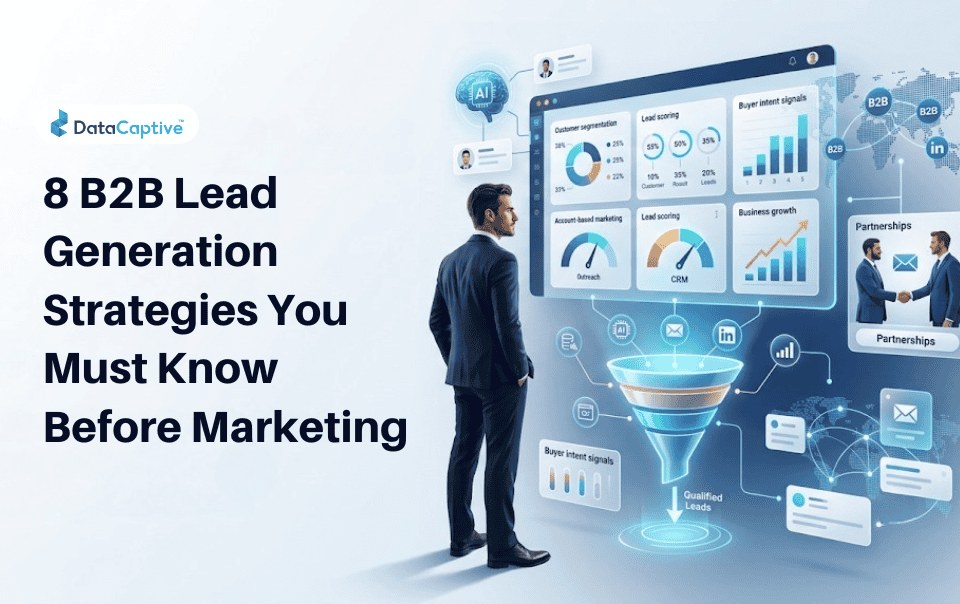
Lead generation in 2026 is about precision, not volume. Buyers now research solutions through search engines, AI assistants, and review platforms before they ever speak with sales, so generic outreach gets ignored quickly.
To stay visible in AI-driven discovery and improve conversions, businesses need targeted data, personalized outreach, and intent-based engagement. The strategies below are designed to help teams attract qualified prospects, shorten sales cycles, and build stronger pipelines without overwhelming readers.
Accurate business data is still the foundation. Instead of manual prospecting, many teams build segmented contact databases by industry, company size, job title, location, revenue, and technology stack.
Today’s buyers expect personalized communication from the very first interaction. Generic email blasts and cold calls are losing effectiveness because decision-makers have become more selective about whom they engage with.
At the same time, search engines are evolving beyond traditional rankings. Google AI Overviews, conversational search engines, answer engines, and large language models now prioritize content that directly answers user intent rather than simply matching keywords. Businesses that align their marketing with these changes gain greater visibility while building trust among potential customers.
The most successful B2B lead generation strategies now focus on three principles:
These principles form the foundation of every strategy discussed below.
Everything starts with knowing exactly who you want to reach.

Many companies waste valuable marketing budgets because they purchase broad contact lists that include businesses outside their ideal customer profile. As a result, response rates remain low while acquisition costs continue to rise.
Instead, begin by defining your Ideal Customer Profile (ICP). Consider factors such as:
Once these criteria are established, build a customized business contact database that reflects your target market instead of a generic audience.
This is where DataCaptive provides significant value. Rather than offering one-size-fits-all data, businesses can request customized contact databases based on their unique sales objectives and targeting requirements.
Learn more about our B2B Email List: B2B Email List
A targeted database improves campaign relevance, increases response rates, and allows sales representatives to spend more time closing deals instead of searching for prospects.

Modern buyers leave digital signals long before submitting a contact form. They search for solutions, download industry resources, compare vendors, attend webinars, and consume educational content throughout their buying journey.
Organizations that monitor these buying signals gain an advantage by reaching prospects while they’re actively evaluating solutions instead of waiting until the buying decision is nearly complete.
Leveraging buyer intent data enables marketing and sales teams to prioritize companies demonstrating genuine interest instead of pursuing cold prospects with little purchase intent.
Combining buyer intent with accurate business contacts creates highly qualified prospect lists that significantly improve campaign performance.
Artificial intelligence has transformed prospecting, but personalization still wins conversations.

Many businesses make the mistake of allowing AI to generate generic emails that sound robotic. Decision-makers quickly recognize automated messaging and often ignore it.
Instead, use AI to improve efficiency while maintaining authentic communication.
Effective personalization includes:
These improvements make email prospecting feel less like mass marketing and more like professional business consulting.
Personalization should extend beyond email. LinkedIn engagement, webinars, newsletters, and educational content all contribute to building familiarity before a direct sales conversation begins.
When AI supports personalization instead of replacing it, outreach becomes far more effective.

They often interact with your brand across several channels before deciding to schedule a meeting. Businesses that diversify their outreach consistently outperform organizations relying on one communication method.
An effective multi-channel approach may include:
This integrated strategy supports stronger demand generation by keeping your brand visible throughout the buyer journey.
Sales representatives can reinforce marketing efforts by following up with personalized outreach after prospects engage with educational resources. This coordinated experience builds trust while increasing conversion opportunities.
For companies that lack the internal resources to manage prospect identification and outreach, partnering with experienced providers can accelerate results.
For companies that lack the internal resources to manage prospect identification and outreach, partnering with experienced providers such as Lead Generation Services can accelerate results.
Instead of focusing solely on generating more leads, successful organizations prioritize generating better-qualified opportunities that align with their sales goals.
As competition increases across industries, businesses embracing integrated marketing and personalized engagement will continue building stronger pipelines while reducing acquisition costs.
Publishing content consistently is no longer enough. In 2026, your content must answer questions clearly so it can appear in Google AI Overviews, AI-powered search experiences, voice search, and large language model responses.

Modern buyers often begin their research by asking detailed questions such as:
When developing educational resources, focus on:
These practices strengthen your B2B lead generation strategies while improving visibility across traditional search engines and AI-powered platforms. Educational content also nurtures prospects until they are ready to engage with your sales team.

People change companies, receive promotions, switch job roles, or update their email addresses regularly. Without ongoing maintenance, your database gradually loses accuracy, resulting in higher bounce rates and lower campaign performance.
Clean data improves deliverability, protects your sender reputation, and helps sales teams spend their time speaking with qualified prospects instead of chasing invalid contacts.
When businesses combine verified contact information with customized prospect lists, their B2B lead generation strategies become more efficient and cost-effective.
Lead generation should never operate on assumptions. Every campaign provides valuable insights that can improve future performance.

Instead of focusing only on the number of leads generated, evaluate the quality of those leads and how they progress through your sales funnel.
Tracking these KPIs helps identify which sales prospecting methods deliver the strongest return on investment.
As your campaigns mature, regularly test new messaging, audience segments, content formats, and outreach channels. Small improvements made consistently often produce significant long-term gains.
The most successful B2B lead generation strategies are continuously refined using real performance data rather than guesswork.
Referrals and strategic partnerships continue to be one of the most dependable ways to improve B2B lead generation strategies. When a prospect is introduced by a trusted source, they are more likely to respond positively, engage in conversation, and move through the sales funnel more quickly.

This approach can be strengthened by building relationships with:
Referral-based outreach is especially effective for businesses using account-based marketing and lead qualification, since referred prospects often already fit the ideal customer profile. When referral programs are combined with accurate contact data and personalized outreach, companies can create a consistent stream of warm opportunities that are easier to convert than cold leads.
Every strategy discussed above depends on one critical factor: reaching the right people with accurate information.
DataCaptive helps businesses simplify this process by providing customized B2B databases built around each organization’s unique targeting requirements. Instead of relying on generic lists, businesses can request contacts segmented by:
Whether your sales team is targeting executives, healthcare organizations, manufacturers, technology companies, financial institutions, or other industries, access to reliable business intelligence creates a stronger foundation for long-term growth.
When businesses use accurate data, personalized outreach, and consistent follow-up, they can improve results and build a stronger sales pipeline.
Using these B2B lead generation strategies can help your team generate better leads and close more deals.
Get a Sample Email List
