
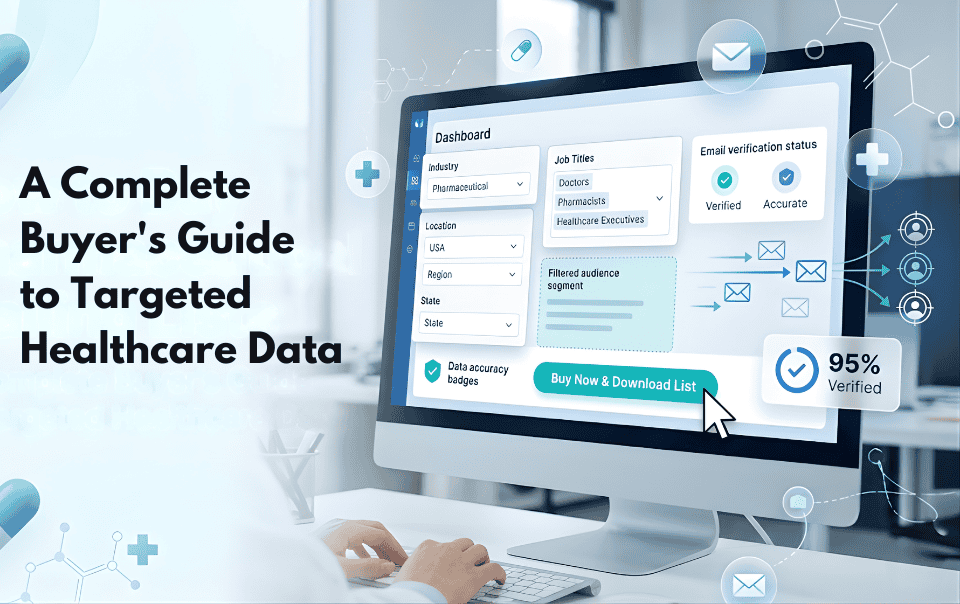
Reaching pharmaceutical decision-makers without a verified contact list is like cold-calling a switchboard and hoping someone transfers you to the right person. It rarely works, and it wastes time your sales team doesn’t have.
A pharmaceutical mailing list gives you direct access to the people who actually make purchasing decisions, procurement heads, R&D directors, compliance officers, and executives at pharma companies. This guide walks you through what these lists include, how to evaluate providers, and the step-by-step process to buy and use pharmaceutical email data effectively.
When you buy pharmaceutical mailing lists, you’re purchasing a database of contact information for professionals and companies in the pharma industry. Top providers like DataCaptive, RSA List Services, and MedicoReach offer verified, compliant contact data that typically includes names, emails, job titles, and phone numbers. Pricing usually falls between $0.03 and $0.07 per contact, though this varies based on list size and how specific your targeting criteria are.
So what exactly are you getting? A pharmaceutical mailing list is essentially a spreadsheet of people you want to reach, procurement managers, R&D directors, compliance officers, and other decision-makers at pharma companies. You can segment and import into your CRM or email platform.
Building a contact list from scratch takes months. You’re researching companies, hunting LinkedIn profiles, and guessing email formats. A pharmaceutical email list skips all of that; you get thousands of verified contacts delivered in a file you can use immediately.
When your sales team has a segmented pharmaceutical email database, they spend their time selling instead of searching. Rather than cold-calling switchboards or sending connection requests into the void, reps can reach out directly to the people who actually make purchasing decisions.
A pharmaceutical mailing list gives you direct access to key decision-makers, executives, procurement heads, and department leaders. You’re not guessing who to contact or hoping your message gets forwarded to the right person.
The same list that powers your email campaigns can also fuel phone outreach, direct mail, and LinkedIn messaging. Coordinating across channels typically produces better response rates than relying on email alone.
If you’re entering a new region or targeting a specialized pharma sub-industry, a purchased list provides instant coverage. You won’t spend months building relationships from zero in unfamiliar territory.
| Data Category | Example Fields |
|---|---|
| Contact Information | Business email, direct dial, mobile, mailing address |
| Firmographic Data | Company name, SIC/NAICS codes, employee count, revenue range |
| Job Title and Seniority | Title, department, decision-making level |
| Technographic Data | CRM software, ERP systems, marketing platforms |
| Geographic Data | Country, state, city, postal code |
This is the core of any pharmaceutical mailing list, the actual ways to reach someone. You’ll typically get business email addresses, direct phone numbers, and physical mailing addresses. Some lists also include LinkedIn profile URLs.
Firmographics describe the company itself. Industry classification codes (SIC and NAICS) tell you what the company does. Employee count and revenue range help you prioritize accounts that match your ideal customer profile.
Role-based fields let you segment by specific titles like “VP of Procurement” or broader categories like “Director-level and above.” This is how you make sure your message reaches someone with actual buying authority.
Technographics reveal what software and systems a company uses, their CRM, ERP, or marketing automation platform. If you’re selling a Salesforce integration, for instance, you’d want to target companies already running Salesforce.
Location fields enable territory-based campaigns. If your sales team is organized by region, geographic segmentation keeps outreach focused and prevents reps from stepping on each other’s accounts.
Software vendors target IT decision-makers and digital transformation leads within pharma companies to sell technology solutions.
CROs and contract manufacturing organizations reach pharmaceutical companies looking to outsource research, development, or manufacturing.
Raw material suppliers and logistics providers connect with purchasing managers and supply chain leaders.
Agencies purchase pharmaceutical companies email lists to run lead generation campaigns on behalf of their clients.
Recruiters access HR managers and hiring decision-makers for talent acquisition campaigns.
Generic email blasts rarely perform well. According to HubSpot’s 2025 State of Marketing Report, 78% of marketers say segmentation is their most effective tactic. Here’s how to approach it.
Segment by seniority level (C-level executives, VPs, Directors) and function (procurement, IT, compliance, R&D). A message written for a CFO looks very different from one aimed at a lab manager.
Target companies that match your ideal customer profile. Enterprise pharma companies have different budgets and buying processes than mid-market biotech startups.
Segment by country, state, or city for territory-based campaigns. This is especially useful when you have regional sales teams or need to account for local compliance requirements.
Segment by specialization to reach companies in specific niches, biotechnology companies, generics, over-the-counter drugs, clinical research, or pharmaceutical manufacturing.
Use technographic segmentation to target companies running specific software. If your product integrates with a particular platform, you can focus on companies already using it.
Tip: The more precisely you segment, the more personalized your outreach can be. Personalization typically lifts response rates significantly compared to generic messaging.
Not all data vendors deliver the same quality. Choosing the wrong provider can mean wasted budget on bounced emails and outdated contacts. Here’s what to evaluate.
Quality providers state their accuracy and deliverability rates upfront. Look for benchmarks around 90% or higher; this indicates clean data that won’t hurt your sender reputation with excessive bounces.
Ask how the data is verified. A solid process combines automated AI tools with human review. Also confirm how often records are updated, every 45 days is a reasonable benchmark, since B2B contact data decays 23–30% per year.
The best providers let you segment by multiple attributes to build highly targeted lists. Avoid generic, one-size-fits-all databases. Look for providers offering 40 or more segmentation attributes.
Make sure the provider complies with GDPR, CAN-SPAM, CCPA, and CASL. Opt-in sourcing, where contacts have consented to receive marketing communications, is essential for legal and ethical outreach under current data protection laws.
Ask providers for their published metrics. Reputable vendors are transparent about accuracy and deliverability. If they won’t share numbers, consider it a warning sign.
Test a sample of records before buying the full list. You can check contacts against your existing CRM or run a quick email verification to confirm accuracy.
Find out how the data is verified. A robust process involves multiple layers, automated tools plus human review to catch errors and outdated information.
B2B contact data degrades over time as people change jobs and companies restructure. Ask how often records are updated and verified to ensure you’re getting fresh contacts.
Legal concerns are reasonable, especially for first-time buyers. Here’s how to stay compliant while running effective campaigns.
If you’re contacting individuals in the EU, your data needs to be GDPR-compliant. With regulators issuing over €6.2 billion in GDPR fines since enforcement began, make sure your provider sources data in ways that respect these regulations.
In the U.S., the CAN-SPAM Act governs commercial email. This includes providing a clear opt-out option and identifying your message as an advertisement.
The California Consumer Privacy Act and similar state laws grant consumers rights over their data. Confirm your provider’s practices align with these requirements.
Opt-in data comes from contacts who have consented to receive marketing communications. Using 100% permission-based lists reduces legal risk and improves deliverability.
Here’s the process from start to finish.
Use your ideal customer profile to select specific job titles, locations, company sizes, pharmaceutical sub-industries, and any other relevant attributes.
Compare providers based on data accuracy, compliance standards, pricing models, and customization options. Don’t default to the cheapest option.
Understand the pricing model, credit-based or one-time fee. Clarify whether you’re getting perpetual ownership or limited-use rental access.
Once you’re satisfied, complete the purchase. Lists are typically delivered in CSV or XLS format within 3-5 business days.
Import the list into your CRM or marketing automation platform. From there, you can start building campaigns immediately.
Getting the list is just the first step. Here’s how to maximize your return.
Tailor your messaging based on the contact’s job function and their company’s specific sub-industry. Generic messages get ignored; relevance drives responses.
Coordinate outreach across email, phone, direct mail, and LinkedIn. A multichannel approach reinforces your message and typically produces better engagement.
Regularly clean your list by removing hard bounces and suppressing contacts who unsubscribe. This protects your sender reputation over time.
DataCaptive offers pharmaceutical mailing lists with 95% data accuracy and 85% email deliverability, backed by a 7-tier verification process combining AI and manual review. All contacts are 100% opt-in, with compliance across HIPPA, GDPR, CAN-SPAM, CCPA, and CASL.
Yes, purchasing pharmaceutical mailing lists is legal when the data is sourced from opt-in contacts and the provider complies with regulations like HIPPA, GDPR, CAN-SPAM, and CCPA.
Pricing varies based on list size, segmentation depth, and data attributes. Most providers offer tiered plans or custom quotes, with costs typically ranging from $0.03 to $0.07 per contact.
Buying grants perpetual ownership for unlimited use. Renting provides temporary access for a single campaign or limited time period.
With providers like DataCaptive, yes. All leads are verified and compliant with GDPR, CCPA, CASL, ACMA, EDPS, and CAN-SPAM.
Use only opt-in, permission-based lists. Include a clear unsubscribe option in every email, personalize your messaging, and follow all email marketing regulations.
Get a Sample Email List
