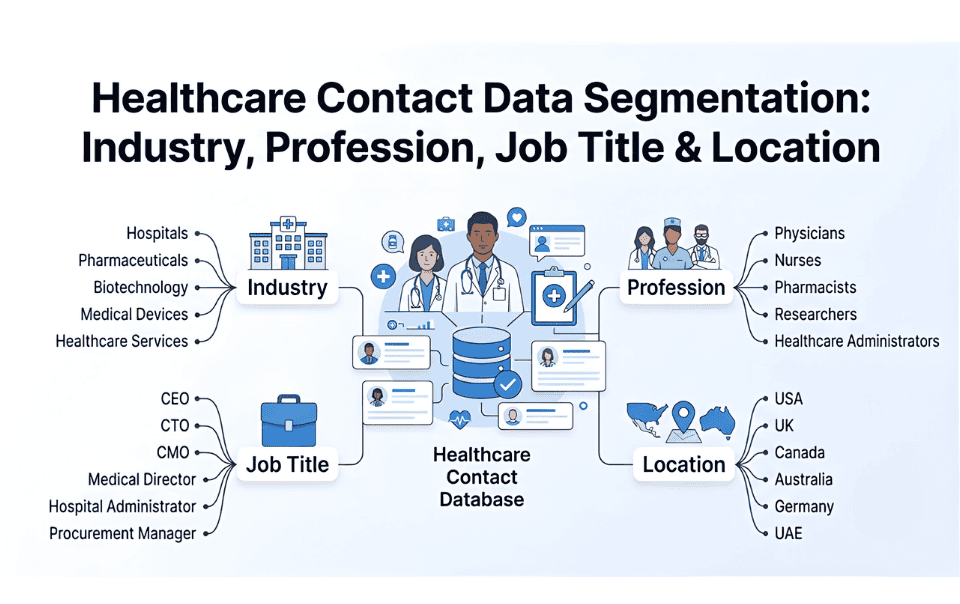
Healthcare Contact Data Segmentation is the process of organizing and filtering healthcare contact records using specific attributes — most commonly industry or sub-sector, profession, job title, and location — to build a more relevant target audience. These four dimensions can be used individually or combined, depending on the campaign’s objective.
This article focuses specifically on how to filter healthcare contact data along these dimensions. For the broader framework covering database types and sources, see our Healthcare Industry Contact Database guide.
An unsegmented healthcare list treats every contact the same, regardless of organization type, role, or location. Segmentation narrows that list down to the attributes that actually matter for a given campaign, which can reduce the number of irrelevant contacts a team has to sort through and support messaging that speaks to a more specific audience.
This applies to whatever Healthcare B2B Contact Data a team is working with — segmentation is how that underlying data gets turned into a usable, campaign-specific audience.
This doesn’t guarantee a specific improvement in response rates, conversions, or revenue — it’s a way to make audience selection more deliberate. It also doesn’t mean every campaign needs maximum segmentation; the right level of filtering depends on the objective, and over-filtering has its own downsides, covered later in this article.
What it is: filtering contacts by the type of healthcare organization they work for.
When to use it: when a company’s ideal customer profile depends on whether the buyer is a provider, payer, supplier, or another type of healthcare business.
What it distinguishes: organizations with fundamentally different buying structures and priorities, even within “healthcare” as a whole.
Healthcare includes several distinct organization categories:
These categories don’t share identical buying structures. A hospital’s procurement process looks little like a solo physician practice’s, and a payer’s evaluation process for a new vendor differs from a pharmaceutical company’s. The right industry filter depends on whether your company sells to providers, payers, suppliers, or other healthcare businesses — selecting the wrong sub-sector filter can mean building a list around organizations that don’t buy the way your ideal customer does.
What it is: filtering contacts by their professional discipline or category.
When to use it: when a campaign is relevant to a specific clinical or professional group regardless of their exact organizational title — recruiting and specialty-focused marketing are common cases.
What it distinguishes: the type of work someone does, as opposed to their specific organizational rank or responsibility.
Common healthcare professions include physicians, nurses, pharmacists, dentists, and therapists, among other professional groups.
Profession and job title answer different questions. Profession describes the professional discipline — what kind of clinician or specialist someone is. Job title describes their specific organizational role, responsibility, and seniority within that discipline. Two people can share a profession and hold very different job titles.
What it is: filtering contacts by their specific organizational role and level of responsibility.
When to use it: when a campaign needs to reach a specific level of authority or function, not just a general professional category.
What it distinguishes: roles within the same profession or department that carry different responsibilities or purchasing involvement.
The same profession can span many job titles:
Job-title segmentation is closely tied to identifying who actually influences or approves a purchase, but that’s a deeper topic on its own. For a full look at healthcare buying roles and how to identify the right buyer, see Healthcare Decision-Maker Contact Database.
What it is: filtering contacts by geography, from broad to specific.
When to use it: for territory-based sales, regional campaigns, or local recruiting.
What it distinguishes: contacts relevant to a specific market or sales territory versus the broader national or global audience.
Geographic segmentation typically ranges across:
Location is rarely used alone — combining it with industry, profession, and job title produces a considerably more relevant audience than filtering on geography by itself.
Geographic targeting can also matter for privacy and marketing compliance, since applicable requirements can depend on where contacts are located and how the data was collected and is being used. Requirements are not uniform across locations, and this isn’t legal advice — teams should confirm their own compliance obligations for the specific regions they’re targeting. Where DataCaptive’s own data practices are relevant, they’re aligned with ISO 27001, SOC 2, GDPR, PIPEDA, DPDPA, and CCPA.
This order is a starting point, not a fixed sequence — which attribute to apply first depends on the campaign objective. A recruiting campaign might start with profession; an ABM campaign might start with industry and organization.
These four dimensions work as layers, not a mandatory sequence. Combining them narrows a broad healthcare list into a specific, campaign-relevant audience.
| Campaign Objective | Industry/Sub-Sector | Profession | Job Title | Location |
|---|---|---|---|---|
| Selling healthcare software | Hospitals, health systems | IT professionals | CIO, IT Director | Regional or national |
| Promoting medical equipment | Hospitals, clinics | Clinical, procurement | Procurement Manager, Department Head | Territory-based |
| Recruiting healthcare professionals | Hospitals, practices | Physicians, nurses | N/A or specific specialty title | Local/metro area |
| Selling financial services | Health systems, practices | Finance professionals | CFO, Finance Director | Regional or national |
| Promoting cybersecurity services | Hospitals, health systems | IT professionals | CIO, CISO | National |
| Selling operational/facility services | Hospitals, clinics | Operations, facilities | Facilities Director, COO | Territory-based |
These are illustrative examples, not universal targeting rules — the right combination depends on your specific offer and ideal customer profile.
More filters do not automatically mean better targeting. The best segment is the one that stays relevant to the campaign while remaining large enough to actually execute against.
Stacking too many filters can shrink an audience to the point where there isn’t enough volume to run a meaningful campaign. A few practical guardrails:
There’s no fixed minimum audience size that applies universally; what counts as “enough” depends on the channel, the campaign goal, and how the list will be used.
DataCaptive’s Healthcare Contact Database lets B2B teams filter contacts by industry or sub-sector, profession, job title, and location, so campaigns can be built around a specific, relevant audience rather than a broad healthcare list.
It’s the process of filtering healthcare contact records by attributes such as industry or sub-sector, profession, job title, and location to build a more relevant target audience.
It’s the process of filtering healthcare contact records by attributes such as industry or sub-sector, profession, job title, and location to build a more relevant target audience.
The four core dimensions are industry/sub-sector, profession, job title, and location, which can be used individually or combined depending on the campaign’s objective.
Profession describes a person’s professional discipline, such as physician or nurse, while job title describes their specific organizational role and level of responsibility within that discipline.
Location segmentation ranges from broad to specific — country, state or province, region, city, or metro area — and is typically combined with industry, profession, and job title for better relevance.
Not necessarily — stacking every available filter can shrink an audience too far to be useful, so it’s generally better to start with the attributes most relevant to the campaign and add more only as they improve relevance.
Get a Quote