
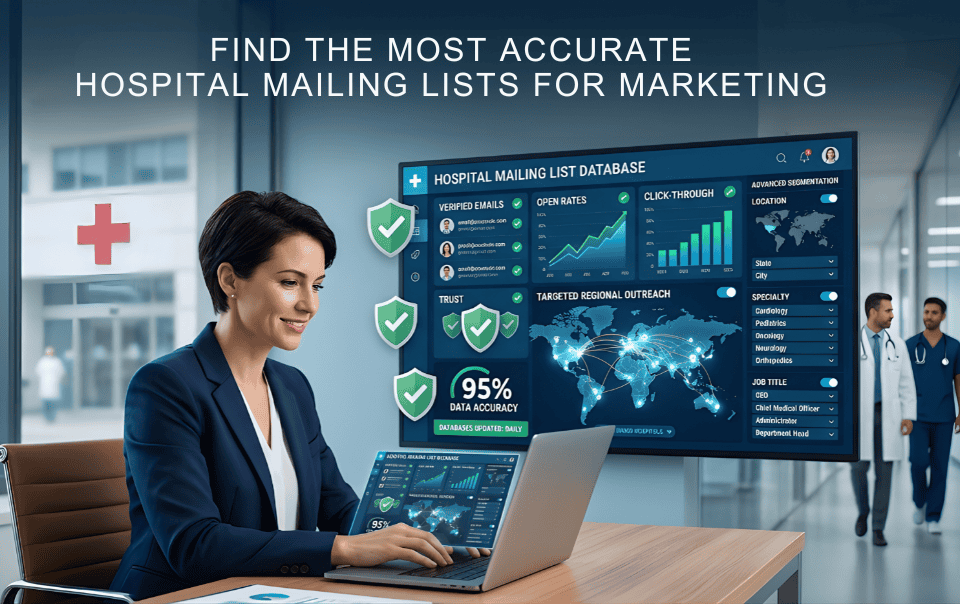
Reaching hospital decision-makers through cold outreach is notoriously difficult; gatekeepers, outdated directories, and generic contact forms slow everything down. A quality hospital mailing list cuts through that friction by putting verified emails, direct phone numbers, and physical addresses for administrators, department heads, and C-suite executives directly into your CRM.
This guide covers what’s included in a hospital database, how to evaluate accuracy before you buy, the types of hospitals you can target, and what to look for when choosing a provider.
A hospital marketing list is a targeted database containing contact information for hospital decision-makers, administrators, and medical professionals. Providers like DataCaptive, MedicoReach, and ZoomInfo offer verified, compliant hospital mailing lists segmented by job title, specialty, location, and hospital type to improve campaign ROI.
Think of it as your direct line to the people who actually approve purchases at hospitals, CFOs, IT directors, procurement managers, and department heads. Instead of cold-calling a general hospital number and hoping someone transfers you, a hospital contact list puts the right contact details in your hands from the start.
The terms “hospital mailing list” and “hospital email list” are often used interchangeably, though a mailing list typically includes physical addresses alongside digital contact information.
Before purchasing any hospital email list, it helps to know exactly what you’re getting. Most reputable providers include a standard set of data attributes that support both segmentation and personalization.
Here’s what a typical hospital email list contains:
The more data fields available, the more precisely you can tailor your messaging. For example, knowing a hospital uses Epic allows you to lead with integration capabilities rather than generic product features.
The result? Only businesses that use fresh, accurate, segmented California Business Mailing Lists can cut through the noise, personalize outreach, and actually convert.
Finding accurate Hospital Databases comes down to asking the right questions before you buy. Not all providers verify their data the same way, and the difference shows up in your bounce rates and response rates.
Multi-tier verification combines AI automation with human review to catch errors that software alone might miss. A 7-tier process, for instance, typically includes email syntax checks, domain verification, SMTP validation, and manual confirmation. Ask providers specifically how they validate contacts; vague answers like “we verify everything” don’t tell you much.
Healthcare staff turnover runs high, with some roles seeing 20% annual turnover or more. Hospital phone numbers refreshed every 45 days stays current, while anything older than 90 days starts degrading quickly. The CFO you’re trying to reach in January might have moved on by March.
Deliverability refers to the percentage of emails that actually reach inboxes rather than bouncing back. Strong providers state specific metrics, 95% accuracy and 85% deliverability represent solid benchmarks in the B2B data industry. If a provider won’t commit to numbers, that tells you something.
Testing a sample list before committing lets you verify relevance, formatting, and accuracy firsthand. Import the sample into your CRM, run a small test campaign, and check the bounce rate. If a provider won’t offer samples, consider that a red flag.
Ready to test before you commit? Request a free sample of our hospitals list to see the data quality for yourself.
Across the 6,093 hospitals in the United States, not all operate the same way, and your targeting strategy depends on which types align with your product or service. Here’s a breakdown of the main categories you’ll find in most hospital mailing lists.
Full-service facilities handling a wide range of conditions and emergencies make up the largest segment in most hospitals email database. They typically have complex purchasing committees with multiple stakeholders involved in buying decisions.
Facilities focused on specific care areas, cardiac, orthopedic, psychiatric, rehabilitation, or pediatric, often have specialized procurement budgets. If you sell niche solutions, specialty hospitals can be more receptive than general facilities.
Affiliated with medical schools, academic hospitals are frequently involved in research and clinical trials. They tend to be early adopters of new technology and more open to innovative partnerships, though their buying cycles can run longer.
Smaller facilities serving underserved or remote communities operate with tighter budgets but often have faster decision-making processes. Fewer layers of administration means fewer approvals required.
A verified list of hospitals directly impacts campaign performance in several ways:
The difference between a 60% and 85% deliverability rate can mean thousands of missed opportunities over a single campaign.
Hospital mailing lists, part of the broader healthcare mailing list category, serve a wide range of B2B use cases. Here’s who typically buys them and why.
Device companies target procurement officers, department heads, and administrators who approve capital equipment purchases. Selling an MRI machine or surgical robot involves lengthy evaluation cycles with multiple stakeholders.
Software providers reach CIOs, IT directors, and operations leaders for EMR implementations, billing solutions, and workflow automation tools. Knowing which EMR a hospital already uses helps tailor the pitch.
HR leaders and department managers are the primary contacts for filling clinical and administrative roles, especially during staffing shortages when hospitals are actively hiring.
Agencies purchase hospital decision makers email list on behalf of clients running campaigns into the healthcare vertical, often requiring custom segmentation by specialty or geography.
Outdated or inaccurate data can drain your campaigns. Reach verified hospital decision-makers with precision and turn missed opportunities into real conversions.
Segmentation is the process of filtering a list by specific criteria to match your ideal customer profile. Better segmentation leads to higher response rates because your message actually resonates with the recipient.
Segment by seniority (C-suite, VP, director, and manager) and function (finance, IT, operations, and clinical) to reach the people who actually influence or approve purchases. A message crafted for a CFO looks different than one for an IT manager.
Bed count serves as a common proxy for hospital size and budget. A 50-bed rural hospital has different purchasing processes and different pain points than a 500-bed academic medical center.
Territory-based sales teams can segment by country, state, region, or metro area. Geographic segmentation is especially useful for field sales or regional marketing campaigns with location-specific offers.
Technographic segmentation targets hospitals based on the software they currently use. If your product integrates with Epic, which won nearly 70% of new hospital EHR contracts in 2024, you can focus exclusively on Epic customers and lead with that integration in your messaging.
Once you have a quality hospital contact list, here’s how marketing and sales teams typically put it to work.
Hospital email lists power outbound campaigns for lead generation, product announcements, and nurture sequences. Personalization based on job title and hospital type improves open rates compared to generic blasts.
Physical mailing addresses enable printed collateral, event invitations, or dimensional mailers. In an inbox-saturated world, a well-designed direct mail piece can stand out.
Phone numbers allow SDR teams to qualify leads and book meetings directly. Combining phone outreach with email follow-up often yields better results than either channel alone.
ABM strategies target specific high-value hospitals with personalized, multichannel campaigns. A quality hospital executives email list provides the foundation for account-level targeting where you treat each hospital as a market of one.
Want to see how this works in practice? Book a demo to explore how hospital executives email lists support your multichannel campaigns.
Choosing the right provider involves more than comparing contact counts. Here’s a checklist of factors that separate reliable providers from risky ones.
Reputable providers follow GDPR, CAN-SPAM, CCPA, and CASL. Hospital sales leads contain business contact information rather than patient data, so HIPAA doesn’t apply, but compliance with marketing regulations still matters for lawful outreach.
Opt-in data comes from contacts who have consented to receive marketing communications. This reduces legal risk and improves deliverability compared to scraped lists or purchased data of unknown origin.
Look for CRM-ready formats like CSV or XLS, plus API options for seamless import into Salesforce, HubSpot, or other platforms. Manual data entry wastes time and introduces errors.
Clear pricing tiers with no hidden fees help you budget accurately. Responsive customer support, ideally with a dedicated account manager, makes troubleshooting faster when questions come up.
| Evaluation Criteria | What to Ask the Provider |
|---|---|
| Verification process | How do you validate contacts? |
| Update frequency | How often is data refreshed? |
| Compliance | Which regulations do you follow? |
| Deliverability | What accuracy and deliverability rates do you guarantee? |
| Data format | What file formats and integrations do you support? |
| Support | Is there a dedicated account manager? |
Accurate, verified hospital sales leads from the foundation for effective healthcare marketing. The right data connects you with decision-makers faster, reduces wasted spend on bounced emails, and supports compliant outreach across channels.
DataCaptive offers 95% contact accuracy, 85% email deliverability, and updates every 45 days, backed by a 7-tier verification process and 100% opt-in contacts. With transparent pricing and free samples available, you can test the data before committing.
Grab a free sample now and see why thousands of B2B marketers trust DataCaptive for hospital mailing lists.
Boost ROI with precision-targeted hospital contacts. Connect with key decision-makers using reliable, opt-in data built for impactful marketing campaigns.
Yes, mailing lists remain effective for B2B outreach when properly verified and segmented. Hospital mailing lists specifically connect vendors with decision-makers through email, direct mail, and phone campaigns, channels that still drive measurable ROI in healthcare sales.
Yes, hospitals accept and deliver mail addressed to specific staff members. Physical mailing addresses in hospital mailing lists enable direct mail campaigns, printed collateral, and dimensional mailers that reach administrators and department heads at their workplace.
Reputable providers compile hospital mailing lists from opt-in sources, including professional registries, conference attendees, subscription forms, and business directories. DataCaptive and similar vendors verify contacts through multi-tier processes that combine automated checks with manual confirmation.
Yes, 90% of organizations, including hospitals, rely on Active Directory as their core identity service. This standardization makes technographic targeting possible; vendors can filter hospital mailing lists by IT infrastructure to tailor integration-focused messaging for specific systems.
Get a Sample Email List
