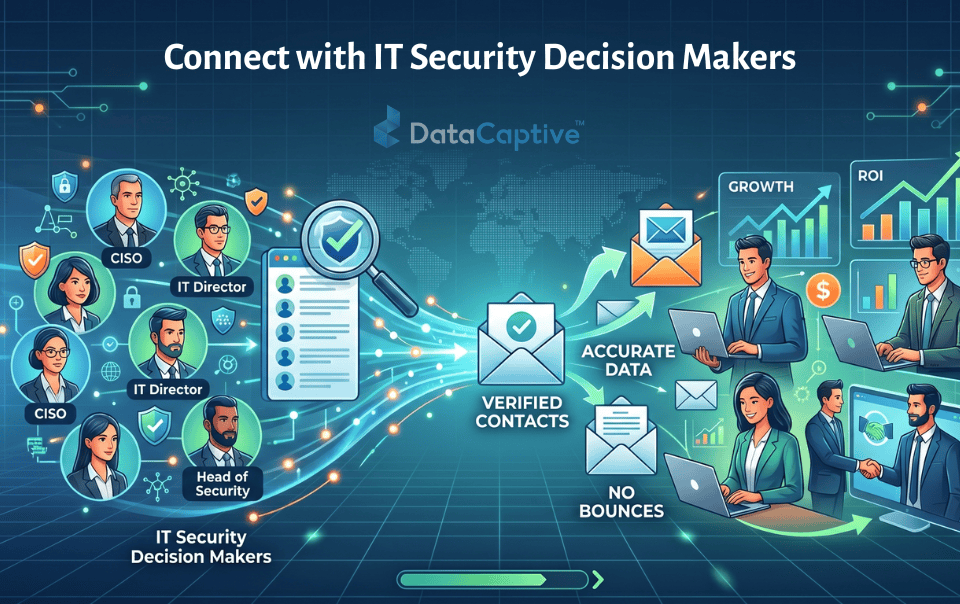
Reaching IT security decision-makers is challenging due to strict communication layers, gatekeepers, and overloaded inboxes, making traditional outreach methods like cold calls and generic emails ineffective. Verified B2B email lists solve this by providing direct, accurate access to key professionals, enabling B2B marketers to connect with the right audience efficiently and improve campaign outcomes.
Key Points:
IT security decision-makers are the key influencers and final authorities behind cybersecurity investments. They are responsible for safeguarding an organization’s digital infrastructure, ensuring regulatory compliance, and selecting the right technologies to prevent threats. For B2B marketers, these professionals represent a highly targeted audience with strong purchase intent and significant budget control.
Strategic leaders who define the overall security vision, align cybersecurity with business goals, and approve major investments.
Operational leaders who manage security teams, implement tools, and oversee day-to-day protection of systems and data.
Specialists focused on regulatory adherence, risk assessment, and ensuring the organization meets industry standards and legal requirements.
IT security decision-makers hold the authority to approve or reject solutions, making them critical stakeholders in the B2B buying process. They control high-value budgets and prioritize solutions that deliver measurable security outcomes, scalability, and compliance assurance. For marketers, engaging this audience means reaching individuals who are not only aware of their challenges but are actively seeking reliable, high-impact solutions—making them ideal targets for conversion-focused campaigns.
Reaching IT security professionals is inherently challenging due to their role, environment, and the nature of cybersecurity itself. These individuals are trained to be cautious, selective, and highly protective of their time and communication channels—making traditional outreach far less effective.
Security leaders rarely engage directly with unsolicited outreach. Communication is typically filtered through executive assistants, procurement teams, or internal IT staff. In large enterprises, vendor onboarding processes and approval layers further restrict direct access. This structure ensures only highly relevant and credible interactions reach decision-makers, but it also makes initial outreach difficult for marketers.
Many marketers rely on generic company email addresses (such as info@ or support@), which are often monitored by multiple teams or automated systems. These inboxes are not designed for decision-making conversations and rarely forward messages to senior security professionals. Without direct contact data—like verified work emails or direct dials—your outreach is unlikely to reach the intended audience.
Broad, untargeted campaigns fail to resonate with IT security professionals. These individuals receive a high volume of vendor emails daily, most of which are irrelevant or overly generic. As a result, open rates, click-through rates, and responses remain low. Poor targeting not only wastes resources but can also harm your sender reputation over time.
Security leaders operate in high-pressure environments where their primary focus is risk mitigation and incident response. They prioritize urgent security matters over unsolicited communications, meaning your outreach must be highly relevant and value-driven to capture their attention.
Many organizations enforce strict communication and data privacy policies, limiting how external vendors can approach internal teams. This further reduces the effectiveness of cold outreach methods and emphasizes the need for compliant, well-targeted engagement strategies.
A verified B2B email list is a curated and continuously maintained database of business contacts that has been validated for accuracy, relevance, and compliance. Unlike static or outdated datasets, these lists are built to ensure that every contact is reachable, up-to-date, and aligned with specific targeting criteria—making them highly effective for precision-driven marketing campaigns.
Verified lists undergo frequent updates to remove inactive, outdated, or incorrect records, ensuring higher data reliability.
Each email address is tested through validation tools and processes to reduce bounce rates and improve inbox placement.
Contacts are categorized by role, industry, company size, geography, and other attributes, enabling precise targeting.
Instead of massive, unfiltered datasets, verified lists focus on accuracy and relevance, leading to better campaign outcomes.
Data is collected and maintained in alignment with global data protection and email marketing regulations.
Automated tools verify email syntax, domain validity, and mailbox existence.
Data is cross-checked by professionals to ensure job roles, company affiliations, and contact details are accurate.
Continuous monitoring to identify job changes, company shifts, or inactive contacts.
Ensures that data collection and usage adhere to applicable privacy laws and consent frameworks.
Direct work emails that connect you with the intended decision-maker.
Enables multi-channel outreach beyond email.
Helps identify true decision-makers and influencers.
Includes company size, industry, revenue range, and geographic location.
Technology stack, buying intent signals, or business triggers that support deeper personalization.
By leveraging verified email lists, marketers can move beyond guesswork and reach the right audience with confidence—improving deliverability, engagement, and overall campaign performance.
Access verified email lists and connect directly with CISOs, IT security managers, and compliance leaders using DataCaptive’s accurate and targeted data solutions.
To maximize campaign performance and targeting accuracy, your email list should include comprehensive and actionable data fields. The more enriched your dataset, the better you can segment, personalize, and engage IT security decision-makers.
Finding accurate and verified contact data can be approached in two main ways, depending on your resources, timeline, and scalability needs.
This method involves manually sourcing and compiling contact data from various platforms.
Sources:
Benefits:
Drawbacks:
This approach involves leveraging professional data vendors that offer pre-verified and ready-to-use contact databases.
Advantages:
For B2B marketers aiming to reach IT security decision-makers efficiently, using a trusted data provider is the most practical and scalable solution—saving time while significantly improving campaign performance.
Got it—you’re aiming for a more natural, readable flow with structure that doesn’t feel forced. Here’s a refined version with better formatting and rhythm:
When selecting a B2B data provider, accuracy, reliability, and scalability should be your top priorities. The success of your outreach campaigns depends heavily on the quality of your data—making it essential to choose a provider you can trust.
DataCaptive stands out as a reliable platform for targeting IT security decision-makers with precision. It combines high-quality data with advanced segmentation capabilities, helping marketers reach the right audience without unnecessary friction.
Why DataCaptive works for B2B marketers:
This ensures faster outreach, better engagement, and a stronger pipeline for marketing and sales teams.
Having verified data is just the starting point. To truly see results, your execution strategy needs to be equally strong.
Segment Your Audience
Breaking your list into smaller segments based on role, company size, or region helps you deliver more relevant and targeted campaigns. Instead of a one-size-fits-all approach, segmentation allows you to speak directly to each group’s priorities.
Personalize Your Messaging
IT security professionals respond better to messaging that reflects their real challenges—whether it’s compliance, threat management, or data protection. Personalization goes beyond names; it’s about relevance.
Focus on Value, Not Just Selling
Instead of pushing products, lead with insights, use cases, or solutions. When your messaging educates or solves a problem, it builds trust and increases engagement.
Use Multi-Touch Outreach
Unlock access to verified IT security contacts tailored to your ideal customer profile. Improve targeting, boost engagement, and accelerate your sales pipeline with DataCaptive.
Reaching IT security decision-makers is simplified with a verified data strategy. High-quality B2B email lists bypass gatekeepers and outdated information, providing direct access to high-value prospects. By prioritizing accurate targeting and personalization, marketers can drive higher engagement, shorten sales cycles, and focus on building meaningful connections rather than manual research.
Partnering with DataCaptive provides the high-accuracy data and advanced segmentation needed to scale campaigns efficiently. Investing in these verified solutions is more than an option—it is a strategic advantage for building a predictable pipeline and ensuring consistent campaign performance.
A verified B2B email list is a curated database of business contacts that has been validated for accuracy, deliverability, and relevance, ensuring your outreach reaches real decision-makers.
High-quality providers maintain accuracy through continuous validation, regular updates, and verification processes, ensuring reliable and up-to-date contact data.
Yes, most verified B2B databases allow advanced segmentation by industry, geography, company size, job role, and seniority level.
Reputable providers follow major data protection and email marketing regulations, ensuring compliance and ethical data usage.
Most trusted providers update their databases regularly—monthly or quarterly—to remove outdated contacts and maintain high accuracy.
You can target a wide range of industries, including IT, healthcare, finance, manufacturing, and more, depending on your campaign needs.
Yes, many high-quality lists include direct dials along with email addresses, enabling multi-channel outreach strategies.
They reduce bounce rates, improve deliverability, enable better targeting, and increase engagement—leading to higher ROI.
They reduce bounce rates, improve deliverability, enable better targeting, and increase engagement—leading to higher ROI.
Building your own list offers control but is time-consuming and harder to scale. Using a verified data provider is faster, more scalable, and ensures higher data accuracy.
Get a Sample Email List