
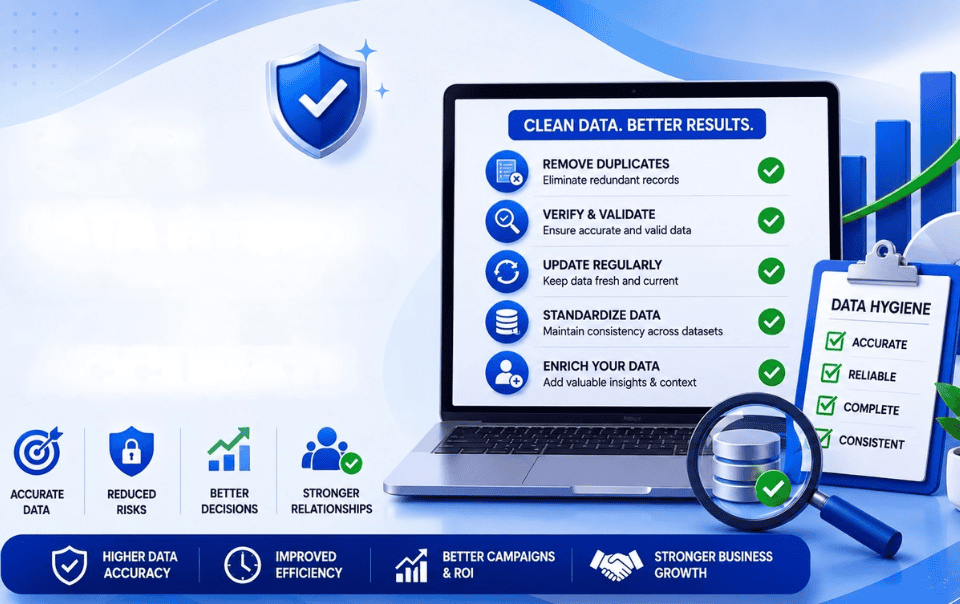
Every year, B2B databases lose accuracy as professionals change jobs, companies evolve, and contact information becomes outdated. With B2B contact data decaying by 20% to 30% annually, maintaining a clean database is essential for successful sales and marketing teams.
Whether you’re running email campaigns, ABM, lead nurturing, or outbound sales, accurate data helps improve targeting, reduce wasted spend, and drive better results. This guide explains what B2B data hygiene is, why it matters, and the best practices to keep your database accurate, compliant, and ready for growth.
B2B data hygiene is the continuous process of cleaning, validating, updating, enriching, standardizing, and maintaining business contacts and company information. It ensures that your CRM, marketing database, and sales prospect lists contain accurate information such as:
Instead of treating data cleansing as a one-time project, successful organizations make data hygiene an ongoing business process.
Maintaining a clean B2B database is about more than avoiding duplicate records. Accurate data enables marketing and sales teams to reach the right decision-makers, personalize campaigns, improve reporting, and make better business decisions.
As contact information changes over time, businesses that regularly verify and update their data are better positioned to improve campaign performance, increase sales efficiency, and maximize the value of their CRM investment.
Bad data creates problems across every department. Common consequences include:
Invalid or outdated email addresses increase bounce rates, damage sender reputation, and reduce inbox placement.
Sales representatives waste valuable time contacting prospects who have changed roles, switched companies, or are no longer relevant.
Marketing budgets are wasted when campaigns target outdated or incomplete contact records.
Duplicate records create inconsistent customer histories, inaccurate reporting, and poor customer experiences.
Business decisions become less reliable when reports are based on incomplete or outdated CRM data.
Maintaining verified and up-to-date business contact information helps organizations support their compliance efforts under applicable privacy regulations.
Many organizations don’t realize how much poor-quality data exists until campaign performance declines.
Here are common warning signs:
If several of these issues sound familiar, your database likely needs a comprehensive data hygiene process.
Never import purchased, collected, or event-generated contacts directly into your CRM.
Instead, verify:
Preventing inaccurate data from entering your CRM is much easier than cleaning it later.
Duplicate records negatively affect both marketing and sales. Duplicates can result in:
Use automated CRM deduplication rules based on:
Schedule duplicate checks monthly.
Consistent formatting improves segmentation and reporting.
Instead of:
Apply formatting standards for:
This ensures cleaner reports and better automation.
Incomplete records reduce campaign effectiveness.
A complete B2B profile may include:
Data enrichment transforms incomplete contacts into highly valuable sales opportunities. In addition to filling missing information, data enrichment improves audience segmentation, lead scoring, account-based marketing (ABM), and AI-powered personalization. Richer customer profiles enable marketing and sales teams to deliver more relevant messaging throughout the buyer journey.
B2B data changes continuously.
Employees:
Rather than waiting until campaign performance drops, establish a recurring verification schedule.
Recommended frequencies:
Routine verification keeps databases reliable year-round.
Monitor:
A sudden increase in hard bounces often indicates outdated contact information that should be removed or reverified immediately.
Segment contacts by:
Proper segmentation also simplifies ongoing database maintenance by making it easier to identify outdated records, inactive contacts, and industry-specific data that requires periodic updates.
Not every contact deserves to remain in your CRM forever.
Remove contacts that are:
A smaller, high-quality database consistently outperforms a larger database filled with inaccurate records.
Data hygiene should be everyone’s responsibility, not just marketing.
Develop clear guidelines covering:
Strong governance prevents future data quality issues.
Many organizations supplement their internal data management efforts by working with reputable B2B data providers that regularly verify, refresh, and enrich business contact information. Choosing a provider that offers permission-based, regularly updated data can help improve CRM accuracy and reduce manual maintenance.
For businesses looking to improve CRM accuracy, DataCaptive offers:
Using verified and refreshed data helps reduce bounce rates, improve campaign performance, and enable sales teams to connect with the right decision-makers more efficiently.
Experience the power of verified B2B Contact List. Get a free sample to see how it can fuel your lead generation.
Instead of cleaning data only when problems arise, create an ongoing workflow.
A practical process includes:
Data hygiene should become part of everyday CRM management rather than a yearly cleanup project.
Many organizations unknowingly introduce poor data quality through avoidable mistakes.
Avoid these common pitfalls:
Preventing these issues saves time, protects your sender reputation, and improves overall database reliability.
Organizations that prioritize data hygiene experience measurable improvements across marketing, sales, and customer success.
Key benefits include:
Simply put, clean data enables better business decisions and more effective customer engagement.
Bad data kills good marketing. If your CRM is full of outdated contacts, duplicates, and missing details, even the best sales strategy will fall flat. Simple B2B data hygiene such as verifying records, removing duplicates, enriching profiles, and refreshing your database keeps your pipeline accurate and your outreach effective.
For an easier way to stay current, DataCaptive offers verified, opt-in B2B contact data and regular database refreshes. That means less time cleaning records and more time reaching the right prospects. Clean data isn’t just maintenance, it’s a growth advantage.
Yes. Data cleansing typically refers to removing inaccurate or duplicate records, while B2B data hygiene is an ongoing process that includes cleansing, validation, enrichment, standardization, and continuous maintenance.
Data becomes outdated due to employee turnover, promotions, company mergers, business closures, department changes, new phone numbers, and updated email addresses.
Data enrichment fills missing information by adding company details, decision-maker information, firmographics, technographics, and other valuable attributes that improve targeting and personalization.
Businesses should work with reputable providers that supply permission-based, regularly verified, and refreshed B2B data. Choosing a trusted provider like DataCaptive can help improve database quality while supporting more effective marketing and sales outreach.
Get a Sample Email List
