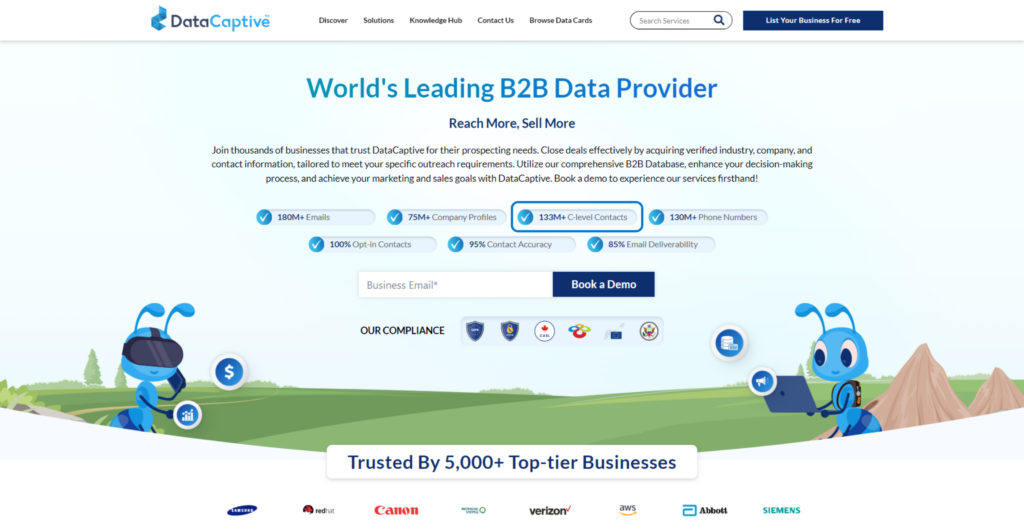
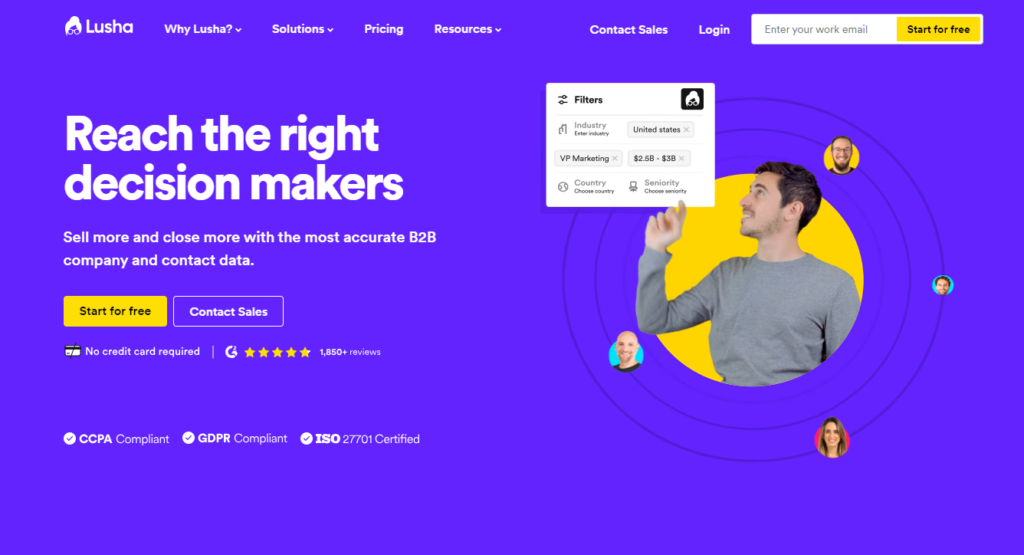
Choosing the right B2B data provider helps sales and marketing teams find relevant prospects, reach decision-makers, and improve lead generation. While DataCaptive and Lusha both provide business contact data, they differ in data coverage, verification methods, segmentation options, pricing, and ideal use cases.
This comparison highlights the key differences between DataCaptive and Lusha to help businesses choose the right solution based on their data requirements, campaign goals, and sales workflows.
Quick Answer: DataCaptive vs Lusha — Which B2B Data Provider Is Better?
DataCaptive and Lusha support different B2B data needs. DataCaptive specializes in verified B2B contact databases, customized segmentation, and scalable data solutions for sales, marketing, and business growth campaigns. Lusha focuses on sales intelligence and quick access to individual professional contacts.
The better choice depends on your goals:
Requirement
Better Choice
Verified B2B contact databases
DataCaptive
Customized audience segmentation
DataCaptive
Large-scale lead generation campaigns
DataCaptive
Individual prospect discovery
Lusha
Sales outreach workflows
Lusha
CRM integration support
Both
Industry-specific contact lists
DataCaptive
Quick contact lookup
Lusha
Bottom Line: DataCaptive is a strong choice for businesses that need customized, segmented, and scalable B2B contact data, while Lusha is suitable for teams that prioritize quick access to individual professional contacts.
DataCaptive vs Lusha: At a Glance
DataCaptive and Lusha both provide business contact information but serve different purposes.
DataCaptive delivers verified B2B contact databases with segmentation options based on industry, job role, company details, and other business attributes. It supports sales, marketing, ABM, recruitment, and lead generation campaigns.
Lusha is a sales intelligence platform designed for prospect discovery. It helps sales teams find professional contact details through search tools, browser extensions, and CRM integrations.
Businesses needing customized databases and targeted campaigns may prefer DataCaptive, while teams requiring fast prospect lookup may find Lusha more suitable.
Feature
DataCaptive
Lusha
Primary Focus
Verified B2B contact data and custom databases
Sales intelligence and prospect discovery
Contact Data
Business emails, phone numbers, and firmographic details
Professional contact information
Segmentation
Industry, role, location, company size, and ICP-based targeting
DataCaptive provides verified B2B databases, flexible segmentation, and scalable data solutions.
Lusha helps sales teams discover individual contacts for prospecting activities.
Both platforms support CRM workflows and sales operations.
DataCaptive fits businesses running targeted campaigns, while Lusha suits quick prospect research needs.
Why Compare DataCaptive and Lusha?
Choosing the right B2B data provider is an important decision for businesses that depend on accurate prospect information for sales, marketing, and revenue growth. Different providers are designed for different workflows, from building targeted contact databases to finding individual prospects for outreach.
A comparison between DataCaptive and Lusha helps businesses understand how each provider approaches business contact data, who each solution is best suited for, and which option aligns with their prospecting goals, campaign requirements, and growth strategy.
Why Choosing the Right B2B Data Provider Matters
The quality of your B2B data directly affects how effectively your teams can identify prospects, reach decision-makers, and build meaningful customer relationships. Choosing a provider that matches your business model can help improve campaign efficiency and reduce wasted outreach efforts.
Businesses should consider factors such as:
Data accuracy and verification processes
Business contact database coverage
Audience segmentation and filtering options
Compliance with global data privacy regulations
CRM and marketing automation integrations
Pricing flexibility and scalability
Customer support and onboarding
Selecting a provider that aligns with your business requirements helps sales and marketing teams reach the right decision-makers with greater confidence.
Who Should Read This Comparison
This comparison is designed for organizations evaluating DataCaptive vs Lusha before investing in a B2B data solution. It is especially useful for:
Sales teams are looking for verified business contact data to improve prospecting.
Marketing teams build targeted campaigns with segmented business audiences.
Revenue and demand generation teams seeking qualified leads for pipeline growth.
Recruitment and staffing firms are searching for accurate professional contact information.
Small and mid-sized businesses comparing affordability, scalability, and data quality.
Enterprise organizations evaluate data coverage, compliance, and integration capabilities.
Whether your goal is lead generation, account-based marketing (ABM), recruitment, or business development, this guide provides a balanced comparison to help you choose the B2B data provider that best fits your needs.
Key Differences Between DataCaptive and Lusha
DataCaptive and Lusha both provide business contact information but support different business needs. DataCaptive focuses on verified B2B contact databases and customized data solutions, while Lusha focuses on individual prospect discovery for sales outreach.
Primary Business Focus
DataCaptive provides verified B2B contact data, industry-specific databases, and customized audience lists based on attributes such as industry, job title, company size, location, and revenue.
Lusha is a sales intelligence platform that helps users find professional contacts through prospecting tools, browser extensions, and CRM integrations.
Target Customers
DataCaptive supports sales, marketing, ABM, recruitment, and business development teams that need scalable datasets aligned with their ideal customer profile (ICP).
Lusha is mainly used by sales professionals, recruiters, and small teams looking for quick access to individual business contacts.
Data Collection & Verification Approach
DataCaptive maintains business contact data through 7-tier verification processes and regular updates every 45 days to improve accuracy and reliability.
Lusha uses multiple data sources and validation methods to provide contact information for prospecting activities. Businesses should evaluate each provider based on data quality, sourcing, and update frequency.
Pricing Philosophy
DataCaptive offers customized pricing based on data requirements, audience targeting, segmentation, and campaign needs.
Lusha follows a subscription-based model based on users, features, and prospecting requirements.
Overall Value Proposition
The right choice depends on your business objectives:
Choose DataCaptive for verified B2B databases, customized segmentation, and large-scale sales and marketing campaigns.
Choose Lusha for quick prospect searches and individual contact discovery.
DataCaptive fits businesses requiring targeted data solutions, while Lusha suits teams focused on direct prospecting workflows.
How We Compared DataCaptive and Lusha
Choosing a B2B data provider requires evaluating more than database size. Factors such as data quality, segmentation, compliance, integrations, pricing, and scalability determine how effectively a provider supports sales and marketing goals.
To compare DataCaptive vs Lusha, we analyzed both providers based on key factors that influence prospecting, campaign performance, and business growth.
Evaluation Criteria
Data Accuracy : Evaluated how contact data is collected, verified, maintained, and refreshed to ensure reliable business information for prospecting and marketing activities.
Database Coverage : Compared industry reach, company profiles, geographic coverage, and the availability of professional contact information across different business segments.
Audience Segmentation : Reviewed the ability to create targeted contact lists using attributes like industry, job title, company size, location, revenue, and firmographic details.
CRM & Sales Integrations : Assessed compatibility with CRM, sales, and marketing platforms to support seamless workflows and improve outreach efficiency.
Compliance & Data Privacy : Compared data handling practices, privacy policies, and alignment with industry regulations for responsible business data usage.
Pricing : Evaluated pricing structures, flexibility, and overall value based on data requirements, features, scalability, and business objectives.
Customer Support : Reviewed onboarding assistance, consultation services, and ongoing support available to help businesses maximize data usage.
Scalability : Considered how effectively each provider supports growing sales, marketing, and lead generation needs as business requirements expand.
Comparison Methodology
This comparison uses publicly available information, product capabilities, and common business use cases. The goal is to help businesses identify the provider that best matches their needs.
Companies needing customized databases and targeted audiences may prioritize different factors than teams looking for quick prospect discovery and outreach support.
DataCaptive vs Lusha: Side-by-Side Feature Comparison
DataCaptive and Lusha both provide B2B contact data but support different workflows. DataCaptive focuses on customized B2B databases for sales and marketing campaigns, while Lusha focuses on individual prospect discovery and outreach.
Database Size & Industry Coverage
DataCaptive: Provides business contact databases across industries, company sizes, and regions with customization options based on industry, job title, location, revenue, and firmographic attributes.
Lusha: Provides professional contact information across industries, helping sales teams discover and connect with individual prospects.
Best for: Businesses needing industry-specific databases and customized audience lists may prefer DataCaptive, while teams focused on prospect research may prefer Lusha.
Contact Data Accuracy & Verification
DataCaptive: Maintains business contact data through verification processes and regular updates to improve accuracy, reliability, and campaign performance.
Lusha: Uses data validation methods to provide updated contact information for sales prospecting and outreach activities.
Best for: Businesses should evaluate verification methods, update frequency, and data quality practices based on their campaign requirements.
Business Email Addresses & Direct Dials
DataCaptive: Provides verified business email addresses, phone numbers, and company details that can be customized for specific audience requirements.
Lusha: Offers professional email addresses and direct phone numbers designed for individual prospect discovery.
Best for: DataCaptive suits campaign-ready contact databases, while Lusha works well for one-to-one prospecting.
Firmographic & Technographic Data
DataCaptive: Offers segmentation using firmographic attributes such as industry, company size, revenue, location, department, and job title.
Lusha: Provides professional and company insights to help users research and qualify prospects.
Best for: Businesses running ABM, market research, and targeted campaigns may benefit from DataCaptive’s deeper segmentation options.
Audience Segmentation & List Building
DataCaptive: Enables customized B2B contact list creation using ICP-based segments, including industry, geography, company size, seniority, and revenue.
Lusha: Supports contact searches based on prospecting requirements rather than on building large, customized databases.
Best for: Lead generation, email marketing, recruitment, and ABM teams may find DataCaptive more suitable.
CRM & Sales Tool Integrations
DataCaptive: Provides CRM-ready datasets that can be used with CRM and marketing automation platforms.
Lusha: Integrates with CRM and sales engagement tools to support prospecting workflows.
Best for: DataCaptive fits businesses needing bulk campaign data, while Lusha suits teams requiring contact discovery during sales activities.
Compliance & Data Privacy
DataCaptive: Follows compliance-focused data practices aligned with ISO 27001:2022, HIPAA, GDPR, CCPA, CASL, ACMA, EDPB, CAN-SPAM, and other applicable privacy standards to support secure and responsible data usage.
Lusha: Maintains privacy-focused practices and supports compliance with applicable data protection regulations for business contact information.
Best for: Businesses should evaluate compliance certifications, data sourcing methods, and privacy practices to ensure alignment with their internal policies and regional requirements.
Data Refresh Frequency
DataCaptive: Regularly verifies and refreshes contact data every 45 days to maintain accurate, up-to-date business information.
Lusha: Updates its database to support ongoing prospecting and sales activities.
Best for: Organizations running continuous campaigns should compare update frequencies and data maintenance processes.
Pricing & Licensing
DataCaptive: Offers customized pricing based on audience size, segmentation needs, data volume, and campaign requirements.
Lusha: Uses subscription-based pricing based on users, features, and prospecting activity.
Best for: Businesses should choose based on overall value, scalability, data needs, and intended usage.
Customer Support & User Experience
DataCaptive: Provides dedicated support to help businesses define targeting requirements and build customized datasets.
Lusha: Offers a self-service platform with support focused on prospecting workflows and product usage.
Best for: Companies needing consultative data solutions may prefer DataCaptive, while teams wanting independent prospect research may prefer Lusha.
Build Better Campaigns with Verified B2B Contact Data
Request a free sample of DataCaptive’s verified business contact data and evaluate its quality, accuracy, and ICP-based segmentation before launching your next sales or marketing campaign.
DataCaptive vs Lusha: Pros and Cons
Both DataCaptive and Lusha provide B2B contact data but support different business needs. DataCaptive focuses on customized databases and scalable data solutions, while Lusha is designed for quick prospect discovery. Understanding their strengths and limitations helps businesses choose the right provider.
DataCaptive
Pros:
Verified B2B Contact Data : Provides verified business emails, phone numbers, and company information to support accurate sales and marketing campaigns.
Advanced Audience Segmentation : Helps businesses create targeted contact databases using ICP segments such as industry, job title, company size, location, and revenue.
Scalable Data Solutions : Supports lead generation, ABM, recruitment, demand generation, and business development campaigns.
Compliance-Focused Practices : Follows data practices aligned with GDPR, CCPA, CAN-SPAM, and other privacy standards.
CRM-Ready Data Delivery : Provides data formats that can be integrated with CRM and marketing automation platforms.
Cons:
Consultative Buying Process : Requires businesses to define their audience requirements and receive customized datasets instead of instant contact searches.
Targeted Campaign Focus : May not be ideal for businesses that only need occasional individual contact lookups.
Lusha
Pros:
Quick Prospect Discovery : Helps sales teams find professional contact information for prospect research and outreach.
CRM Integrations : Connects with popular CRM and sales tools to support prospecting workflows.
User-Friendly Platform : Suitable for sales representatives, recruiters, and small teams needing fast contact access.
Self-Service Experience : Allows users to search for contacts without requesting customized datasets.
Cons:
Limited Database Customization : May not support highly customized contact databases based on detailed ICP requirements.
Prospecting-Focused Solution : Better suited for individual contact discovery than large-scale marketing campaigns.
Growing Subscription Costs : Pricing can increase as users, features, and contact requirements expand.
Summary
DataCaptive is better suited for organizations requiring customized B2B databases, advanced segmentation, and scalable campaign data. Lusha works well for teams focused on quick prospect searches and self-service contact discovery. The right choice depends on your business goals, campaign requirements, and data usage needs.
Which B2B Data Provider Is Best for Your Business?
The right B2B data provider depends on your business goals, team requirements, and how you plan to use contact data. DataCaptive is focused on customized B2B databases and scalable campaigns, while Lusha is designed for quick prospect discovery and individual contact searches.
Best for Startups
Recommended: Lusha for quick prospecting | DataCaptive for growth-focused campaigns
DataCaptive: Suitable for startups planning targeted email campaigns, market expansion, and structured lead generation with customized databases and ICP-based segmentation.
Lusha: Useful for early-stage startups that need quick access to individual business contacts for outbound sales and prospect research.
Best for Small & Mid-Sized Businesses
Recommended: DataCaptive for scalable growth | Lusha for daily prospecting
DataCaptive: Helps SMBs build targeted contact databases by segmenting data by industry, company size, job title, location, and revenue to support sales and marketing efforts.
Lusha: Works well for teams that need to find individual contacts quickly during sales outreach and prospecting activities.
Best for Enterprise Organizations
Recommended: DataCaptive
DataCaptive: Supports enterprise needs with large-scale databases, advanced segmentation, and customized data solutions for sales, marketing, ABM, and demand generation.
Lusha: Can support enterprise sales teams that need quick prospect research for specific accounts and individual contacts.
Best for Sales Teams
Recommended: Depends on sales workflow DataCaptive: Best suited for teams managing outbound campaigns, territory planning, and account-based sales programs requiring segmented contact databases.
Lusha: Ideal for sales professionals who need quick access to decision-makers during daily prospecting and outreach.
Best for Marketing Teams
Recommended: DataCaptive
DataCaptive: Enables marketers to create segmented audiences based on industry, job function, company profile, geography, and ICP criteria for demand generation and email campaigns.
Lusha: More focused on individual contact discovery rather than large-scale marketing audience building.
Best for Lead Generation
Recommended: DataCaptive
DataCaptive: Helps businesses create customized prospect lists for lead generation, outbound campaigns, ABM, and pipeline growth initiatives.
Lusha: Suitable for finding individual contacts but may not be designed for large-scale campaign databases.
Best for Recruitment & Staffing
Recommended: Depends on hiring requirements
DataCaptive: Supports staffing firms that need segmented professional databases based on industry, role, location, and other hiring criteria.
Lusha: Useful for recruiters who need quick access to individual professional contacts for candidate outreach.
Best for Global Prospecting
Recommended: DataCaptive
DataCaptive: Helps businesses expand into new markets with customized global contact databases segmented by industry, location, and business attributes.
Lusha: Supports international prospect research by helping teams find individual business contacts across markets.
Why Businesses Choose DataCaptive?
Businesses rely on accurate B2B data to improve prospect targeting, increase outreach effectiveness, and support sales growth. DataCaptive provides verified contact data, flexible segmentation, compliance-focused practices, and customized solutions for sales, marketing, recruitment, and business development teams.
Verified B2B Contact Data : DataCaptive provides verified business emails, phone numbers, company details, and professional information. Regular verification and updates help businesses access reliable data for prospecting and marketing campaigns.
Flexible ICP-Based Segmentation : DataCaptive helps businesses build customized contact databases based on their ideal customer profile (ICP). Teams can segment audiences using industry, job title, seniority level, company size, revenue, location, department, technology usage, and other firmographic attributes to reach relevant prospects.
Compliance-First Data Practices : DataCaptive follows responsible data practices aligned with GDPR, CCPA, CAN-SPAM, and other privacy standards to help businesses use B2B contact data effectively while supporting compliance requirements.
CRM-Ready Data Delivery : DataCaptive provides structured data formats that integrate with CRM and marketing platforms, helping teams manage contacts for email campaigns, sales outreach, ABM, and lead generation.
Dedicated Customer Support : DataCaptive assists businesses in defining targeting requirements, selecting relevant audience segments, and receiving customized data solutions aligned with their campaign goals.
Custom Data Solutions for Business Growth : DataCaptive delivers customized B2B contact databases based on industry, target audience, and business objectives to support sales, demand generation, recruitment, ABM, and market expansion.
Turn Better Data into Better Business Opportunities
Whether you’re launching a campaign, expanding into new markets, or targeting key decision-makers, DataCaptive delivers verified, segmented B2B contact data tailored to your goals.
Final Verdict
The right choice between DataCaptive and Lusha depends on your business goals and how you use B2B contact data. DataCaptive focuses on verified B2B databases, customized segmentation, and scalable data solutions, while Lusha supports quick individual prospect discovery and sales outreach.
Choose DataCaptive If...
Choose DataCaptive if you need:
Verified B2B Contact Data : Reliable business emails, phone numbers, and company details for sales, marketing, recruitment, and business development.
Customized Audience Segmentation : Contact databases based on ICP criteria such as industry, job title, company size, location, and revenue.
Scalable Data Solutions : Targeted datasets for lead generation, ABM, email marketing, and business growth campaigns.
CRM-Ready Data : Structured contact data that supports sales and marketing workflows.
DataCaptive is ideal for businesses that need targeted audiences, customized databases, and campaign-ready B2B data.
Choose Lusha If...
Choose Lusha if you need:
Quick Prospect Discovery : Individual business contacts for sales research and outreach.
Self-Service Prospecting : Easy access to professional contact information through prospecting tools.
Sales Outreach Support : Contact discovery features for sales representatives and small teams.
Lusha is suitable for teams focused on finding individual prospects quickly for direct outreach.
Our Recommendation
DataCaptive is a better fit for businesses running targeted campaigns, lead generation, ABM, and scalable sales initiatives. Lusha works well for teams that prioritize quick prospect searches and individual contact discovery.
Before choosing a provider, consider factors such as data accuracy, segmentation, compliance, integrations, and scalability to find the solution that best matches your business needs.
DataCaptive focuses on verified B2B contact databases, customized segmentation, and scalable data solutions for sales, marketing, recruitment, and ABM campaigns. Lusha focuses on prospect discovery by helping users find individual professional contacts for sales outreach and quick contact searches.
DataCaptive focuses on high-quality B2B contact data with 95%+ data accuracy. Its database is maintained through a 7-tier verification process and updated every 45 days to improve data reliability. Businesses should evaluate providers based on verification methods, data freshness, and their specific campaign requirements.
Yes. DataCaptive provides 100% verified opt-in business email addresses along with phone numbers, company details, and professional attributes. Businesses can request customized contact databases based on industry, job role, company size, location, revenue, and other ICP-based requirements.
The right choice depends on business goals. Small businesses needing quick individual prospect searches may prefer Lusha, while companies looking for targeted contact lists, lead generation, and scalable marketing campaigns may benefit from DataCaptive’s customized B2B data solutions.
Yes. Both providers support CRM workflows. DataCaptive delivers CRM-ready contact databases for sales and marketing campaigns, while Lusha provides CRM integrations focused on prospecting and sales engagement activities.
DataCaptive offers advanced audience segmentation based on ICP attributes such as industry, job title, company size, location, revenue, and firmographic details. Lusha provides search-based prospecting features designed for finding individual contacts.
Both providers follow privacy-focused data practices. DataCaptive follows compliance processes aligned with GDPR, CCPA, CAN-SPAM, and other applicable standards. Businesses should review each provider’s policies based on their target markets and compliance requirements.
DataCaptive regularly verifies and refreshes its database every 45 days to maintain accurate business contact information. Data update frequency can vary based on provider practices, data sources, and verification methods used to maintain contact quality.
Yes. DataCaptive provides customized B2B contact databases based on business requirements. Organizations can define target audiences using industry, location, job role, company size, revenue, and other ICP-based criteria.
The better option depends on business needs. DataCaptive is suitable for organizations requiring customized databases, segmentation, and scalable data solutions, while Lusha fits teams focused on individual prospect searches and sales outreach.
Transform Your Prospecting with Verified B2B Data
Whether you’re generating leads, launching ABM campaigns, or expanding into new markets, DataCaptive helps you connect with the right businesses using verified, customized contact data.