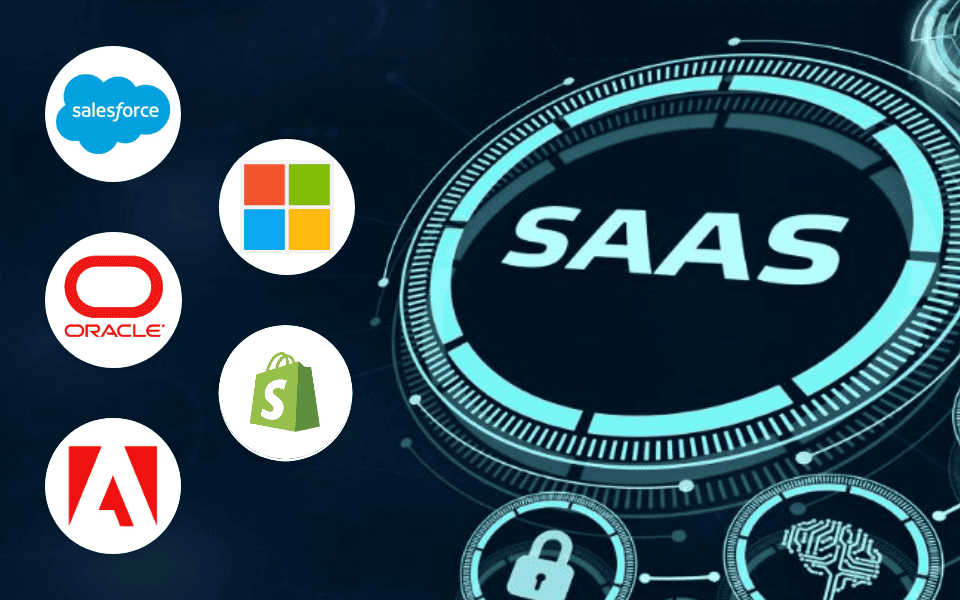
Some of the major SaaS companies in the USA and global market include Salesforce, Microsoft, Oracle, ServiceNow, Adobe, Intuit, HubSpot, Zoom, and Workday. Shopify is also included in this list as a major SaaS-powered commerce platform headquartered in Canada.
Now, let’s explore each company in detail.

Salesforce is a global leader in cloud-based CRM solutions, helping businesses manage sales, marketing, and customer service in one platform. It consistently ranks among the top 10 b2b SaaS companies due to its enterprise-focused innovation. Organizations rely on Salesforce to automate workflows and improve customer engagement. Its scalable ecosystem supports companies of all sizes worldwide.

Microsoft delivers powerful SaaS solutions through Microsoft 365, Dynamics, and Azure cloud services. It stands among the top 10 SaaS companies in usa with a strong global enterprise presence. Businesses depend on Microsoft for productivity, collaboration, and secure cloud infrastructure. Its integrated tools simplify digital transformation at scale.

Oracle provides enterprise-grade SaaS applications for finance, HR, and supply chain management. It is widely recognized among the top 10 SaaS companies by revenue 2026 for its strong enterprise customer base. Large organizations trust Oracle for secure and data-driven business operations. Its cloud infrastructure supports mission-critical workloads worldwide.

ServiceNow streamlines digital workflows across IT, HR, and customer service departments. It ranks among the top 10 fastest growing SaaS companies due to its automation capabilities. Enterprises use ServiceNow to improve operational efficiency and reduce manual processes. Its platform connects teams through intelligent workflow management.

Adobe offers creative and marketing SaaS solutions used by professionals worldwide. Its platforms are often featured among the best SaaS apps for design and digital experiences. Businesses rely on Adobe Creative Cloud and Experience Cloud to enhance branding and customer journeys. The company continues to innovate in AI-powered content creation.


Shopify enables businesses to build and scale online stores with ease. It stands among the top 10 SaaS companies in Canada driving digital commerce growth. Entrepreneurs and enterprises alike use Shopify to manage payments, inventory, and customer experiences. Its user-friendly tools simplify global e-commerce operations.

HubSpot provides inbound marketing, CRM, and sales automation tools. It is frequently listed among the best SaaS websites for its user-friendly platform. Growing businesses use HubSpot to attract leads and nurture customer relationships. Its integrated ecosystem supports marketing and sales alignment.

Zoom revolutionized digital communication with reliable video conferencing solutions. It is often included in the top 10 SaaS applications used globally. Organizations depend on Zoom for remote meetings, webinars, and collaboration. Its cloud-based infrastructure ensures seamless connectivity worldwide.

Workday delivers cloud-based HR and financial management solutions. It is considered one of the top 10 successful micro SaaS companies in specialized enterprise services. Businesses use Workday to manage workforce planning, payroll, and analytics efficiently. Its platform supports data-driven decision-making for growing enterprises.
If your business works in B2B marketing, partnerships, or enterprise sales, targeting SaaS companies may already be part of your strategy. These organizations drive digital transformation across industries, making them valuable collaborators, customers, and innovation partners.
However, reaching the right people within enterprise SaaS companies isn’t always easy. Decision-makers are often spread across departments, roles change frequently, and publicly available contact information may not always be current. This can slow outreach efforts, create inefficiencies, and sometimes lead to missed opportunities.
Understanding these challenges is the first step toward building a smarter outreach approach.
To address these challenges, many organizations focus on improving how they collect, verify, and manage business information. Structured datasets — when responsibly sourced and regularly updated — can help teams:
This doesn’t replace strong communication skills or value-driven messaging, but it supports a more informed and efficient outreach strategy.
When used thoughtfully, organized business data can provide several practical advantages for B2B teams:
Accurate segmentation helps ensure outreach reaches professionals who are most likely to benefit from your offering.
Instead of spending weeks researching contacts, teams can focus on refining messaging, building relationships, and closing opportunities.
Relevant data allows outreach to be more personalized, increasing the likelihood of meaningful engagement.
Company data often reveals industry trends, emerging markets, and partnership opportunities.
Organizations generally use a mix of approaches when gathering SaaS company information:
Each method has advantages and limitations, so combining multiple sources often produces the best results.
Not all datasets are equally reliable. Before relying on any business data, it helps to assess:
These factors help ensure outreach remains ethical, compliant, and effective.
Many organizations rely on specialized B2B data providers to simplify outreach and market research. Instead of focusing only on database size or marketing claims, it’s generally more useful to evaluate factors like data verification methods, compliance practices, update frequency, and customization options.
Industry data providers, including DataCaptive, emphasize verified contact intelligence, segmentation flexibility, and compliance-focused data practices to support modern B2B outreach strategies. Evaluating such solutions helps businesses understand how structured data improves targeting accuracy.
DataCaptive provides a verified Email List of SaaS Companies tailored specifically for focused B2B campaigns.
With DataCaptive, you get:
With a trusted Contact List of SaaS Companies, your campaigns become more precise, compliant, and conversion-focused.
Enterprise SaaS companies continue to reshape global business through scalable cloud platforms, automation, and AI-driven innovation. Successfully connecting with this sector requires more than just outreach — it involves understanding industry dynamics, maintaining reliable business intelligence, and approaching engagement strategically.
Organizations that invest in accurate, structured data often find it easier to identify relevant stakeholders, improve targeting precision, and build more meaningful B2B relationships. Providers like DataCaptive, for example, focus on verified business
Ultimately, combining high-quality data with strong messaging and relationship-building practices helps businesses engage SaaS leaders more effectively and stay competitive in a rapidly evolving digital landscape.
Key trends include AI integration, vertical-specific SaaS solutions, usage-based pricing models, and increased focus on automation and data-driven decision-making.
Get a Sample Email List