
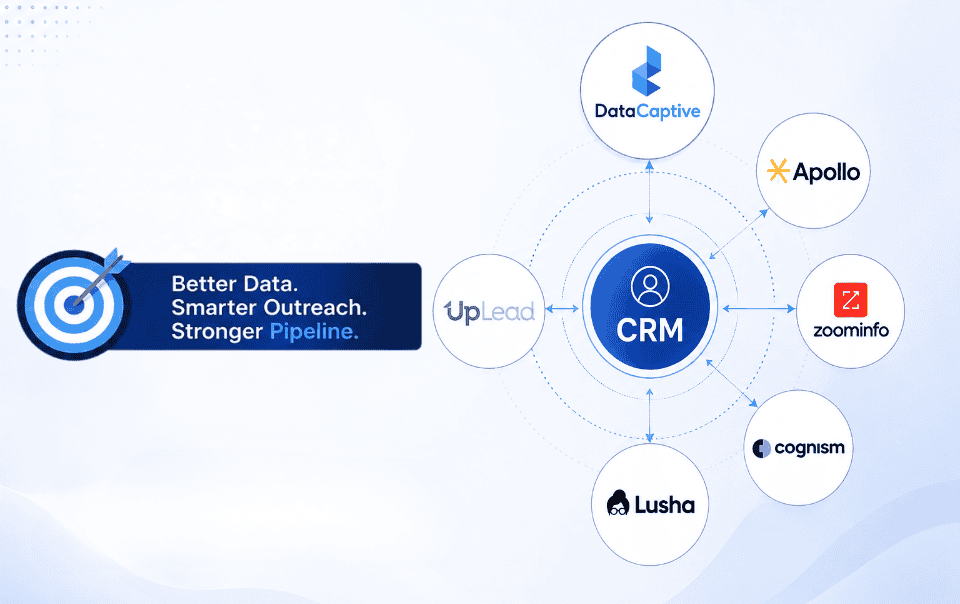
Your CRM is only as good as the data behind it.
Outdated contacts, missing decision-makers, and stale company details can quietly kill your pipeline. In 2026, the right B2B data providers do more than fill database gaps—they help sales and marketing teams find the right prospects, enrich CRM records, and build sharper, more targeted campaigns.
From all-in-one platforms like Apollo and ZoomInfo to focused providers like DataCaptive, Cognism, Lusha, and UpLead, each vendor brings a different strength to the table.
So, which one is right for your team? In this guide, we compare six leading B2B data providers based on data quality, CRM enrichment, segmentation, integrations, and real-world use cases—so you can choose the right platform for your sales and marketing goals.
Not every B2B data provider is built for the same job. To rank these platforms fairly, we looked at the factors that have the biggest impact on sales prospecting, CRM enrichment, and marketing performance:
Using these criteria, we compared each provider based on its strengths, limitations, and best-fit use cases rather than simply ranking them by database size.
| Rank | Vendor | Best For | Key Strength |
|---|---|---|---|
| 1 | ZoomInfo | Enterprise-grade enrichment | Data depth and account intelligence |
| 2 | Apollo | All-in-one prospecting | Data + engagement workflows |
| 3 | DataCaptive | Custom CRM enrichment | Verified, ICP-focused business data |
| 4 | Cognism | EMEA-focused teams | Compliance and phone data |
| 5 | Lusha | Fast prospect discovery | Simple access to verified contact data |
| 6 | UpLead | Straightforward prospecting | Real-time email verification |
Choosing a B2B data provider isn’t just about database size. The right platform should help your team enrich CRM records, find decision-makers, build targeted prospect lists, improve data quality, and support scalable B2B lead generation. Below, we compare six leading providers based on data coverage, enrichment capabilities, segmentation, CRM compatibility, and overall value for U.S.-based sales and marketing teams.
ZoomInfo remains one of the strongest choices for organizations that need broad B2B intelligence across sales, marketing, and RevOps.
Its biggest advantage is depth. ZoomInfo combines contact and company information with account intelligence, technology data, intent signals, and enrichment capabilities. Its Enrich API supports native CRM connections, direct API calls, webhooks, and third-party middleware, making it suitable for organizations that want enrichment embedded directly into their data infrastructure.
ZoomInfo is particularly strong when CRM enrichment is part of a broader revenue intelligence strategy rather than a standalone data-cleaning exercise.
Its depth can be more than a smaller or mid-market team needs. Organizations should evaluate total platform complexity, required functionality, and budget before choosing it purely for contact enrichment.
The strongest overall option for organizations prioritizing comprehensive B2B intelligence and sophisticated enrichment workflows.
Apollo is a compelling choice for mid-market sales teams because it combines B2B contact data, prospecting, enrichment, sequencing, and sales engagement in one platform.
Apollo’s current enrichment offering can update CRM records on demand, on a schedule, or in real time. It also supports CSV workflows, APIs, and integrations. Its platform additionally uses AI research, buyer intent signals, and lead-scoring capabilities to help sales teams prioritize accounts.
Apollo uses a credit-based model, with different actions consuming different amounts of credits. For example, its current pricing information states that accessing an email uses one credit. In contrast, a phone number uses eight credits, and enrichment can use up to nine credits per record.
Apollo reduces the number of tools required for B2B lead generation. A sales team can identify prospects, enrich records, build lists, and execute outreach without constantly moving between platforms.
Teams focused specifically on large-scale CRM enrichment may find Apollo’s broader sales-engagement orientation less specialized than a dedicated enrichment provider.
One of the best choices for mid-market teams that want prospecting, enrichment, and sales execution in a unified workflow.
DataCaptive takes a data-focused approach to CRM enrichment and B2B prospecting, helping sales and marketing teams improve existing records, identify decision-makers, and build targeted prospect lists.
Its current published database includes 400M+ business contacts, 130M+ phone numbers, 75M+ company profiles, and 7.5M+ C-level contacts. DataCaptive also reports 95%+ data accuracy, 85%+ email deliverability, and a 45-day data refresh cycle. These figures are vendor-reported and should be validated against your target audience before purchase.
The biggest differentiator is its focus on customized B2B data enrichment. Instead of treating enrichment as simply adding fields to a record, teams can use it to improve segmentation and make their existing CRM more useful for outbound and marketing automation.
Organizations looking for a massive all-in-one sales engagement ecosystem may prefer platforms such as Apollo or ZoomInfo.
A strong choice for mid-market organizations that care about targeted, usable data and want CRM enrichment to support specific ICP and prospecting requirements.
Cognism has built a strong reputation around compliant B2B data, sales intelligence, and international prospecting, with particular strength in Europe.
Its CRM enrichment capabilities allow organizations to identify incomplete records and enrich them through governed workflows. Cognism supports enrichment through CRM integrations and APIs, including workflows designed for Salesforce and HubSpot.
Cognism’s positioning is especially relevant for teams selling into the UK and Europe, where data privacy and regulatory considerations can be central to prospecting operations.
Cognism combines contact data with sales intelligence while putting considerable emphasis on compliant data practices and verified mobile numbers.
For teams primarily targeting North America and looking for a lower-complexity prospecting platform, other vendors may offer a better overall fit.
Lusha is designed around making B2B contact and company data accessible to sales and marketing teams without excessive complexity.
Its current platform provides verified contact and company information, buying signals, CRM enrichment, and API-based workflows. Lusha’s enrichment tools can automatically update CRM records and add ICP-matched contacts to existing accounts.
Lusha also promotes a database of more than 300 million contacts and reports 98% email accuracy and 86% phone accuracy in its current CRM-related materials. These are vendor-reported figures, so buyers should validate accuracy against their own target market before deciding to purchase.
UpLead is a good fit for teams that want B2B contact data without the complexity of a larger sales-intelligence ecosystem.
UpLead’s enrichment service can append more than 50 data points to contacts and companies. The company also states that its platform verifies emails in real time and currently provides access to more than 180 million contacts and 19 million company profiles across 200+ countries.
Real-time email verification is useful for sales and marketing teams where email deliverability is a major concern.
Compared with larger platforms, UpLead is less focused on being a complete sales engagement and revenue intelligence suite.
A straightforward option for teams primarily looking for verified contact data and practical prospect list building.
The biggest database isn’t always the best database. The right provider should deliver accurate data that fits your ICP, works with your existing tools, and supports your sales and marketing goals.
Before making a decision, consider these factors:
There is no universal winner.
➤ Choose ZoomInfo if you need extensive enterprise-grade intelligence and sophisticated enrichment.
➤ Choose Apollo if you want B2B data, prospecting, and sales engagement in one platform.
➤ Choose DataCaptive if targeted CRM enrichment, custom prospect lists, and ICP-focused business data are your priorities.
➤ Choose Cognism if European coverage, compliance, and high-quality phone data are particularly important.
➤ Choose Lusha if your team wants fast, accessible contact discovery and straightforward enrichment.
➤ Choose UpLead if verified contact data and real-time email verification are the main requirements.
For most mid-market sales teams, the decision should ultimately come down to data quality, ICP fit, enrichment workflow, and the ability to turn clean CRM records into better prospecting and marketing execution.
The goal of CRM enrichment isn’t to fill your database with more names. It’s to give your sales and marketing teams enough accurate context to identify the right accounts, reach the right decision-makers, and create more relevant conversations.
That is what makes a B2B data provider valuable in 2026.
The right B2B data provider can do more than fill gaps in your CRM—it can help your sales and marketing teams find better prospects, build more targeted lists, and turn clean data into pipeline.
ZoomInfo, Apollo, DataCaptive, Cognism, Lusha, and UpLead each bring different strengths to the table. The best choice depends on your ICP, target market, enrichment needs, CRM setup, and budget.
For mid-market teams, the priority should be simple: choose accurate, relevant, and actionable data over database size alone. When your CRM has the right information at the right time, your team can spend less time cleaning data and more time creating opportunities.
Look for accurate and frequently updated data, strong ICP coverage, reliable verification, useful segmentation, CRM compatibility, geographic coverage, automation capabilities, and transparent pricing. The best B2B contact database supports your actual sales and marketing workflow.
Get a Sample Email List
Get A Quote on Price
