
Your CRM is full.
Your sales team is busy.
Your campaigns are running.
So why isn’t your pipeline growing?
The problem might not be your strategy. It might be your data.
Outdated contacts, inaccurate business prospect lists, poor ICP targeting, and missing decision-makers can quietly drain your sales and marketing performance.
Because in B2B, more data doesn’t mean better data.
If your team is still spending hours finding the right prospects, fixing bad records, or chasing leads that never convert, your data may be holding you back.
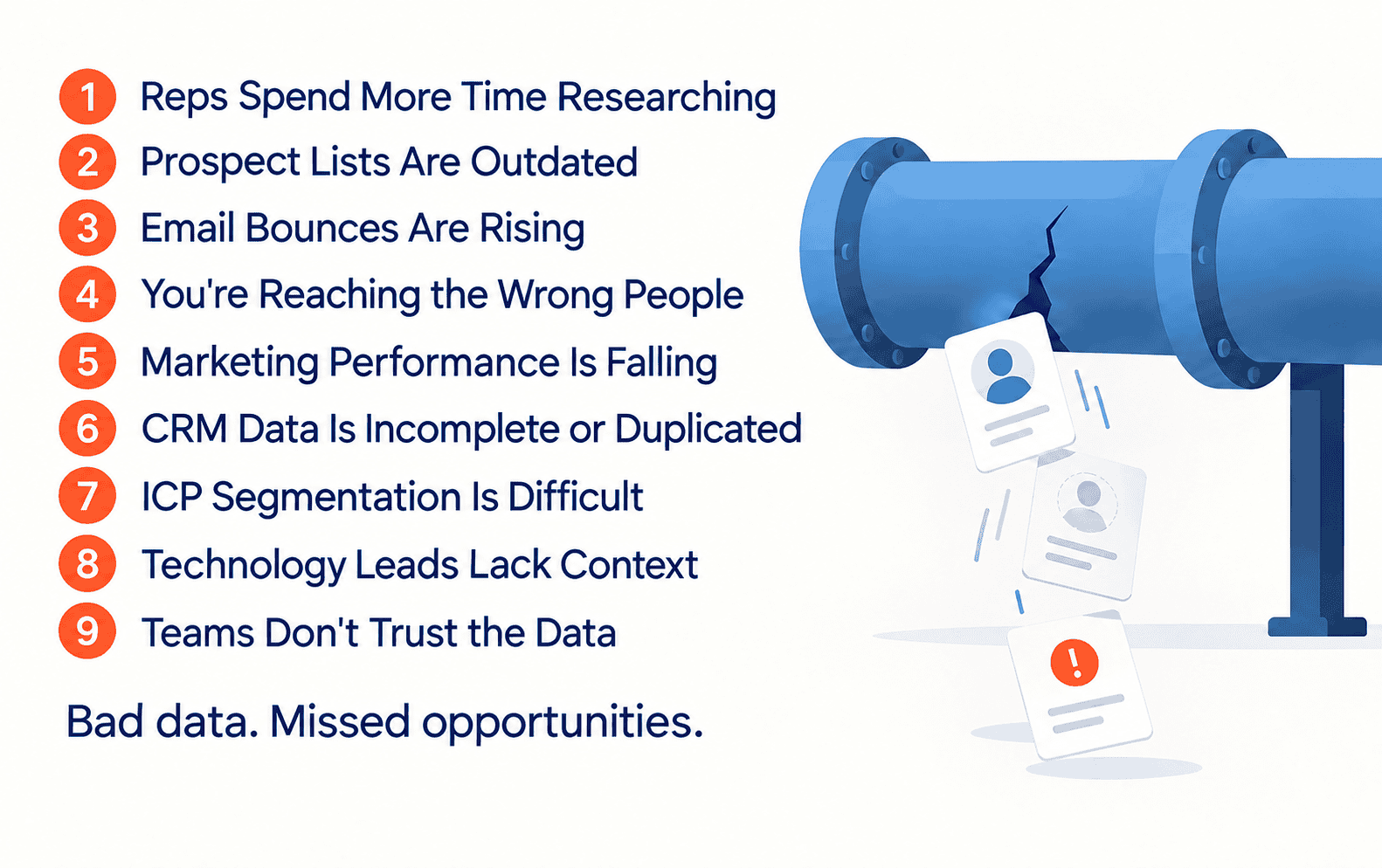
Here are 9 signs it’s time to upgrade your B2B data services.
B2B data services help sales and marketing teams source, verify, clean, enrich, maintain, and organize business and contact information.
Depending on the provider, services can include:
The goal isn’t simply to give your team more records. It is to give them better records they can actually use.
For teams that need a broader source of verified business and contact information, a B2B contact database can provide the foundation for targeted prospecting.
Don’t let bad data slow down your sales and marketing. Check these 9 warning signs to see where your current data is falling short—and when it’s time to upgrade your B2B data services.
Your sales team shouldn’t spend hours searching LinkedIn, company websites, directories, and search engines to determine whether a prospect is still relevant.
If reps regularly have to:
Your existing data may not be giving them enough usable information.
This becomes especially expensive as your sales organization grows.
Instead of starting conversations with qualified prospects, reps become data researchers.
Better B2B contact data services can provide more complete contact and company information before records reach the sales workflow. Data enrichment, for example, can add attributes such as company size, industry, revenue, location, job title, and technology usage.
Warning sign: If your SDRs are spending significant selling time fixing or researching records, your data process needs attention.
People change jobs.
Companies merge, acquire other businesses, change domains, relocate, or shut down. Job titles and responsibilities change as organizations evolve.
That means even a previously accurate database can become less reliable over time.
Data decay affects more than email addresses. Job titles, phone numbers, departments, company information, and other firmographic fields can also become outdated.
Look at your existing business prospect lists and ask:
If you don’t have clear answers, your database may already be showing signs of decay.
Warning sign: Your sales team frequently hears, “They don’t work here anymore.”
An increase in email bounces is one of the clearest signals that contact data quality needs attention.
Invalid or outdated email addresses can occur when employees leave organizations, domains change, companies restructure, or records are collected without adequate verification.
The issue isn’t only campaign performance.
Poor-quality email data can also create additional operational problems for teams running automated outreach at scale.
Instead of repeatedly uploading unverified lists into your marketing automation platform, stronger B2B data services can incorporate email validation and verification into the data workflow. For a deeper look at finding accurate business contacts, explore this guide to B2B contact data.
Many current B2B data providers position email verification, ongoing enrichment, and data freshness as core capabilities rather than optional extras.
Warning sign: Your bounce rate is rising while your list size continues to grow.
Having 10,000 contacts doesn’t help if only a small percentage are relevant to your sales strategy.
One of the biggest weaknesses of generic prospect lists is that they can provide volume without enough context.
For example, a technology company selling enterprise cybersecurity software may need to reach:
A generic technology-company list may contain employees from finance, HR, administration, sales, or other departments who aren’t relevant buyers.
Better B2B data services can help companies build lists around specific ICP criteria, job functions, seniority, industries, company sizes, locations, and other attributes. Data enrichment and contact intelligence can also help teams identify decision-makers by role, industry, and region.
Warning sign: Your sales reps regularly discover that the people on their lists aren’t involved in the buying decision.
When email open rates, engagement, conversions, or lead quality decline, marketers often start changing:
Those elements matter—but the audience matters too.
If your database contains outdated, irrelevant, or poorly segmented contacts, even a well-designed campaign can struggle.
Poor data can create a chain reaction:
Weak data → poor targeting → weaker engagement → lower-quality leads → inefficient follow-up.
That makes data quality an important part of diagnosing marketing performance.
For example, enriched data can give marketing teams additional context for segmentation and personalization, including company size, industry, technology usage, and other attributes.
Warning sign: Your campaign strategy keeps changing, but the audience quality problem remains the same.
Open your CRM and search for a few important accounts.
Do you find:
If yes, your CRM may be acting more like a storage system than a reliable sales intelligence system.
Duplicate and incomplete records make reporting harder and can confuse sales and marketing.
They can also affect segmentation, lead routing, scoring, personalization, and account ownership.
Data cleansing and enrichment services can help standardize records, remove duplicates, fill missing fields, and prepare data for CRM use.
Warning sign: Your team doesn’t fully trust the CRM when making decisions about accounts or prospects.
Modern B2B marketing depends heavily on segmentation.
You may want to create an audience such as:
SaaS companies with 100–1,000 employees, operating in North America, using Salesforce, with senior marketing decision-makers.
That’s much more useful than:
Companies in software.
The more precise your targeting becomes, the more data attributes you need.
Strong B2B data services can support segmentation using combinations of:
Technographic data can be especially useful for technology sales because it helps identify organizations by the software or technologies they use.
Warning sign: Your marketing automation platform supports sophisticated segmentation, but your database doesn’t contain the fields required to use it.
For technology companies, a name, email address, and company name may not be enough.
Sales teams often need to understand the account before starting a conversation.
For example:
Basic record
Enriched record
The second record gives sales and marketing considerably more context.
That context can support account prioritization, personalized outreach, lead scoring, campaign segmentation, and sales preparation.
For this reason, current B2B data providers increasingly combine contact information with firmographic, technographic, and intent-related signals.
Warning sign: Your team has contact information but still needs to conduct extensive account research before every campaign or sales conversation.
This may be the biggest warning sign of all.
Ask your sales and marketing teams:
“Do you trust the data in our CRM?”
If the answer is “not really,” you have a data problem that technology alone won’t solve.
When sales doesn’t trust marketing-generated leads, marketing may respond by increasing lead volume.
When marketing doesn’t trust CRM reporting, teams may create separate spreadsheets.
When operations doesn’t trust either system, manual verification becomes the safety net.
Soon, everyone has their own version of the truth.
A stronger B2B data strategy should give teams confidence that records are:
Warning sign: Your teams routinely verify information manually before they are willing to use it.
The difference isn’t just how many contacts you get—it’s how useful, accurate, and actionable that data is.
Before choosing a provider, don’t evaluate the database only by its total number of records.
Look at the capabilities that affect whether your team can actually use the data.
In other words, don’t buy the biggest database. Buy the data your sales and marketing workflows can actually use.
For a deeper comparison framework, see this guide on how to choose a B2B contact database.
You don’t necessarily need sophisticated B2B data services just because your company has a CRM.
The need becomes more obvious when data problems start affecting revenue-generating workflows.
Consider upgrading when:
At that point, better data isn’t simply a sales tool.
It becomes part of your revenue infrastructure.
If your primary goal is improving pipeline generation, you can also explore dedicated lead generation services.
If outdated, incomplete, or poorly targeted data is slowing down your sales and marketing efforts, DataCaptive can help you build more actionable B2B prospect data.
With targeted B2B data services, you can:
Instead of relying on broad, static lists, DataCaptive helps sales and marketing teams work with data aligned with their targeting requirements.
The goal isn’t simply to add more contacts to your database. It’s to give your team relevant data they can actually use to find, target, and engage the right business prospects.
More contacts won’t fix bad data. Better data will.
If outdated records, irrelevant prospects, and incomplete CRM data are slowing your sales and marketing, it’s time to rethink your data strategy.
With DataCaptive, you can build more targeted, relevant, and actionable B2B data to find the right companies, reach the right decision-makers, and strengthen your sales lead generation.
Better data. Better targeting. Better opportunities.
Get a Sample Email List
